Hello! Welcome to your next step on the path to composing music like Ludovico Einaudi.
In the previous modules, you've mastered the foundational skills within your DAW: you can navigate the piano roll, understand rhythm, and most importantly, you've learned how to construct scales like C Major. Think of a scale as your palette of available colors. Now, we're going to learn how to mix those colors to create harmony. This lesson is your introduction to chords, the building blocks of the rich, emotional soundscapes you admire. Specifically, we will define and build your very first triad, the most fundamental type of chord in all of Western music.
From Single Notes to Harmony
So far, we've mostly dealt with notes one at a time to form melodies and scales. But the essence of harmony, which gives music its emotional depth and texture, comes from playing multiple notes at the same time. This is called a chord.
In your DAW's piano roll, this is what chords look like—notes stacked vertically on top of each other so they all sound at the same moment.

What is a Triad?
While a chord can have many notes, the most common and essential type is the triad. As the name suggests, a triad is a chord made of exactly three notes. Let's get a formal definition.
The basics of music theory for beginners | Native Instruments Blog
This article from the Native Instruments blog provides a clear and concise introduction to chords. You'll focus on the sections that define chords and triads.
Please read the sections titled "Chords in music" and "Triads." Start from the definition of a chord and continue reading down to the sentence that begins the definition of a triad. This will introduce you to the three components of this fundamental chord structure.
As the article mentions, a triad consists of three specific parts: a root, a third, and a fifth.
- The Root: This is the bottom note of the chord, its foundation. It's the note that gives the chord its name (e.g., the root of a C chord is C).
- The Third: This is the middle note. It's called the "third" because it is three scale-notes up from the root.
- The Fifth: This is the top note. It's five scale-notes up from the root.
Don't worry about the terms "major third" or "perfect fifth" for now. We'll explore those in the next lesson. The key idea is this "root-third-fifth" structure.
The "Skip a Note" Method
The most intuitive way to build a triad in the piano roll, especially when you have a scale to work with, is the "skip a note" method. You start on a note (the root), skip the next note in the scale, add the following one (the third), skip another note, and add the next one (the fifth).
Let's see this in action. This is the most practical part of the lesson and will be your primary method for building chords visually.
Write KILLER CHORDS For Beginners (FL Studio Tutorial)
The "FL Studio Basics" channel provides a wonderfully simple visual demonstration of how to build a triad in a piano roll. While the DAW is FL Studio, the piano roll logic is identical to BandLab.
First, watch the brief definition of a chord from the beginning. Then, pay close attention to the core technique shown from building a chord. The presenter shows exactly how to use the "skip one highlighted note" method to find the third and the fifth.
The concept is simple but powerful:
- Place your root note.
- Skip the next available scale note.
- Place your third.
- Skip the next available scale note.
- Place your fifth.
Let's reinforce this with another great explanation from musician and producer Andrew Huang.
Learn music theory in half an hour.
Andrew Huang's popular video breaks down music theory essentials. He provides another clear look at the "skip a note" method for building triads.
Watch the segment from Chords. He defines what chords are and then clearly explains and demonstrates how a triad is built by playing a note, skipping a note, playing a note, and so on, within the context of a scale.
Your Turn: Build Your First Triad
Now it's time to apply this in BandLab. This is your first step in hands-on harmony.
- Open BandLab and create a new project with a piano instrument.
- Enter the C Major Scale: As a refresher from the previous module, lay out the notes of the C Major scale: C, D, E, F, G, A, B. These are your "legal" notes.
- Build a C Major Triad:
- Place a note on C. This is your root.
- Look at your scale. The next note is D. Skip it.
- Place a note on E. This is your third.
- Look at your scale. The next note is F. Skip it.
- Place a note on G. This is your fifth.
You should now have three notes stacked vertically: C, E, and G. Play them together. Congratulations, you've just built your first triad! This specific chord is called a "C Major" triad.
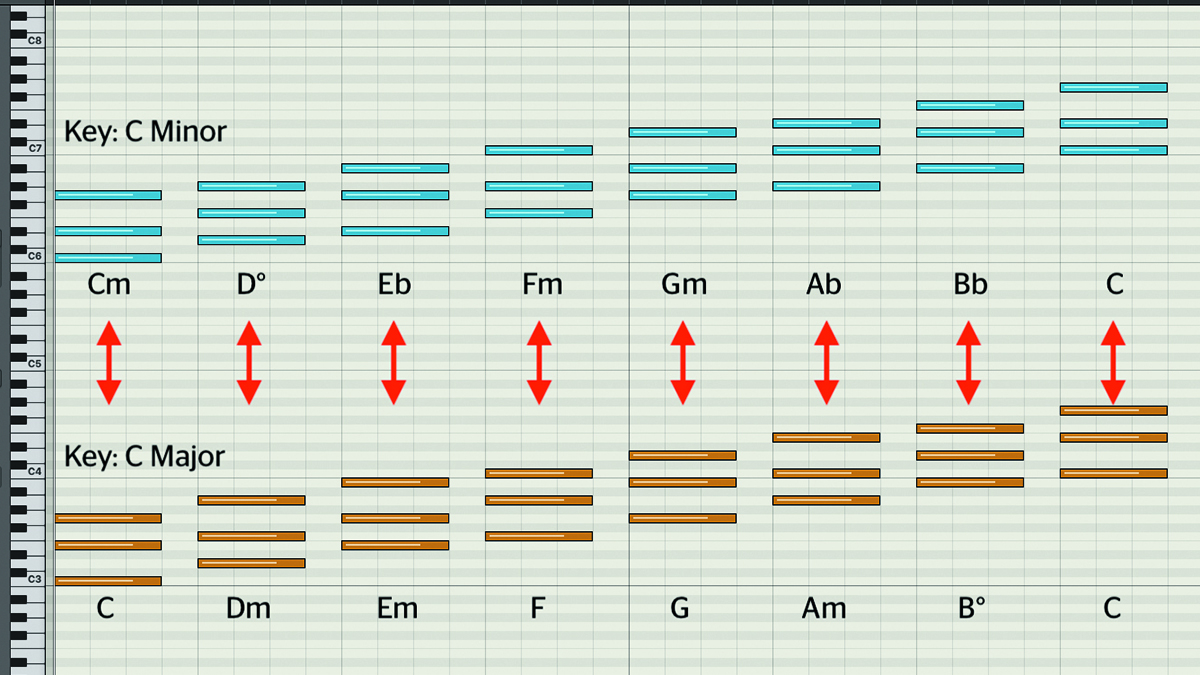
This technique of building chords from the notes of a scale is called creating diatonic chords. The image below shows all the triads you can build using only the notes of the C Major scale (in orange). You can see the C-E-G chord you just made is the very first one.
Key Takeaways
- A chord is a group of three or more notes played at the same time.
- A triad is the most common type of chord, consisting of exactly three notes.
- The three notes of a triad are called the root, the third, and the fifth.
- In your DAW's piano roll, you can easily build a triad from a scale using the "skip a note" method.
What's Next?
You now understand what a triad is and how to construct one visually. You probably noticed that some chords have a "happy" sound while others sound more "sad" or "melancholic"—a key feature of Einaudi's music. In our next lesson, we will explore this difference by learning how to build major and minor triads from any root note, giving you control over the emotional character of your music.