Welcome back! In our last lesson, you mastered a crucial skill: building major and minor triads from any starting note using a universal formula of semitones. This gave you direct control over the emotional color of a chord, allowing you to create "happy" (major) and "sad" (minor) sounds at will.
Today, we will bring this knowledge back into the context of a musical key. We'll explore how a scale, like C Major, doesn't just provide notes for a melody, but also contains a built-in family of chords that naturally sound good together. You will learn to construct this entire family of chords by building a triad on each note of the scale, using only the notes available within that key. This process is the key to unlocking the harmonic world of your favorite composers and beginning to write your own compelling chord progressions.
What are Diatonic Chords?
The concept we're exploring today is diatonic harmony. The word "diatonic" simply means "using the notes of the scale." Therefore, diatonic chords are the chords that are native to a particular key, built exclusively from the notes of that key's scale.
Thinking about chords this way provides a framework, or a kind of musical syntax. Knowing individual chords is like knowing words in a language; knowing the diatonic chords of a key is like understanding how to form sentences.
The following resource provides a great explanation of this idea.
Diatonic Chords - The Complete Guide - Piano With Jonny
This article from Piano With Jonny explains why diatonic chords are so fundamental.
Please read the introduction, from the beginning down to the section titled "What are Diatonic Chords?". Focus on the analogy of musical 'syntax' – this will help you understand why this concept is so powerful for composition.
The "Stacking Thirds" Method
So, how do we build these native chords? The method is surprisingly simple and visual, especially in a piano roll. It's an extension of the "skip a note" idea you've encountered before.
For each note of the scale, we will use it as the root of a new chord. Then, we build a three-note triad by stacking notes on top, always skipping one scale note in between. This process is often called "stacking thirds."
The following video demonstrates this entire process from start to finish. It's the core activity of today's lesson, and watching it first will give you a clear roadmap for what you're about to do in BandLab.
Every Player Needs To Learn The Diatonic Chords of A Key (Easy Theory)
This video from the "Piano From Scratch" channel provides an excellent walkthrough of building and identifying all the diatonic chords in the key of C Major.
Watch the segment from the introduction. The presenter will first number the notes of the C Major scale and then build a triad on each one using the "skip a note" method. Pay close attention to how the quality of the chord (major or minor) changes automatically depending on which scale note it starts on.
Your Turn: Building the Diatonic Chords of C Major
Now, it's time to apply this in BandLab. This exercise will transform theory into tangible sound and visuals.
-
Set Up Your Project: Open BandLab and create a new project with a piano instrument.
-
Enter the C Major Scale: First, lay out the C Major scale on the piano roll: C, D, E, F, G, A, B. You can place them one after another. This is your "palette" of available notes.
-
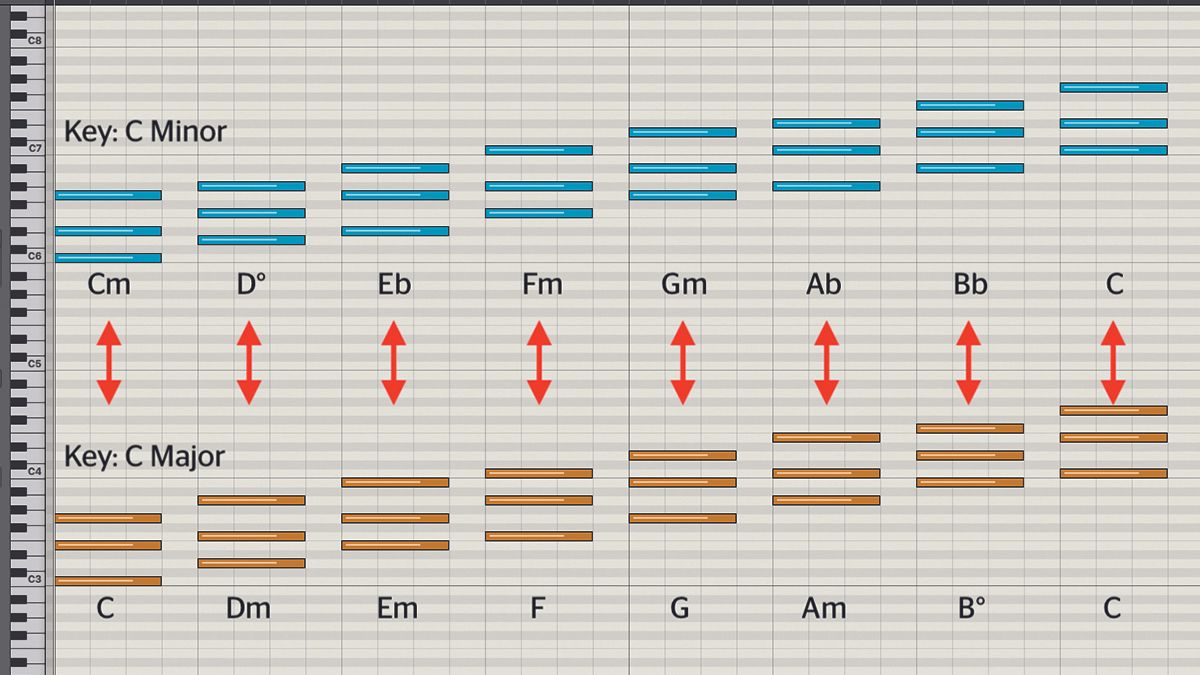
Build the Chords: Now, build a triad on each note of the scale, remembering the rule: use only the white keys (the notes of C Major).
- Chord 1 (starting on C): Root is C. Skip D, add E. Skip F, add G. Chord: C-E-G.
- Chord 2 (starting on D): Root is D. Skip E, add F. Skip G, add A. Chord: D-F-A.
- Chord 3 (starting on E): Root is E. Skip F, add G. Skip A, add B. Chord: E-G-B.
- Chord 4 (starting on F): Root is F. Skip G, add A. Skip B, add C. Chord: F-A-C.
- Chord 5 (starting on G): Root is G. Skip A, add B. Skip C, add D. Chord: G-B-D.
- Chord 6 (starting on A): Root is A. Skip B, add C. Skip D, add E. Chord: A-C-E.
- Chord 7 (starting on B): Root is B. Skip C, add D. Skip E, add F. Chord: B-D-F.
When you're done, your piano roll should look something like the C Major section of this image:
Analyzing Your Chords
You've now constructed the seven diatonic triads of C Major. Play each one. Do you hear how some sound "bright" and others "melancholic"? Let's analyze them using the semitone-counting formulas you learned in the last lesson to identify their quality.
- Chord 1 (C-E-G): C to E is 4 semitones. E to G is 3 semitones. (4+3) -> Major
- Chord 2 (D-F-A): D to F is 3 semitones. F to A is 4 semitones. (3+4) -> minor
- Chord 3 (E-G-B): E to G is 3 semitones. G to B is 4 semitones. (3+4) -> minor
- Chord 4 (F-A-C): F to A is 4 semitones. A to C is 3 semitones. (4+3) -> Major
- Chord 5 (G-B-D): G to B is 4 semitones. B to D is 3 semitones. (4+3) -> Major
- Chord 6 (A-C-E): A to C is 3 semitones. C to E is 4 semitones. (3+4) -> minor
What about the last chord?
- Chord 7 (B-D-F): B to D is 3 semitones. D to F is 3 semitones. (3+3) -> Diminished
This reveals a new chord quality! A diminished triad is built from a root, a minor third (+3 semitones), and another minor third on top (+3 semitones). It has a very tense, unstable sound that wants to resolve. Composers often use it to create a feeling of suspense before moving to a more stable chord.
A Universal Pattern
By building chords using only the notes of the C Major scale, we have discovered a beautiful, predictable pattern of chord qualities:
- Chord 1: Major
- Chord 2: minor
- Chord 3: minor
- Chord 4: Major
- Chord 5: Major
- Chord 6: minor
- Chord 7: diminished
The most amazing thing is that this pattern (Major, minor, minor, Major, Major, minor, diminished) is the same for every major key. Whether you are in C Major, G Major, or F# Major, the chord built on the first note of the scale will always be major, the one on the second note will always be minor, and so on. This is a foundational pillar of Western music theory.
Key Takeaways
- Diatonic chords are the family of chords native to a key, built using only the notes of that key's scale.
- We construct them by "stacking thirds" or using the "skip a note" method on each degree of the scale.
- This process reveals a predictable pattern of chord qualities within any major key: three major chords, three minor chords, and one diminished chord.
- The pattern for any major key is: Major, minor, minor, Major, Major, minor, diminished.
What's Next?
You have now uncovered the harmonic "palette" that comes with a major key. This is a huge step toward composing music that feels structured and coherent. In our next lesson, we will learn how to identify this pattern using a shorthand called Roman numerals (I, ii, iii, IV, V, vi, vii°). This powerful system will allow us to analyze, understand, and create chord progressions in any key, forming the basis for the emotional journeys in your own compositions.