Welcome to the first lesson in your Reading Mastery course. Your long-term goal of becoming an author is an ambitious and rewarding one, and this course is the foundational first step. Before one can write compelling stories, one must first learn to read deeply and understand how those stories are built from the ground up.
You’ve described a common and frustrating experience: starting a book with enthusiasm, only to find yourself unable to return to it. Your struggle with Dostoyevsky is not a reflection of your ability, but rather a sign of a mismatch between aspiration and preparation. It's like an aspiring mountaineer attempting Everest without first mastering smaller peaks.
This lesson tackles that exact problem. We will fulfill our first learning outcome: to identify your personal barriers to completing books and design a sustainable daily reading routine. We won't focus on what to read just yet. Instead, we'll build the engine that will power your reading journey for years to come—the habit itself. We'll approach this systematically, much like a project manager would: first, by diagnosing the core issues, and then by designing a robust process to overcome them.
1. Diagnosing the Barriers: Why Don't We Finish Books?
The first step in solving a problem is understanding its root cause. When a reading habit falters, it's rarely due to a single catastrophic failure. More often, it's a series of small frictions and psychological hurdles that, over time, drain our momentum.
Let's explore some of these common barriers. A great starting point is to re-evaluate the pressure we put on ourselves.
19 Powerful Techniques to Build a Reading Habit - Nick Wignall
In his article on building a reading habit, author Nick Wignall starts with a counter-intuitive piece of advice that directly addresses a major psychological barrier to consistent reading.
Please read the first technique, "Quit More Books." Pay close attention to the idea that forcing yourself through a book you don't enjoy can weaken your overall motivation to read.
This idea is liberating. You are not obligated to finish every book you start. Your time is valuable, and your goal is to build a joyful and sustainable habit. Slogging through a book that doesn't resonate is counter-productive. This was likely a factor in your experience with Dostoyevsky; it's a challenging book, and if you weren't enjoying it, every page becomes a chore that drains your "reading energy."
To build on this, it's crucial to connect your reading to a purpose that is meaningful to you.
How to make a daily habit of reading more books | Psyche Guides
The Psyche guide on reading habits emphasizes the importance of motivation. It distinguishes between reading for its own sake (intrinsic) and reading for an external payoff (extrinsic).
Read the section "Start by thinking about why you want to read more books." As you read, reflect on your own reasons. You want to become an author of mystery and sci-fi. This is a powerful intrinsic motivator. Reading within these genres isn't just a leisure activity; it's professional development for your future craft.
So, two major barriers are:
- The Obligation Trap: The false belief that you must finish every book, which turns reading into a chore.
- Mismatched Motivation: Reading what you feel you should read (like a dense classic) instead of what genuinely fuels your passion and aligns with your goals (like a great sci-fi novel).
Other common barriers include external distractions and simple friction. Is your phone more accessible than your book? Is reading something you only do "if you have time," rather than a planned activity? These are the systemic issues we will now design a process to solve.
2. Designing Your Routine: The Habit Loop
A habit isn't built on willpower; it's built on design. Drawing from your background in managing complex systems, think of a habit not as a goal, but as a repeatable, four-stage process known as the "Habit Loop."
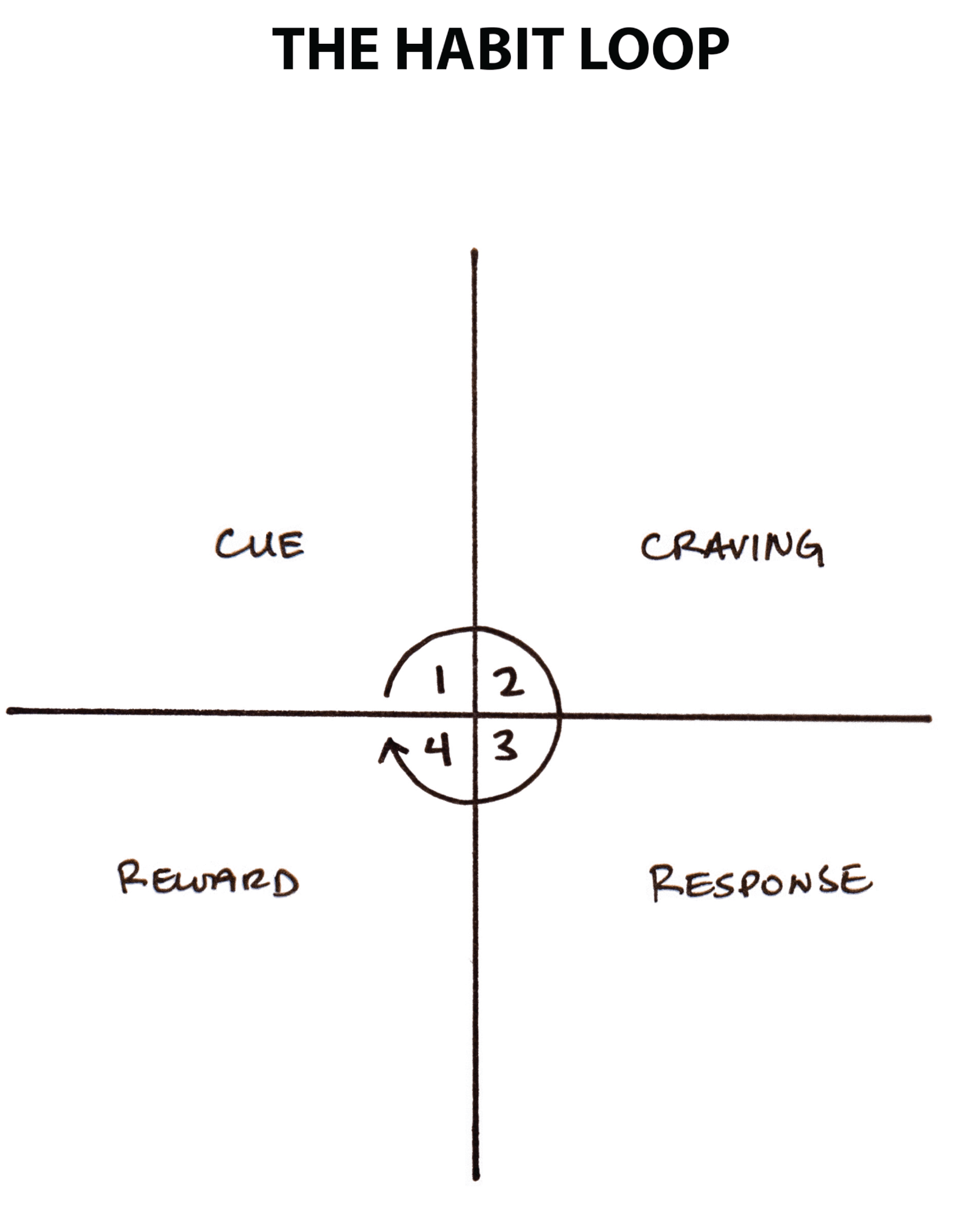
We will now design your initial reading routine by addressing each stage of this loop with practical, evidence-based techniques.
Stage 1: The Cue (Make it Obvious)
The trigger for a habit needs to be clear and consistent. Instead of waiting for inspiration to strike, we can create our own cues. A powerful way to do this is by linking the new habit to an existing one.
How to make a daily habit of reading more books | Psyche Guides
This article explains the concept of "piggybacking" a new habit onto an established one. This removes the need to remember to read; it becomes an automatic part of your daily flow.
Read the section titled "Piggyback on existing habits." Think about your own daily routine. What is a solid, consistent action you take every day (e.g., brewing your morning coffee, sitting down on the train, finishing dinner dishes) that you could use as a cue for reading?
Another way to create a cue is to redesign your environment.
The Best Way To Build A Daily Reading Habit In 2025
In this video, Joel Snape discusses how to make reading the path of least resistance. He calls it the "easy reach rule."
Watch the section from the 'easy reach' rule. The key idea is to make your book more accessible than your distractions. This could mean leaving a book on your coffee table or nightstand, or placing your reading app on your phone's home screen and moving social media apps into a folder.
Your Action for Stage 1:
- Identify an existing habit to use as your cue (e.g., "After I brush my teeth at night...").
- Make one change to your environment to make your book more visible and accessible.
Stage 2: The Craving (Make it Attractive)
To want to read, the experience must be appealing. This is where your choice of book is critical. Don't start with the literary Everest; start with a book from a genre you already love.
How to Rebuild a Reading Habit (14 Tips)
This video offers excellent advice on rebuilding a reading habit, particularly the importance of starting with enjoyable, less demanding books to build momentum.
Watch the two segments on starting small and humble and reading what interests you. This reinforces the idea of giving yourself permission to read "easy" or "cheap" fiction if it gets you reading consistently. Your interest in mystery and sci-fi is the perfect place to start.
Furthermore, framing the habit as part of your identity makes it intensely attractive. You're not just "a person who is trying to read more." You are becoming a reader. You are becoming a writer. Every page you read is a vote for that identity.
Stage 3: The Response (Make it Easy)
The most critical step in habit formation is to lower the barrier to entry so much that it's harder to say "no" than "yes."
How to make a daily habit of reading more books | Psyche Guides
James Clear, author of Atomic Habits, popularized the "two-minute rule." It is a powerful antidote to the feeling of being overwhelmed.
Read the section "Set modest goals." The goal is not to read a chapter, or even ten pages. The goal is to open the book and read for two minutes. That's it. Anyone can read for two minutes. This establishes the habit, which you can improve later.
To truly commit to this, the most effective technique of all is to schedule it. As a project manager, you know that what gets scheduled gets done. Reading should be no different.

How to Rebuild a Reading Habit (14 Tips)
This video explains the simple, powerful act of putting reading time on your calendar.
Watch the section from "schedule time to read." Notice how scheduling transforms reading from a low-priority option into a protected, non-negotiable appointment with yourself.
Stage 4: The Reward (Make it Satisfying)
The human brain repeats actions that feel good. The problem with reading is that the main reward—finishing the book—can be weeks away. We need to create an immediate sense of satisfaction. The key is to reward the habit, not the outcome.
Instead of feeling good only when you finish a book, feel good every time you complete your two-minute session. A great way to do this is with a simple habit tracker. Each day you complete your reading habit, you make a mark on a calendar. The goal is simple: don't break the chain.
How to make a daily habit of reading more books | Psyche Guides
This section explains why tracking the daily action, no matter how small, is more motivating than tracking the long-term goal.
Read the section discussing progress monitoring, which you can find under the 'Learn more' heading. Focus on this key sentence: "The feeling of progress is very motivating to the human brain." Your reward is the satisfaction of seeing that chain of completed days grow.
Your First Reading System
Now, let's put this all together. Your task for this week is not to finish a book. It is simply to design and implement your initial reading system. Take a few minutes to fill this out for yourself:
- My Primary Barrier: What is the one biggest thing that stops you from reading now? (e.g., "I get distracted by my phone," "I feel too tired at the end of the day.")
- My 'Why': What is your core motivation? (e.g., "I am becoming a writer, and this is my training.")
- My Cue (The IF/THEN Plan): "IF
[my existing daily habit], THEN I will pick up my book." - My Response (The Two-Minute Rule): "I will read for at least two minutes."
- My Environment: Where will your book live so it's more accessible than your biggest distraction?
- My Reward: How will you track your habit to get a daily sense of progress? (e.g., a checkmark on a calendar, an app).
This is your first, simple, sustainable reading routine. It is designed to be easy, resilient, and repeatable.
Conclusion
In this lesson, we laid the critical groundwork for your entire reading journey. We've moved away from the frustrating cycle of starting and stopping, and toward a systematic approach to habit formation.
You've learned to:
- Identify barriers like the obligation trap and mismatched motivation.
- Reframe your goal by giving yourself permission to quit books and read what you truly enjoy.
- Design a sustainable routine using the four stages of the Habit Loop: making the cue obvious, the craving attractive, the response easy, and the reward satisfying.
The goal for this first week is consistency, not volume. Practice your two-minute habit. Let it become automatic.
In our next lesson, we will address what happens when this routine inevitably falters. We'll learn the 'five-minute restart' technique—a powerful tool to regain momentum with a book after an unavoidable break, ensuring that a missed day doesn't derail your entire journey.