Hello! Welcome back to our exploration of ancient Greece.
In our last lesson, we witnessed the immense preparations of Xerxes, who amassed a colossal army and navy and even reshaped the landscape with bridges and canals. The message was clear: this was not a punitive raid, but an invasion bent on total conquest. The sheer scale of this force sent a shockwave of terror across the divided Greek world, forcing the fiercely independent city-states to confront an existential question: unite and fight, or submit and be conquered?
Today, we will examine the Greek response to this crisis. Our goal is to describe the formation of the Hellenic League and the competing Greek strategies for defense. We'll delve into the difficult political compromises required to forge an alliance and then analyze the clashing strategic visions for how to best defend Greece against an overwhelming foe.
1. A House Divided: Forging the Hellenic League
Your background in software development has likely shown you that getting disparate teams with different priorities to agree on a unified architecture is a major challenge. Now, imagine those teams were not just departments in a company, but rival city-states with long histories of warfare against one another. This was the situation in Greece in 481 BC.
The concept of a unified "Greece" was cultural, not political. The Greeks shared language, religion, and customs, but were organized into hundreds of independent city-states (poleis), each jealously guarding its autonomy. The two most powerful states, Athens and Sparta, were bitter rivals. To have any hope of survival, they had to create an unprecedented military alliance.
Key Battles of History Part 1: Salamis 480 BC
This article, 'Key Battles of History Part 1: Salamis 480 BC', does an excellent job of setting the stage. It explains the fragmented nature of the Greek world and the deep-seated rivalry between Athens, the burgeoning naval and cultural power, and Sparta, the undisputed master of land warfare.
Please read the sections 'Geopolitical Context', 'Citystate: Athens', 'Citystate: Sparta', and the two paragraphs that follow, ending just before the section 'Empire: Persia'. As you read, focus on the fundamental political problem: how could these two proud, rival states possibly agree to fight under a single command?
As the reading highlights, the solution was a landmark political compromise. In the autumn of 481 BC, representatives from a number of Greek states (though by no means all of them) met at a congress on the Isthmus of Corinth. There, they swore an oath to fight together, put aside their local feuds, and punish any Greek state that sided with the Persians (a practice known as "Medizing"). This alliance became known as the Hellenic League.
The most critical decision was command. Athens possessed the largest and most skilled navy, making it the clear choice to lead at sea. However, the Peloponnesian states, led by Sparta, refused to serve under an Athenian commander. To prevent the alliance from collapsing before it even began, the Athenians, likely persuaded by their brilliant leader Themistocles, made a crucial concession. Sparta was granted supreme command of both the land and sea forces. While an Athenian would effectively lead the navy in practice, the overall strategos was a Spartan. This was the political price of unity.
2. The Great Debate: Competing Strategies for Defense
With the alliance formed, the next question was how to fight. This sparked a fierce debate that revealed the deep divisions still simmering beneath the surface of the league. Two primary strategies emerged.
Strategy 1: Fortress Peloponnese
The Spartans and their Peloponnesian allies favored a conservative, defense-in-depth strategy. Their plan was simple and geographically sound: abandon the rest of Greece and fortify the Isthmus of Corinth.

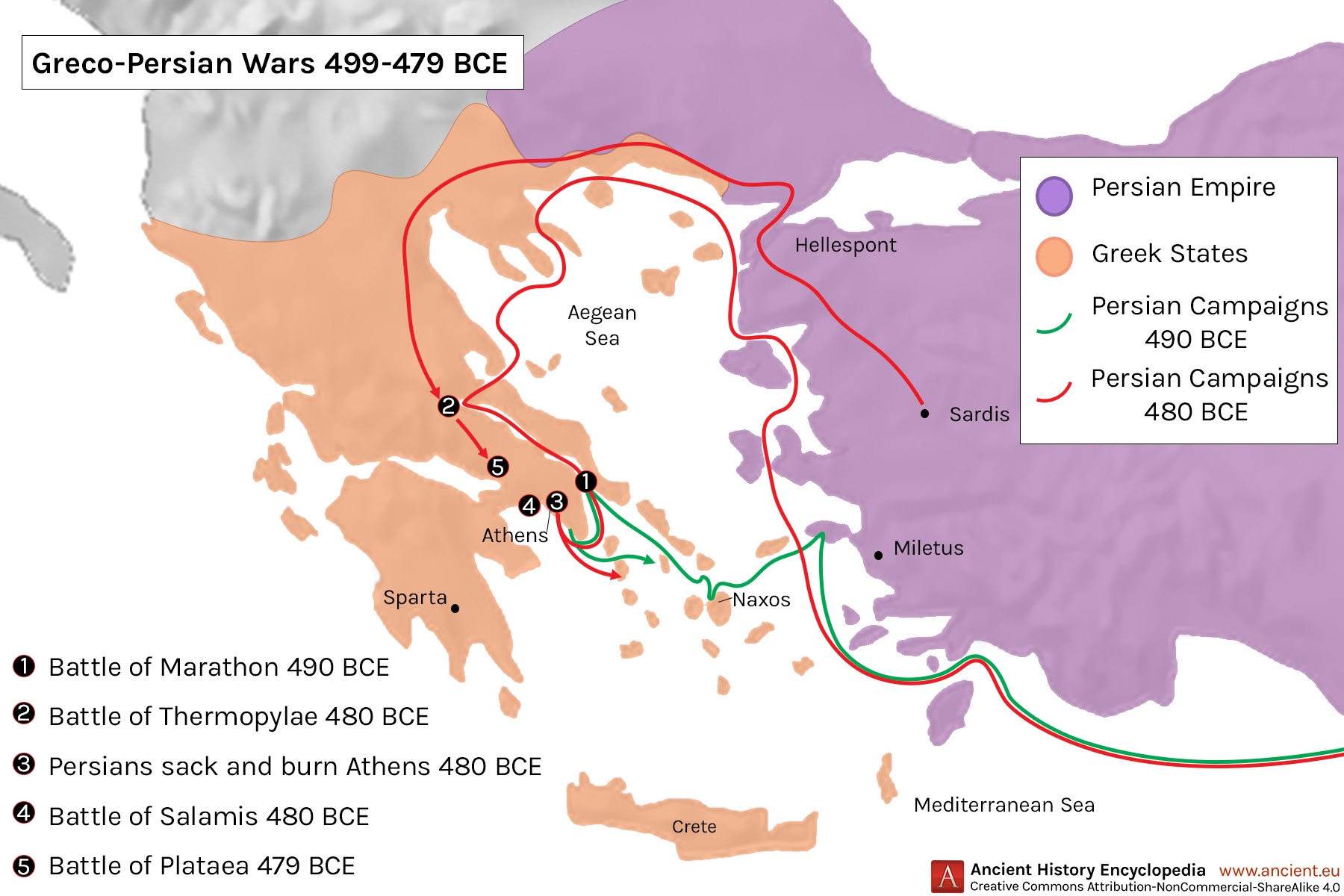
As you can see from the map, the Isthmus is an ideal defensive position. By building a wall across this narrow bottleneck, the Peloponnesians could hold off a much larger land army indefinitely. The navy's role in this plan would be to guard the flanks of the Isthmus, preventing the Persians from simply sailing around and landing troops in their rear.
The strength of this strategy was its reliability. It concentrated all allied forces at the most defensible point to protect the Peloponnesian heartland. Its glaring weakness, however, was that it meant sacrificing everything north of the Isthmus—including the city of Athens—to the invading army.
Strategy 2: The Forward Defense
The Athenians, led by Themistocles, advocated for a much bolder and more complex strategy: a forward defense. The goal was to confront the Persians as far north as possible, using Greece's mountainous terrain and narrow sea channels to negate the Persian advantage in numbers.
This strategy viewed Greece as an integrated system, where land and sea power had to work in perfect concert. To understand how this unfolded, let's watch a video that outlines the initial Greek plans.
Avenging Leonidas - The 2nd Greco Persian War (ALL PARTS) DOCUMENTARY
The video 'Avenging Leonidas' provides an excellent overview of the strategic deliberations among the Greek allies as Xerxes' army advanced.
Watch from 3:41 to 7:00. The first part (until 5:17) explains the initial, abandoned plan to defend the Vale of Tempe. The second part describes the decision to make a stand at the more defensible locations of Thermopylae and Artemisium.
As the video explained, the strategic thinking evolved:
- The Vale of Tempe: The first idea was to hold a pass in northern Thessaly. This was quickly abandoned when the Greeks realized the Persians could easily bypass it, trapping their army.
- Thermopylae and Artemisium: The revised plan, the brainchild of Themistocles, was a masterpiece of combined-arms strategy.
- Land: A small Greek army would block the narrow coastal pass of Thermopylae. Here, in a confined space, the superior armor and fighting skill of the Greek hoplites could hold off the vast Persian multitudes.
- Sea: Simultaneously, the allied Greek navy would hold the nearby straits of Artemisium. This was critical. It prevented the massive Persian navy from sailing around the land force at Thermopylae and attacking them from behind.
This plan was a high-risk, high-reward gambit. If either the land or sea force failed, the other would be doomed. But if it worked, it would halt the entire Persian invasion far from the Greek heartland, protecting Athens and other central Greek cities.
Test your understanding!
Imagine you are a Spartan general on the Hellenic League's war council. Your primary responsibility is to Sparta and its Peloponnesian allies. Argue in favor of the "Fortress Peloponnese" strategy (defending the Isthmus of Corinth). What are its strengths from your perspective, and why might you view Themistocles' forward defense plan as reckless?
Show answer
From a Spartan perspective, defending the Isthmus is the most logical and least risky plan.
- Strengths: It's the most defensible point, a natural fortress that maximizes our hoplites' strengths. It keeps our army close to home, protecting our lands and families. We conserve our strength for a single, decisive defense rather than wasting men in risky battles far to the north.
- Recklessness of Themistocles' Plan: The forward defense is a dangerous gamble. It splits our forces (army and navy) and sends them far into enemy-controlled territory. If the Athenian navy fails at Artemisium—and their fleet is dwarfed by the Persian one—our army at Thermopylae will be cut off and annihilated. Why should we risk the best soldiers in Greece to defend the cities of allies who may abandon us? Themistocles asks us to risk everything for Athens, but our sacred duty is to Sparta. The Isthmus is the only defense that guarantees the survival of the Peloponnese.
The Hellenic League ultimately agreed to Themistocles' plan, sending an advance force to Thermopylae and Artemisium. The internal debate, however, was far from over. The desire to retreat to the Isthmus would remain the default position for the Peloponnesians throughout the war, creating constant tension within the alliance.
Conclusion
Faced with an existential threat, the Greeks achieved the near-impossible. They set aside generations of rivalry to form the Hellenic League, a fragile but vital alliance for survival. This political unity was a victory in itself, but it immediately gave rise to a fundamental strategic debate.
Key Takeaways:
- The Hellenic League: Forged in 481 BC at the Congress of Corinth, this was a military alliance of Greek city-states created to resist the Persian invasion.
- A Crucial Compromise: To ensure unity, Athens conceded overall command of the allied forces to Sparta, the preeminent land power, despite Athens having the superior navy.
- Two Competing Strategies: The core strategic conflict was between the conservative "Fortress Peloponnese" plan (defending the Isthmus of Corinth) and Themistocles' ambitious "Forward Defense," which aimed to use geography to stop the Persians in the north.
- The Initial Plan: The league adopted a combined-arms strategy to hold the pass of Thermopylae on land and the straits of Artemisium at sea, a plan designed to negate Persia's numerical superiority.
Preview of the Next Lesson:
The stage is now set. The Greek plan has been made, and an advance force led by a Spartan king is marching north to a narrow pass known as the "Hot Gates." In our next lesson, we will analyze the strategic importance and cultural legacy of the legendary Battle of Thermopylae.