Hello!
In our last lesson, we saw how the growing power of Athens and the fear it inspired in Sparta led the Greek world to the brink of war. The final diplomatic crises—over Corcyra, Potidaea, and Megara—pushed them over the edge. The Peloponnesian War has begun.
Now, we will examine the initial plans laid out by the two main combatants. This lesson will compare the initial strategies of Athens (the Periclean strategy) and Sparta (the Archidamian strategy). We'll see how each side planned to leverage its unique strengths to achieve victory, setting the stage for a conflict unlike any Greece had seen before.
The Lion and the Shark
The Peloponnesian War is often described as a conflict between a lion and a shark. Sparta, the lion, was the undisputed master of the land, possessing the most formidable infantry army in the Greek world. Athens, the shark, ruled the sea with its unrivaled navy and vast maritime empire. The central strategic problem for both was how to force their strength upon an opponent who fought on a different element.
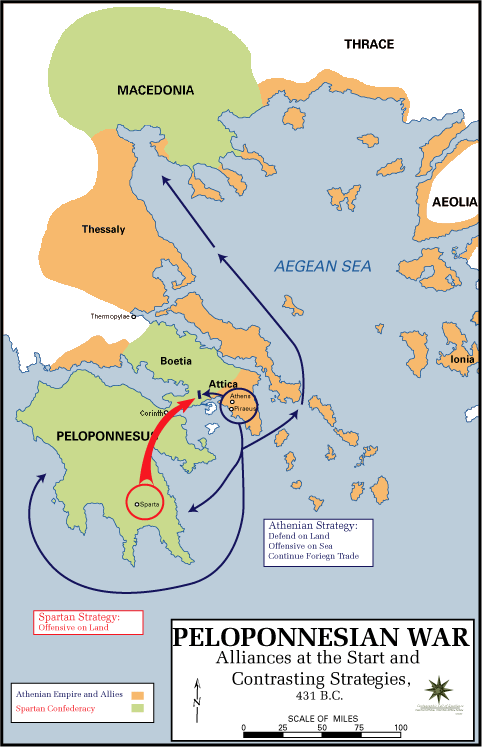
This asymmetry in military power shaped the entire conflict. To understand the thinking of the commanders, let's start by looking at how they saw their own strengths and their enemy's weaknesses.
Periclean Grand Strategy during The Peloponnesian War1
The historian Thucydides provides remarkable speeches from both the Athenian leader Pericles and the Spartan King Archidamus, where they lay out their strategic assessments. This academic paper, 'Periclean Grand Strategy during The Peloponnesian War' by Athanassios Platias, provides a fantastic summary of their views.
Please read the section titled '1.2. Athens and Sparta: the Bilateral Balance' (pages 60-62). Pay close attention to how both Pericles and Archidamus identify the same key factors: Athenian naval and financial power versus Spartan land power.
As you've read, both leaders had a remarkably clear-eyed view of the situation. Sparta had the hoplites, but Athens had the ships, the walls, and the money. This understanding formed the basis of their opening moves.
Sparta's Plan: The Archidamian Strategy
Sparta's strategy was named after its king, Archidamus II. It was rooted in the traditional Greek way of war: seeking a decisive, glorious battle.
The plan was straightforward:
- Invade Attica: Every year, at the start of the campaign season, the Spartan-led Peloponnesian army would march into Attica, the agricultural heartland surrounding Athens.
- Ravage the Land: They would systematically burn crops, chop down olive trees, and destroy farmsteads.
- Seek Decisive Battle: This destruction served two purposes: to inflict economic pain and, more importantly, to enrage the Athenians and provoke their army to march out and fight. The Spartans were confident that in a pitched hoplite battle, their victory was assured.
However, King Archidamus himself was more cautious than his allies. He suspected this traditional approach might not work against an unconventional enemy like Athens. The following video explores his more nuanced perspective.
Geostrategy of the Peloponnesian War 2: Pericles vs Archidamus
The 'Strategy Stuff' channel provides excellent analysis of military history. This video explains Archidamus's thinking and why he pursued the invasion strategy despite his personal doubts.
Please watch the segment on Archidamus's strategy from 19:14 to 24:11. Note his pre-war analysis: he understood that Athens could only be beaten at sea and that Sparta lacked the means to do so initially. His invasions were also about preserving Sparta's reputation as the leader of its alliance.
Archidamus's strategy was therefore a blend of tradition and necessity. He hoped to either lure the Athenians out or that the psychological pressure of seeing their lands destroyed would force them to seek terms.
Athens's Plan: The Periclean Strategy
The Athenian leader Pericles, anticipating Sparta's every move, devised a radical and deeply controversial counter-strategy. He understood that playing by Sparta's rules meant certain defeat.
The Periclean strategy had three core components:
- Abandon the Land: The entire population of Attica was to evacuate their farms and homes and take refuge within the Long Walls, the formidable fortifications connecting the city of Athens to its port, Piraeus.
- Become an Island: With the population safe behind the walls, Athens would use its navy to maintain control of the sea lanes. This allowed them to import all the grain and supplies they needed from their empire, making the destruction of Attica's farms strategically irrelevant.
- Harass the Enemy: While enduring the siege on land, the Athenian navy would be used offensively. It would launch raids all along the coast of the Peloponnese, disrupting Sparta's allies, encouraging helot revolts, and making the war as costly for them as possible.
This plan was psychologically difficult, requiring the Athenians to passively watch as their property was destroyed. Pericles's job was to convince them that their homes and farms were expendable, but that their lives and the empire were not.
To explore the ultimate goal of this strategy, let's return to the Strategy Stuff video, which discusses two scholarly interpretations.
Geostrategy of the Peloponnesian War 2: Pericles vs Archidamus
Was Pericles's goal simply to outlast Sparta, or was it something more ambitious? This part of the video breaks down the debate.
Watch the sections on the 'Strategic Defensive' (07:40 - 12:21) and 'Strategic Offensive' (12:21 - 17:10) interpretations of Pericles's plan. Consider which one seems more plausible to you.
While a defensive "wait-them-out" strategy is plausible, the "strategic offensive" view—that Pericles was playing a long game to dismantle the Spartan alliance—better accounts for the aggressive naval raids Athens undertook from the very beginning.
A Clash of Philosophies: Annihilation vs. Exhaustion
The competing plans of Athens and Sparta represent two fundamentally different approaches to warfare, what military theorists call strategies of annihilation and exhaustion. The paper by Athanassios Platias you looked at earlier introduces this framework perfectly.
-
Strategy of Annihilation (Sparta): This strategy aims to win the war by destroying the enemy's main military force in a single decisive battle. All efforts are focused on achieving this one climactic confrontation. This is a classic "Clausewitzian" approach.
-
Strategy of Exhaustion (Athens): This strategy avoids a decisive battle and instead aims to win by gradually wearing down the enemy's resources, morale, and political will to fight. The goal is to make the war so costly and prolonged that the enemy gives up. Victory is achieved not by a single knockout blow, but by winning a war of attrition.
This theoretical distinction provides a powerful lens through which to understand the entire first phase of the war.
Periclean Grand Strategy during The Peloponnesian War1
The paper you read earlier neatly summarises this strategic clash. The table in this section is particularly useful.
Please reread the section '2.1. Policy Objectives and Grand Strategic Designs' (pages 63-64) and look closely at 'Table 2: The Grand Strategies of Athens and Sparta' on page 74. This table provides the most concise comparison of the two approaches.
Test your understanding!
Imagine you're playing a real-time strategy game. Your opponent has a powerful, slow-moving but very strong army. Which of these actions would best reflect a strategy of exhaustion?
- Gathering all your forces for a single, massive attack on their main army.
- Building strong defensive towers around your main base.
- Using small, fast units to constantly attack their resource collectors, avoiding direct confrontation with their main army.
Show answer
Option 3 is the best example of a strategy of exhaustion. You are not trying to win in a single battle (annihilation), but are instead wearing down your opponent's economy and will to fight over the long term, making it harder for them to sustain their powerful army. Option 1 is a classic annihilation strategy, and Option 2 is purely defensive, lacking the offensive component of Pericles's plan.
The First Year: Strategies in Action
In the summer of 431 BC, the plans were put into motion. King Archidamus led the Peloponnesian army into Attica. The Athenians retreated behind their walls. As the Spartans burned the fields, the Athenian fleet set sail.
So, who won the first round? While the sight of a burning countryside was demoralizing for Athens, the Periclean strategy proved remarkably effective in its first year.
Sea Power in the Peloponnesian War
Let's look at a modern assessment of the first year of the war. This paper, 'Sea Power in the Peloponnesian War,' argues that the effectiveness of Sparta's invasions has been overstated, while the success of Athens's naval raids has been underestimated.
Please read the two sections starting on page 125, 'Sparta’s original strategy was ultimately a failure...' and 'In contrast, Athens’s accomplishments during the first year of the war...'. This provides a concise summary of how each strategy fared in practice.
As the paper argues, Sparta's ravaging did less long-term damage than believed, while Athens's naval operations secured key strategic locations (like the islands of Aegina and Cephalonia) and struck fear into the Spartan heartland by raiding near the territory of the helots. From a purely strategic standpoint, Round 1 went to Athens.
Conclusion
Today we've compared the opening strategies of the Peloponnesian War, seeing how they were a direct reflection of the unique strengths and geographies of Athens and Sparta.
Key Takeaways:
- Strategic Asymmetry: The war pitted Sparta's land power ("the lion") against Athens's sea power ("the shark").
- Sparta's Archidamian Strategy: A traditional strategy of annihilation, aiming to use annual invasions of Attica to force a decisive land battle.
- Athens's Periclean Strategy: A novel strategy of exhaustion, aiming to avoid land battle by hiding behind the Long Walls, using the navy to import supplies, and launching retaliatory raids to wear down the enemy's will.
- Initial Results: In the first year, the Athenian strategy proved more effective, achieving concrete strategic gains while frustrating Sparta's plan for a quick victory.
Preview of the Next Lesson:
Pericles's strategy was based on cold, hard logic. He calculated that Athens could withstand the psychological pressure and financial strain of a long war better than Sparta. But war is full of unforeseen events. In our next lesson, we will see how a biological catastrophe—the great Plague of Athens—shattered Pericles's calculations, decimated the city's population, and changed the course of the war.