Hello!
In our last lesson, we charted the turbulent course of the Archidamian War, the first decade of the Peloponnesian War. We saw Pericles's grand strategy of retreating behind the Long Walls and using the navy to outlast Sparta. We also noted that this strategy was catastrophically derailed in its second year by an unforeseen enemy: a great plague.
Today, we will zoom in on that catastrophe. This lesson is dedicated to understanding the devastating impact of the Plague on Athens, from the societal collapse it triggered to the death of Pericles himself. While the previous lesson placed the plague within the war's timeline, this lesson will explore its profound effects on the city's people, culture, and leadership, an event from which Athens would never fully recover.
The Perfect Storm: A City Under Siege
In 430 BC, the second year of the war, the Spartan army once again invaded and began to ravage the countryside of Attica. As planned, the rural population flooded into the city for protection. The space between the Long Walls, designed to secure access to the port of Piraeus, became a vast, overcrowded refugee camp.
Pericles's strategy, so sound on paper, had created a tinderbox. The spark was a disease that arrived through the bustling port, the very lifeline his strategy depended on.
To understand how these conditions set the stage for disaster, let's start with a short video.
The Plague of Athens - Past Pandemics
This video from 'Dig It With Raven' provides an excellent introduction to the Plague of Athens, clearly explaining how Pericles's strategy contributed to the overcrowding and created a perfect breeding ground for disease.
Please watch the segment from 01:17 to 02:28. Focus on the connection between the war strategy and the conditions that allowed the plague to spread so rapidly.
As the video explains, the population of Athens nearly tripled, creating unsanitary and intensely crowded conditions. It was a public health nightmare waiting to happen, a critical vulnerability that the military-focused strategy had overlooked.
An Eyewitness to Apocalypse: Thucydides' Account
Our main source for the plague is the historian Thucydides, who was not just an observer but also a survivor of the disease. His clinical, detailed, and harrowing account is one of the most famous passages from the ancient world. It is not an abstract historical summary but a visceral description of human suffering and societal breakdown.
I'd like you to read his description directly. As you do, think about the impact not just on the body, but on the mind and spirit of the Athenians.
Thucydides on the Plague of Athens: Text & Commentary
The following resource from World History Encyclopedia provides an excellent translation of Thucydides' narrative of the plague. Reading his own words is the best way to grasp the horror of the event.
Please read the section titled 'The Text' (which contains the translated passage from Thucydides' History of the Peloponnesian War, II.vii.3-54). Pay attention to three things: the physical symptoms, the psychological despair, and the breakdown of traditions like funeral rites.
Anatomy of a Collapse
Thucydides' account reveals a society disintegrating under pressure. The plague's impact went far beyond the staggering death toll, estimated to be between 75,000 and 100,000 people—perhaps a quarter of the total population. It caused a systemic failure of Athenian society.

Let's break down the key areas of this collapse, using an expert analysis to add depth to Thucydides' account.
The Plague and the Peloponnesian War
This article from 'War on the Rocks' features a discussion with historian Neville Morley. It provides a sharp analysis of the plague's multifaceted impact, drawing directly from Thucydides.
Please read the selected portions of the interview. The text discusses the bewildering symptoms, the lack of any effective response, and, most importantly, the psychological and social consequences—how Athenian society essentially fell apart.
Drawing from both Thucydides and the analysis you just read, we can identify several key impacts:
- Medical and Public Health Failure: Doctors were helpless and died in great numbers. Traditional religious appeals to the gods were useless. The authorities, with no concept of public health, could do little more than try (and fail) to manage the disposal of bodies.
- Social and Moral Breakdown: Fear dissolved the bonds of family and friendship. Funeral rites, a cornerstone of Greek piety and social custom, were abandoned. People "turned to shameless forms of disposal," as Thucydides grimly notes.
- Psychological Shift: A profound sense of despair and lawlessness took hold. With the future uncertain, many Athenians adopted a hedonistic, "live-for-the-day" mentality. The pursuit of honor, which requires a belief in the future, was replaced by the pursuit of immediate pleasure. As Thucydides puts it, "No fear of the gods or law of men had any restraining power."
- Religious Crisis: The plague was indiscriminate, killing the pious and the impious alike. This led many to believe the gods had abandoned Athens, causing a deep crisis of faith. Temples, where people sought refuge, became filled with the dead and dying.
Test your understanding!
Given your background in systems, think of Athenian society as a complex system. How did the plague act as a catalyst for a "cascading failure" across different subsystems (e.g., healthcare, religion, law, social norms)?
Show answer
The plague initiated a classic cascading failure. The initial shock was to the biological/health subsystem, with a disease that overwhelmed the population's immunity and the rudimentary medical knowledge of the time.
This immediately caused a failure in the social subsystem:
- The high death rate among caregivers (doctors, family) broke down the networks of care.
- Fear severed social ties, leading to isolation.
- The sheer number of bodies overwhelmed the religious/cultural subsystem, making proper funeral rites impossible.
The failure of both medicine and religious rituals to stop the plague led to a collapse in the ideological/belief subsystem. People lost faith in both the gods and traditional morality.
This, in turn, precipitated a failure in the legal and political subsystem. Without fear of divine or human punishment, lawlessness and short-term self-interest prevailed, fundamentally eroding the civic order that underpinned the democracy. Each system's failure amplified the stress on the others, leading to a total societal crisis.
The Death of the First Citizen
In 429 BC, the plague claimed its most important victim: Pericles. He had led Athens for decades, shaping its democratic institutions and imperial ambition. His death occurred at the very moment his leadership was most needed.
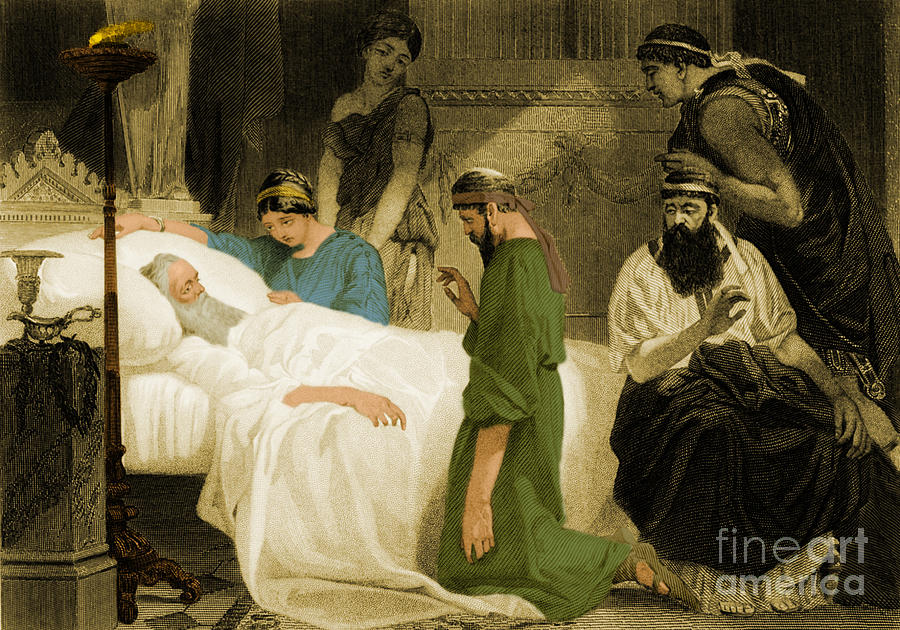
The loss of Pericles was more than just the loss of a general or politician; it was the loss of the architect and anchor of Athens's grand strategy.
What Happened to Ancient Greece After The Death of Pericles
The channel 'Nutty History' focuses on the consequences of Pericles's death. This video will help you understand the power vacuum he left behind and how it changed Athens forever.
Please watch from the beginning to 03:43. The video explains why Pericles's death could not have come at a worse time and how it unleashed a more chaotic and self-interested style of politics.
As Thucydides argued, under Pericles, Athens was "a democracy in name, but in reality, the rule of the first man." No other leader commanded the same respect or possessed the strategic foresight to steer the state. After his death, the restrained, long-term strategy he championed died with him. Power fell to more aggressive and often reckless leaders—the "demagogues" like Cleon, whom we met in the last lesson. The cautious, calculated war of attrition was replaced by a more desperate and ambitious fight for survival and dominance.
Conclusion
The Great Plague of Athens was a defining moment in the Peloponnesian War and in the history of the city. It was a tragedy born from the very strategy designed to protect it.
Key Takeaways:
- Pericles's strategy of bringing the population within the walls created the perfect conditions for a deadly epidemic.
- The plague killed roughly 25% of the population, crippling Athens's military and civic manpower.
- The catastrophe triggered a profound societal breakdown, dissolving social norms, legal restraints, and religious faith, as documented by the eyewitness Thucydides.
- The death of Pericles in 429 BC created a leadership vacuum, leading to a more volatile political climate and a shift away from his cautious war strategy.
- The Athens that emerged from the plague was weakened, traumatized, and politically fragmented, setting the stage for the increasingly bitter and desperate conflict to come.
Preview of the Next Lesson:
The Archidamian War ended with the shaky Peace of Nicias in 421 BC. However, a city as deeply wounded as Athens, now led by a new generation of ambitious and aggressive politicians, was ill-suited to maintaining a fragile truce. In our next lesson, we will analyze the significance of the Peace of Nicias as a temporary halt in the conflict and see how the unresolved tensions and lingering resentments quickly brought the war roaring back to life.