Hello!
In our last lesson, we saw how the Peloponnesian War paused not with a true resolution, but with the deeply flawed and unstable Peace of Nicias. This treaty created a tense "cold war" atmosphere, where the underlying rivalry between Athens and Sparta simmered just below the surface. Today, we'll examine the event that shattered this fragile peace and set Athens on a path to ruin: the Sicilian Expedition.
Our goal is to explain the motivations for the Athenian expedition to Sicily. This was arguably the most momentous and complex foreign policy decision Athens ever made. We won't find a single, simple reason. Instead, we'll unravel a web of interconnected motives: a plausible pretext, vast strategic ambitions, powerful economic incentives, and the clashing personalities of the city's most influential leaders. Understanding this decision is crucial, as its failure would ultimately decide the outcome of the entire war.
The Official Story: A Plea from an Ally
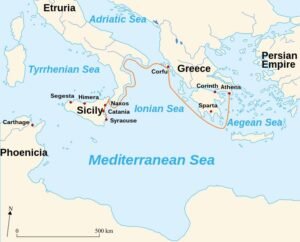
Great military ventures often begin with a seemingly reasonable justification. In the winter of 416/415 BC, ambassadors from the city of Segesta in Sicily arrived in Athens with a desperate plea for help.
To understand this initial trigger, let's watch a short video that sets the scene.
The Sicilian Expedition: How One Campaign Decided Ancient Athens' Fate | Line of Fire | Odyssey
This segment from the Odyssey documentary 'The Sicilian Expedition' explains the official request that brought the question of Sicily before the Athenian Assembly.
Watch from 04:33 to 06:20. Focus on the conflict between Segesta and its neighbors, and how Segesta framed its appeal to Athens.
As the video explains, Segesta was at odds with its neighbor Selinus, which was being backed by the most powerful city on the island, Syracuse. Syracuse was a Corinthian colony, and Corinth was one of Sparta's most important allies.
The Segestans presented Athens with two arguments:
- A duty to an ally: They invoked their alliance with Athens, appealing to Athenian honor and credibility.
- A strategic threat: They warned that if Syracuse were allowed to dominate Sicily, it would inevitably use its power to aid Sparta and the Peloponnesian League against Athens.
This appeal provided Athens with a casus belli—an official, legitimate reason to intervene. But as we'll see, this was merely the tip of the iceberg. The real motivations ran much deeper.
The Realpolitik: A Grand Strategy for Empire
While helping an ally was the public justification, the true scale of Athenian ambition was far greater. The most influential Athenians didn't just see a small intervention; they saw an opportunity to win the entire Peloponnesian War in one decisive, indirect stroke.
The following academic paper provides a concise and systematic breakdown of the various strategic and economic factors at play.
Operational Art's Historical Origins - The Sicilian Campaign of ...
This analysis from a paper on the US Army's educational platform, 'Operational Art's Historical Origins', clearly outlines the plausible motives for the expedition, moving beyond the simple pretext.
Read from the paragraph beginning 'Several possible motives exist...' to the end of the paragraph '...a mix of all of these reasons.' This section catalogs the strategic, economic, and logistical arguments for the expedition.
Based on this reading and other sources, we can identify three primary strategic motivations:
1. Economic Dominance:
- Wealth: Sicily was famously rich, a "breadbasket" of the ancient world. Conquering it meant access to immense wealth in the form of tribute and plunder, which could fund the war effort indefinitely. As the article from Symposium Journal notes, the Athenians hoped to "insure victory for themselves while enriching themselves enormously."
- Control of Trade: Athens was critically dependent on grain imports, primarily from the Black Sea. This reliance on a single Sea Line of Communication (SLOC) was a strategic vulnerability. Gaining control of Sicily would secure a vital alternative source of grain. From your perspective as a software engineer, you can think of this as moving from a system with a single point of failure to one with redundancy and resilience.
2. Pre-emptive Strike:
- The Segestan argument resonated with Athenian fears. Syracuse was a growing power. Preventing it from unifying Sicily and then joining forces with Sparta was a logical, if aggressive, defensive move.
3. The Knockout Blow:
- This was the most audacious goal. By conquering Sicily, Athens could cut off Corinth and other Peloponnesian states from their own vital supplies. With Sicily's resources added to its own naval empire, Athens would surround the Peloponnese. This vision is clearly articulated in the next video.
The Athenian Expedition to Conquer Sicily - Peloponnesian War part 6/7 - Ancient History
The channel 'See U in History / Mythology' captures the sheer scale of the Athenian ambition.
Watch from 00:24 to 01:40. Pay attention to how the plan was envisioned as a way to make Athens 'practically invincible'.
This was not just a plan to help an ally; it was a bid for total hegemony over the Greek world.
The Human Factor: Ambition, Caution, and Public Mania
Decisions of this magnitude are not made in a vacuum. They are driven by leaders and approved by a populace with its own desires and fears. In Athens, the debate was dominated by two towering figures: Alcibiades and Nicias.
The Champion: Alcibiades
Alcibiades was the expedition's greatest cheerleader. Young, handsome, fabulously wealthy, and from an aristocratic but controversial family, he was a political rockstar. He was also endlessly ambitious and saw the expedition as his personal path to immortal glory.
Just Win, Baby. Nicias, Alcibiades and the Sicilian Expedition
To understand Alcibiades's role, we need to understand the man. This article from the 'Symposium Journal' provides a sharp character sketch.
First, read the two paragraphs under the heading 'Alcibiades' to get a sense of his background and personality. Then, read the three paragraphs under the heading 'Let us now examine Alcibiades...' to see how he used his charisma and manipulative skill to push for the expedition. Note his powerful argument: 'if we do not rule others we run the risk of being ruled by them ourselves.'
Alcibiades appealed directly to the Athenians' imperial pride, their love of glory, and their belief in their own destiny. He framed expansion not as a choice, but as a necessity for survival.
The Opposition: Nicias
In the other corner stood Nicias, the elder statesman who had negotiated the very peace this expedition would shatter. He was cautious, deeply pious, and believed the venture was a reckless gamble that risked everything Athens had.
His opposition, however, had a disastrously ironic outcome.
Just Win, Baby. Nicias, Alcibiades and the Sicilian Expedition
The same article explains Nicias's opposition and how his attempt to dissuade the Athenians backfired spectacularly.
Read the three paragraphs under the heading 'The next and best example...'. Focus on how Nicias's strategy to deter the assembly by exaggerating the costs and risks had the opposite effect.
In the Assembly, Nicias argued that conquering Sicily would require a fleet and army of unprecedented size. He hoped the enormous price tag would scare the citizens into voting no. Instead, the Assembly, swept up in a wave of optimism, became even more enthusiastic. They saw the massive force not as a sign of risk, but as a guarantee of an easy victory. They voted for the giant expedition and, in a cruel twist of fate, appointed the reluctant Nicias as one of its three commanders, alongside the eager Alcibiades and a seasoned general named Lamachus.
The historian Thucydides describes the mood in Athens as a kind of fever, an eros (a passionate longing) for the distant and the adventurous, with the young dreaming of glory and the old of easy riches.
Test your understanding!
You've seen several motivations for the Sicilian Expedition. Imagine you are an Athenian citizen in the Assembly of 415 BC. Which argument would you find most persuasive and why:
- Alcibiades's appeal to glory and the necessity of empire ("rule or be ruled")?
- The strategic argument about pre-empting Syracuse and securing grain supplies?
- Nicias's warning about the immense risk and cost, which paradoxically convinced others of the expedition's certain success?
Show answer
There is no single correct answer, as different citizens would have been swayed by different arguments.
- If you were a young man who grew up during the stalemate of the Archidamian War, you might be captivated by Alcibiades's appeal to glory. The promise of adventure, pay, and making a name for yourself in a grand victory would be very powerful.
- If you were a more pragmatic merchant or a citizen concerned with the city's long-term security, the strategic and economic arguments might be most compelling. Securing the food supply and crippling a potential enemy of the state is a rational, if aggressive, long-term policy.
- The effect of Nicias's speech is the most psychologically interesting. An Athenian confident in their city's power might hear Nicias's list of requirements not as a warning, but as a checklist for victory. "So all we need is 100 ships and 5,000 hoplites? Excellent! Let's vote for that and guarantee our success!" It speaks to a collective overconfidence, or perhaps a desire to believe that risk can be eliminated with overwhelming force.
This mix of emotional appeal, strategic logic, and mass overconfidence is what made the push for the expedition so irresistible.
Conclusion
The decision to invade Sicily was not the result of a single cause but a "perfect storm" of motivating factors.
Key Takeaways:
- Official Pretext: The formal justification was to aid an ally, Segesta, against its enemies, who were backed by the pro-Spartan city of Syracuse.
- Strategic Ambition: The true goal was far grander: to conquer Sicily, securing its immense wealth and grain, and delivering a knockout blow to the Peloponnesian League by encircling it and cutting off its supplies.
- Economic Drivers: The lure of Sicilian riches and the desire to control a new, secure source of grain were powerful incentives for the commercial empire of Athens.
- Human and Political Dynamics: The decision was driven by the charismatic ambition of Alcibiades, the failed cautionary tactics of Nicias, and a public mood of overconfidence and desire for glory.
Athens was placing an enormous bet, risking a substantial portion of its military and financial strength on a single, distant campaign. They believed the potential reward—total victory in the war—was worth the risk.
Preview of the Next Lesson:
Now that we understand why Athens undertook this colossal gamble, we will follow the expedition on its fateful journey. In our next lesson, we will describe the catastrophic defeat of the Athenian forces at Syracuse and its impact on Athenian power, witnessing how this dream of ultimate victory turned into a nightmare that crippled the Athenian empire.