Hello!
In our last lesson, we took apart Philip's revolutionary military machine, examining the sarissa phalanx, the Companion Cavalry, and the combined arms system that made them so deadly. We saw the "what"—the anvil, the hammer, and the professional army that wielded them.
Today, we move from the workshop to the field of history. Our focus will be on how Philip used this incredible tool, in combination with a brilliant and often ruthless political mind, to achieve his goals. Our learning outcome is to analyze Philip's use of diplomacy and warfare to expand his power. You'll see that for Philip, war and diplomacy were not separate activities but two sides of the same coin, to be used interchangeably to dismantle his opponents and build an empire. He was a master of what the historian Polybius would later call "acting with calculation," a true practitioner of realpolitik.
The Dual Persona of a King
Before we dive into his campaigns, it's essential to understand the man himself. To many Greeks, especially the Athenians, Philip was a brutish, hard-drinking barbarian from the uncivilized north. However, those who met him in person often came away with a very different impression.
To explore this complex character, let's start with a video that delves into his background and personality.
Diplomatic Genius of Philip of Macedon
The video 'Diplomatic Genius of Philip of Macedon' from the Kings and Generals channel provides a great introduction to the two faces Philip presented to the world.
Please watch from the beginning of the video until 06:06. This section covers his upbringing in a violent court, his education in Thebes, and the contrasting descriptions of him as both a brutish barbarian and a charming, silver-tongued diplomat.
As the video explains, Philip was a political actor of the highest order. He could be the boisterous Macedonian warrior when it suited him, but he could also deploy immense charm and rhetorical skill. This ability to switch between personas was a key part of his diplomatic toolkit, allowing him to disarm, intimidate, or persuade as the situation required.
His primary tools for expansion were:
- Warfare: The direct application of his reformed, professional army.
- Diplomacy: Which for Philip included a wide range of tactics:
- Bribery and "Gifts": He famously quipped that no fortress was impregnable if a donkey laden with gold could get to the gates.
- Strategic Marriages: He contracted at least seven marriages to secure borders and form alliances.
- Exploiting Divisions: He was a master at turning Greek city-states against one another.
- Intrigue and Assassination: In the cutthroat world of Macedonian politics, eliminating rivals was standard procedure.
Phase 1: Securing the Kingdom (359 BC)
When Philip took the throne in 359 BC, Macedon was on the verge of disintegration. His brother had been killed in a disastrous defeat, the treasury was empty, and enemies were closing in from all sides. His first task was survival.
The video below details how he masterfully navigated this initial crisis.
Diplomatic Genius of Philip of Macedon
Let's return to the 'Diplomatic Genius of Philip of Macedon' video. The next section shows how Philip immediately put his hybrid approach into practice to save his kingdom.
Please watch from 06:06 to 09:28. Notice how he uses different strategies for different threats: peace and tribute for the powerful Illyrians, bribes for the Paeonians, and swift assassination for internal rivals.
In just a few months, Philip had stabilized the situation. He bought himself time with diplomacy where he was weak, used targeted force where he was strong, and eliminated internal threats with ruthless efficiency. With his borders temporarily secure, he could begin his great project of expansion.
Case Study: The "Benevolent" Takeover of Thessaly
One of the best examples of Philip's sophisticated strategy is his absorption of Thessaly, the rich agricultural region to the south of Macedon. A direct invasion would have been costly and united the Thessalians against him. Instead, Philip played the long game.
Diplomatic Genius of Philip of Macedon
The Kings and Generals video provides an excellent narrative of this diplomatic masterclass.
Watch from 09:28 to 15:26. Pay close attention to the mantra: 'act with permission at all times.' See how he used an invitation to intervene, positioned himself as an honest broker, used his wealth to win friends, and patiently waited for the perfect moment to use his army.
By getting himself elected Archon (leader) of the Thessalian League for life, Philip gained control of Thessaly's resources and famous cavalry without a protracted war of conquest. He had turned a potential enemy into a powerful asset, a recurring theme in his career. He even named his daughter Thessalonike—"Victory in Thessaly"—to commemorate this strategic triumph.
From Regional Player to Greek Power Broker: The Third Sacred War
Philip's intervention in Thessaly brought him to the borders of central Greece. His opportunity to cross that threshold came with the Third Sacred War (356-346 BC). The conflict began when the region of Phokis seized the sacred sanctuary of Apollo at Delphi and used its treasures to fund a mercenary army.
This act of sacrilege shocked the Greek world. Thebes, an enemy of Phokis, appealed to Philip for help.
Philip II of Macedon: The Greatest Military Strategist of his Time and Father of Alexander the Great
The video from History with Cy explains how Philip leveraged this religious war to elevate his standing in Greece.
Watch from 11:44 to 14:34. This section details how Philip, invited into the conflict, positioned himself as the champion of the god Apollo. Note the ultimate political prize he won: entry into the Amphictyonic League.
By defeating the Phokians, Philip did more than just win a battle. He won immense prestige and, crucially, the two Phokian votes in the Amphictyonic League. This ancient council, which administered the affairs of Delphi, gave Philip a legitimate, formal voice in the heart of Greek political and religious life. The "barbarian" from the north was now an official player in pan-Hellenic affairs.
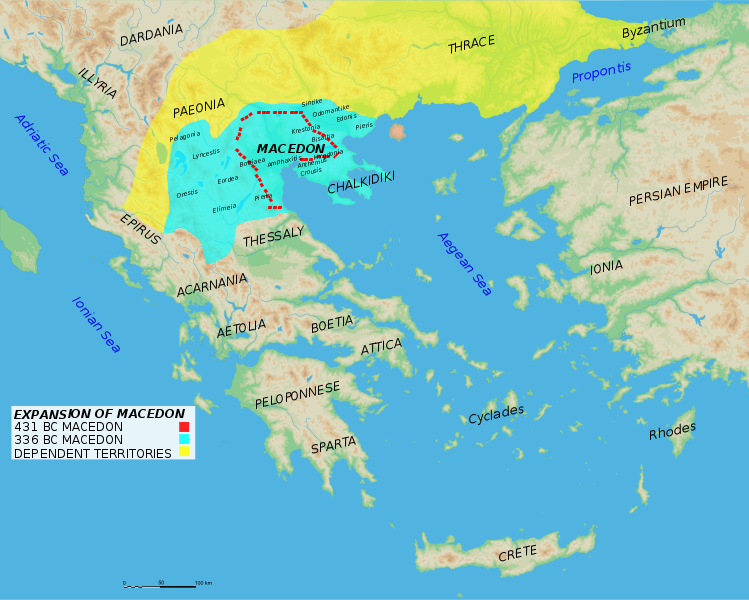
Visualizing the Expansion
Let's pause to visualize the results of Philip's strategy. In about two decades, he had transformed a beleaguered kingdom into a sprawling empire.
The Endgame: Checkmate
By the early 340s BC, Philip's power was undeniable. He had secured his northern frontiers, absorbed Thessaly, and controlled the board in central Greece. The final pieces in his game were the great city-states of the south, primarily Athens and Thebes.
His strategy was to keep them off-balance and divided while he consolidated his power.
Diplomatic Genius of Philip of Macedon
This clip from Kings and Generals explains the geopolitical checkmate Philip engineered.
Watch this final clip from 17:17 to 21:55. It shows how he used alliances to pin his enemies, expanded into Thrace to threaten Athens' vital interests, and patiently waited for the right moment to force a final confrontation.
The decisive confrontation came at the Battle of Chaeronea in 338 BC. Here, Philip's new army, the subject of our last lesson, proved its absolute superiority, crushing the combined forces of Athens and Thebes.
Test your understanding!
After his victory at Chaeronea, Philip treated the defeated Thebans harshly but was surprisingly lenient with Athens. Based on what you've learned about his strategic thinking, why might he have adopted this two-faced policy?
Show answer
Philip's goal was not just to conquer Greece, but to unite it (under his leadership) for a future invasion of Persia. Thebes was a land power and a long-time rival; garrisoning it neutralized a potential threat in his rear. Athens, on the other hand, possessed the most powerful navy in Greece. He needed that fleet for his Persian campaign. By treating Athens leniently—returning their prisoners without ransom and offering a generous peace—he aimed to secure their cooperation rather than provoke their eternal hatred. It was a pragmatic, forward-thinking decision that prioritized his long-term strategic goals over short-term revenge.
His victory was followed by his final political masterstroke: the League of Corinth. He summoned all the Greek states (except Sparta, which stubbornly refused) and formed a pan-Hellenic federation. While it was framed as a defensive alliance to bring peace to Greece and prepare for a war of revenge against Persia, its true purpose was to legalize Macedonian hegemony. Philip was named hegemon (leader) of the league, making him the official commander-in-chief of Greece.
Conclusion
Philip II's expansion of Macedon was a brilliant symphony of force and persuasion. He was a master strategist who understood that a battle won on the field was only half the victory; the other half was won at the negotiating table, in the marriage bed, and with bags of gold. He rarely used force when cunning would suffice, and he used the fruits of his conquests to fund his diplomacy, creating a self-reinforcing cycle of expansion.
Key Takeaways:
- A Hybrid Approach: Philip seamlessly blended warfare with diplomacy, bribery, strategic marriages, and intrigue to achieve his objectives.
- Patient Opportunism: He was an expert at playing the long game, using invitations (Thessaly) and regional crises (The Third Sacred War) to legitimize his interventions and expand his influence gradually.
- Warfare as a Means to a Political End: Military victories were not an end in themselves but tools to achieve political goals, such as gaining entry to the Amphictyonic League or forcing the creation of the League of Corinth.
- Strategic Foresight: His leniency towards Athens after Chaeronea demonstrates his ability to look beyond immediate victory towards his ultimate goal: the invasion of the Persian Empire.
Preview of the Next Lesson:
Philip’s inexorable rise did not go unchallenged. In Athens, one man saw the danger from the very beginning and dedicated his life to opposing the Macedonian king. In our next lesson, we will explore this great ideological and political rivalry by examining Demosthenes' rhetorical campaign to warn Athens of the Macedonian threat.