Hello! Welcome to the second module of our course, "A Tale of Two Cities."
In the last lesson, we concluded our survey of the foundational elements of the Greek world by looking at the Great Colonization movement. We saw how the Greeks spread their culture, language, and political model—the polis—across the Mediterranean. This expansion set the stage for some of these city-states to grow immensely powerful and influential.
Now, we turn our attention to the two poleis that would come to define the Classical era through their rivalry: Sparta and Athens. We'll begin with Sparta, a city that even other Greeks viewed with a mixture of awe, fear, and bewilderment. Xenophon, an Athenian who knew them well, wrote: "It occurred to me one day that Sparta... was evidently the most powerful and most celebrated city in Greece; and I fell to wondering how this could have happened. But when I considered the institutions of the Spartans, I wondered no longer."
In this lesson, we'll begin to examine those very institutions. Our goal is to describe the unique Spartan social system (Spartiates, Perioeci, Helots) and the 'agoge' training system. We will see how every aspect of Spartan society was engineered to create one thing: the perfect soldier.
Part 1: A Society Built on Fear
To understand Sparta, we must first understand its fundamental problem: it was a city built on the subjugation of a vast, hostile population. The entire Spartan way of life was a response to the constant, simmering threat of a slave rebellion.
This enslaved population was known as the Helots. They were not private property in the way other Greek slaves were, but state-owned serfs tied to the land. Their labor produced the food and wealth that sustained Sparta, liberating the Spartan citizens to dedicate their entire lives to warfare. This economic arrangement, however, came at a great psychological cost. The Spartans were vastly outnumbered by the Helots—by some estimates, as much as ten to one—and lived in a state of permanent anxiety.
To get a sense of this dynamic, let's watch a short video that frames the Helot problem as the central driver of Spartan militarism.
The Constitution of the Spartans
The video 'The Constitution of the Spartans' from Historia Civilis explains the origins of the Helots and how the wealth they generated allowed every Spartan citizen to become a full-time soldier, while also creating a constant fear of revolt.
Please watch from 02:12 to 03:46. Focus on how the massive Helot population both supported and threatened the Spartan state.
This precarious situation led to the development of a rigid, three-tiered social structure.
CLCV 205 - Lecture 9 - Sparta (cont.) - Open Yale Courses
For a detailed narrative on these social classes, let's turn to Professor Donald Kagan's lecture on Sparta. He provides an excellent description of the Helots, the Perioeci, and the Spartiates.
Please read the first four paragraphs of the lecture transcript, starting with 'Greeks spoke in the Mycenaean Period...' and ending with '...they are permanently thinking about somehow getting free and permanently, therefore, presenting a threat...'. This section details the origins and status of the Helots and introduces the Perioeci.
As you've just read, Spartan society was divided into three main groups:
- Spartiates (or Homoioi): The elite, full citizens. They were the descendants of the original Dorian conquerors. A Spartiate man was forbidden from engaging in trade or agriculture; his sole purpose was to be a soldier. From birth to death, his life was dedicated to the state. The state granted him a plot of land (kleros) and the Helots to work it, which provided the economic means for his warrior lifestyle.
- Perioeci ("dwellers around")**: These were free inhabitants of the towns and villages around Sparta, but they were not citizens. They managed their own communities but were subject to Sparta in matters of foreign policy and were obligated to serve in the army. Crucially, the Perioeci were the craftsmen, merchants, and manufacturers for the Spartan state, performing all the economic roles forbidden to the Spartiates.
- Helots: The state-owned serfs, primarily the conquered population of the neighboring region of Messenia. They had no rights and were brutally oppressed, but they were the economic engine of Sparta.
This diagram provides a clear visual summary of this strict hierarchy.
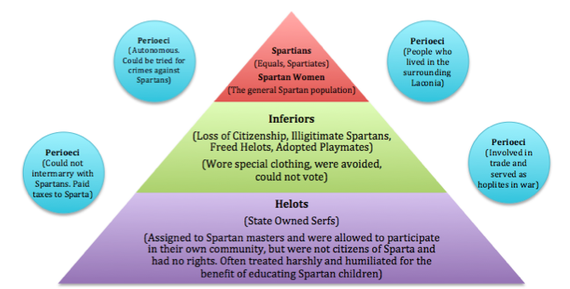
You'll notice the diagram mentions "Inferiors" (Hypomeiones). This was a tragic but important class of people who had, for some reason—cowardice in battle, inability to contribute to the common mess, or illegitimate birth—lost their full citizenship status. They lived as outcasts within the city, a constant reminder of the price of failure.
Test your understanding!
Imagine you are a Spartan leader. You need a new set of bronze shields, a shipment of grain from your land, and a detachment of soldiers for a border patrol. Which social class would you rely on for each of these tasks?
Show answer
- Bronze Shields: You would rely on the Perioeci, who were the craftsmen and manufacturers.
- Grain Shipment: The grain would be produced by the Helots working your kleros (allotment of land).
- Soldiers: The fighting force would be composed primarily of Spartiates, though Perioeci would also serve as hoplites in the army.
Part 2: Forging the Weapon: The Agoge
How did Sparta create the disciplined, fearless soldiers required to maintain this oppressive system? The answer lies in its unique and brutal state-run education program, the agoge (). This was not a school in the modern sense; it was a lifelong system of indoctrination that began at birth.

The agoge was designed to systematically break down family ties and instill unwavering loyalty to the state and to one's comrades. It was a crucible intended to produce men who valued discipline, endurance, and courage above all else.
CLCV 205 - Lecture 9 - Sparta (cont.) - Open Yale Courses
Professor Kagan's lecture provides a vivid, narrative account of the agoge, walking through the life of a Spartan boy from his birth inspection to his life as an adult soldier. It is a powerful story of extreme social engineering.
Please read the section under the heading 'Chapter 3. The Training and Education of a Spartan Boy', starting with 'We begin with the training and education of the young...' and ending with '...they are still maintaining their close quasi familial association with their fellow fighting men.' This is a longer reading, but it provides the kind of rich, narrative detail you enjoy.
To reinforce what you've just read, let's watch a short video that summarizes the key stages of this intense training.
The History of Ancient Sparta and the Spartans (History of Ancient Greece)
The video 'The History of Ancient Sparta and the Spartans' offers a concise overview of the agoge, from the examination at birth to the harsh life in the barracks.
Please watch from 09:41 to 11:52. This segment visually outlines the process you just read about.
The key stages of the agoge were:
- Birth: Infants were examined by state elders. Any sign of weakness or deformity meant the baby was left to die.
- Age 7: Boys were taken from their families and enrolled in "packs" (agelai), living in barracks.
- Ages 7-12: Basic training in discipline, obedience, and physical hardship. They were kept underfed to encourage cunning and theft (though being caught was severely punished).
- Ages 12-20: Training intensified. The focus was on military skills, endurance, and absolute obedience.
- Ages 20-30: The young man became a full-time soldier. He could marry, but had to live in the barracks, sneaking out to see his wife, further weakening family ties in favor of the military unit.
- Age 30: He became a full citizen (Homoios), allowed to live at home, but still took his evening meal with his military messmates.
Part 3: Maintaining Control: The Syssitia and the Krypteia
The control mechanisms of the agoge extended into adult life. Two institutions were particularly important for maintaining social cohesion among the Spartiates and terror among the Helots.
SPARTA: Social & Political structure
The webpage 'SPARTA: Social & Political structure' provides a concise explanation of two key institutions: the syssitia (common mess halls) and the Krypteia (secret police).
Please read the section titled 'control of the helots: the military, syssitia, krypteia'. Focus on the descriptions of the Krypteia and the syssitia.
-
The Syssitia: These were the common messes where all Spartiate men ate their evening meal. Membership was a requirement for citizenship. Eating every meal with the 15 or so men who were also your comrades in the phalanx built an extraordinary bond of loyalty and camaraderie. It was an extension of the barracks life, ensuring the bonds of the army remained stronger than the bonds of family.
-
The Krypteia: This was Sparta's secret police, a terrifying institution designed to control the Helots through random acts of violence. The most promising young men from the agoge were sent out into the countryside to live off the land and murder any Helot they encountered. The state would formally declare war on the Helots each year, so these killings were legally sanctioned. The Krypteia served as both a final test for Spartan youths and a brutal instrument of psychological warfare against the enslaved population.
Conclusion
Sparta was a society unlike any other in Greece. It was a military camp masquerading as a city, where every social custom and political institution was subordinated to the single goal of maintaining military dominance.
Key Takeaways:
- Social Structure: Spartan society was a rigid three-tiered pyramid. The Spartiates were the full-time warrior elite, the Perioeci were the free tradesmen and craftsmen, and the Helots were the enslaved population whose labor supported the entire structure.
- The Helot Problem: The constant threat of a Helot rebellion was the central organizing principle of Spartan life, explaining its extreme militarism and oppressive nature.
- The Agoge: This brutal, lifelong state training program was designed to forge the ultimate soldier by breaking down individuality and instilling discipline, endurance, and absolute loyalty to the state.
- Social Control: Institutions like the communal Syssitia and the terror-inducing Krypteia reinforced the military ethos and maintained control over the social hierarchy.
Preview of the Next Lesson:
We have now seen how Spartan society was structured and how its warriors were made. But who ruled this unique state? In our next lesson, we will explain the structure of Spartan government, including the dual monarchy and the Gerousia. We'll explore how this strange mix of monarchy, oligarchy, and democracy functioned to guide the Spartan war machine.