Hello. Last lesson focused on arriving at the start rested: the taper reduces training rather than testing or replacing it. Your race plan should follow the same principle. A fast short run or an ambitious finish time cannot establish what you can sustain for 26.2 miles.
This lesson shows how to choose a conservative pace or planned run–walk pattern from the training you actually completed, then adjust it for the course, conditions, and cutoff rules. The result should be a usable starting plan with permission to slow down—not a pace you must defend regardless of how the day unfolds.
Let the longest relevant evidence carry the most weight
A recent short race can indicate fitness, but it cannot by itself establish marathon endurance. A runner may have the speed for an appealing predicted finish time yet lack the long-run consistency, recovery, or practiced fueling needed to sustain that prediction. Conversely, a slow easy long run is not necessarily a maximum-effort test. Look at several pieces of evidence together:
- Consistency: Were weeks of training completed and recovered from, or were there substantial interruptions?
- Long runs: Could you keep the intended easy effort or rehearsed run–walk rhythm controlled near the end? How did you recover afterward?
- Race-effort practice, if already in your plan: Did modest stretches at a proposed marathon effort remain controlled rather than become a struggle?
- Fueling and drinking rehearsals: Did the strategy work while moving at a similar effort?
Treat a shorter-distance result as a rough upper-limit check, not a command to run its predicted marathon pace. If training evidence conflicts with the prediction, favor the more conservative interpretation. Do not add a hard test during the taper to settle the question.
In Everything Runners Need To Know About Marathon Pace, coach Brant Stachel explains both why short-race predictions can overstate a novice runner’s marathon readiness and how to weigh them against training and perceived effort.
Everything Runners Need To Know About Marathon Pace
Watch Everything Runners Need To Know About Marathon Pace by Brant Stachel for a method of checking a proposed pace against more than one source of evidence.
Watch race predictions for the assumptions behind converting shorter results into marathon targets. Then watch training checks, focusing on how long-run experience and perceived effort can challenge a calculated target. Finally, conditions explains why the same watch pace can demand a different effort in difficult weather or terrain. The coach describes demanding pace workouts as one source of evidence; these are not workouts to add late in your preparation.
A useful output from this review is a starting range, not a falsely precise number. For example, if a proposed pace felt controlled during relevant rehearsals and the long runs ended well, it may be a reasonable candidate under similar conditions. If that pace already felt labored late in training, choose a slower target or a rehearsed run–walk plan. If you have little long-run evidence, a finish-oriented effort plan is more defensible than a short-race-based time goal; a substantial preparation gap may also call for reconsidering whether to start.
Protect the opening miles
Marathon pace should not feel like a short race. The early miles are especially deceptive because rested legs, crowds, and excitement can make an unsustainable speed feel easy. The aim is to reach the later miles with choices still available, rather than spending energy early and hoping to recover it.
Coach Steve Magness explains why a controlled first half gives a less experienced runner more room to judge the second half.
How to Run a Marathon: Professional Coach Explains
Watch How to Run a Marathon: Professional Coach Explains by Steve Magness for the distinction between an ambitious even split and a more forgiving conservative start.
Watch race pacing. Focus on his description of how effort should feel as the race progresses and why training, rather than a hoped-for finish time, should inform the starting pace. His suggestion to speed up later is conditional on how the runner feels; it is not a required second-half acceleration.
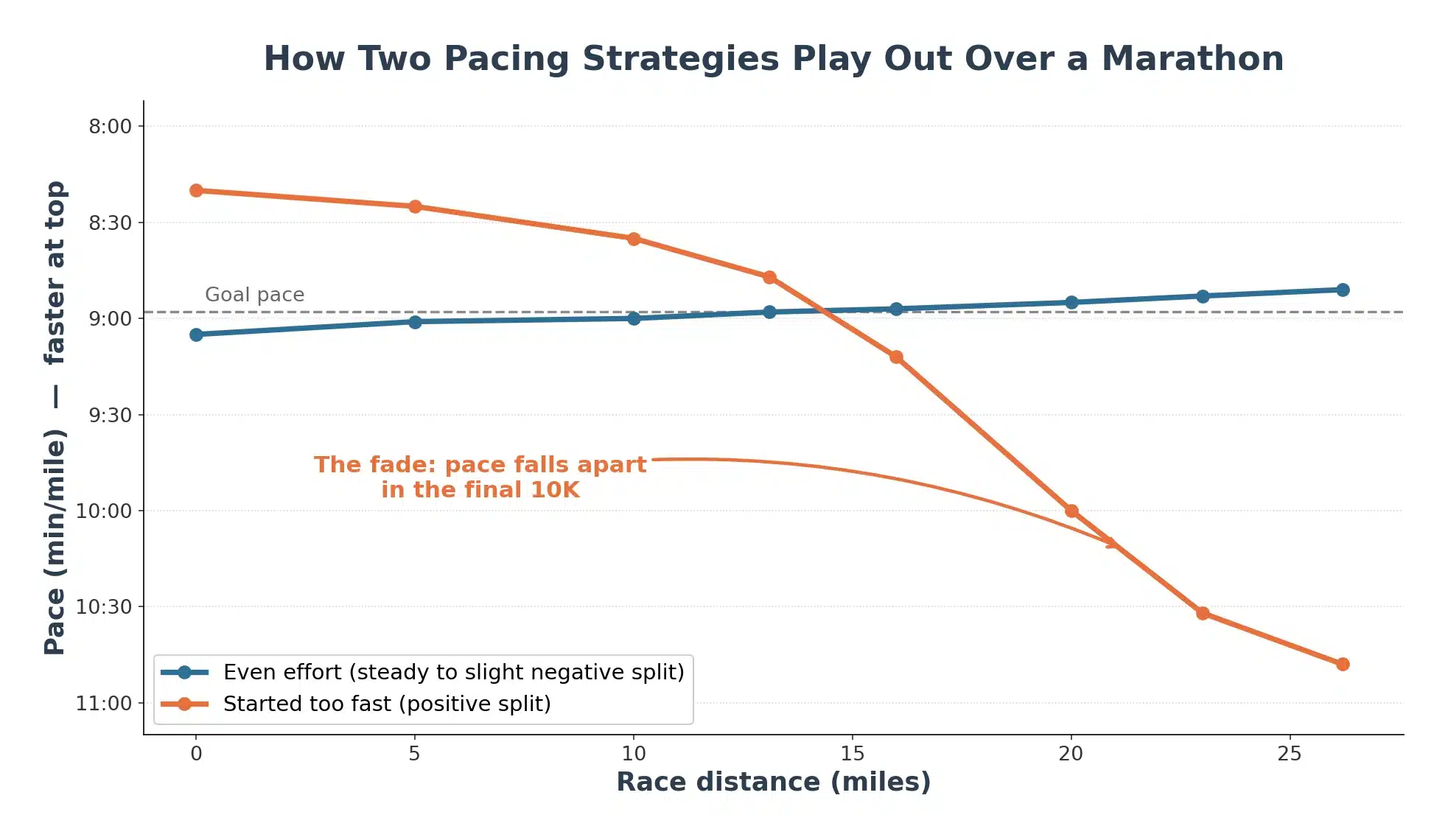
The graph below illustrates the risk of starting too fast. Faster paces are higher on its vertical axis. The orange line begins well ahead of the roughly nine-minute-per-mile reference, then slows markedly; the blue line stays close to a steady effort. These are illustrative paths, not a prediction that every runner who starts quickly will follow the orange line.
Turn that principle into simple decisions:
- At the start: Stay at or below your conservative planned effort, even if other runners pass you. If you use a watch, treat its pace as a check against going too fast, not as an instruction to push through unexpectedly hard effort.
- Through the middle: Keep the effort controlled, follow the fueling and drinking schedule you rehearsed, and notice whether breathing and leg fatigue are changing sooner than expected.
- Late in the race: Continue steadily if that is what you can sustain. A slight increase is optional only if you remain well, are fueling successfully, and genuinely have capacity left. Slowing down is a valid adjustment, not a failure of the plan.
An even split means similar times for the two halves; a negative split means the second half is faster. Neither label matters more than finishing safely at a sustainable effort. For a first marathon, “start conservatively, then reassess” is more useful than promising a particular split.
Make walk breaks part of the plan, if they fit your training
A run–walk strategy is not merely a backup for when running becomes impossible. Planned walks can help you regulate effort, take fuel, and maintain a repeatable rhythm. The important distinction is between walking on a rehearsed schedule from early in the race and waiting until exhaustion forces an unplanned stop.
Read the selected portions of Galloway Run-Walk-Run Method: Ratios by Pace + How to Start for its practical explanation of early walk breaks and interval timing. Its pace-to-ratio table offers possibilities to test, not prescribed ratios or guaranteed finishing times.
Galloway Run-Walk-Run Method: Ratios by Pace + How to Start
Read this RunnersConnect guide to see how a planned walk break differs from an emergency walk late in the race, and how to make an interval pattern repeatable.
Start with the paragraph just before “What Run-Walk Ratio Should You Use?” and read early walks and ratios through that section’s table and advice to test a ratio on long runs. Then, under “How Do You Start Run-Walk-Run Training?”, begin at “First, pick a starting ratio” and read interval setup. Focus on using a timer, walking naturally during breaks, and keeping running segments controlled. Do not adopt a table entry solely because its listed goal pace matches a hoped-for finish.
Choose a pattern that worked repeatedly in your long runs, including their later portions. If you rehearsed four minutes of comfortable running followed by one minute of natural walking, starting that pattern from the opening miles is more coherent than running continuously until tired and then trying it for the first time. If you trained comfortably with continuous running, you need not add walk breaks on race day. Either approach can be adjusted downward when conditions or symptoms demand it.
A run–walk plan also needs an overall pace estimate. Do not average running and walking speeds as though you spent equal time at each. Suppose a rehearsed pattern is four minutes running at 12:00 per mile and one minute walking at 16:00 per mile. In each five-minute cycle, the distance is approximately
That gives an overall moving pace of roughly 12:38 per mile, or about 5 hours 31 minutes for 26.2 miles if the pattern stays unchanged. It does not include aid-station stops, a slower late-race pace, hills, or heat. Use estimates like this to check feasibility, not to promise a finish time.
Adjust the plan to the course and its clock
A pace rehearsed on a cool, flat route may require more effort on a warm, humid, windy, or hilly course. On climbs, let the pace slow to preserve a controlled effort; do not try to “win back” every second by forcing the downhills. In heat or humidity, plan for slower running or more walking, and be willing to revise a time goal. Follow the fueling and hydration approach you practiced, while adapting fluid access to the actual course.
Race cutoffs require their own calculation. Check the event’s published rules rather than assuming “six hours” always means six hours after you cross the start line. Determine:
- whether the finish cutoff is measured from the first start signal or from your own start;
- whether there are intermediate checkpoint cutoffs;
- how long you may wait before crossing the start line;
- how much time your plan allows for aid stations and ordinary slowing.
For example, a projected 5:31 moving time under ideal, unchanged conditions is not comfortably inside a six-hour cutoff measured from the first start signal if you cross the line ten minutes later and spend ten minutes stopped. That leaves only about nine minutes for hills, weather, crowding, or late fatigue. The prudent response is not automatically to run the opening miles faster. It may be to choose a race with a more suitable cutoff, revise the participation plan, or reconsider starting that event.
Cutoffs are logistical constraints, not safety overrides. If conditions become hazardous or you develop concerning symptoms, stopping takes priority over reaching a checkpoint. Chest pain, fainting, confusion, or collapse requires stopping and seeking emergency help; unusual severe breathlessness also warrants stopping and urgent assessment. Do not reinterpret these signs as ordinary marathon fatigue.
Keep the plan conditional
A useful race plan can fit on a small card: your conservative opening effort or rehearsed interval, where you will take familiar fuel and fluids, the course’s checkpoint times, and the signs that mean slowing, stopping, or seeking help. It should also say what changes if the day is harder than expected. A fixed finish-time target without those contingencies is not a complete pacing strategy.
The key distinction is between evidence and aspiration. Let consistent long runs, recovery, and rehearsed effort set the starting plan. Begin patiently, use walk breaks early if you practiced them, adjust to the conditions, and leave time for the realities of the course clock. In the next lesson, you will audit the whole preparation plan—including pacing, recovery, fueling, and safety rules—to see whether its parts work together.