Hello. In the previous lesson, you built a carbohydrate plan from the time you expect to spend running and the amount of carbohydrate in each serving. This lesson keeps fuel and fluid as related but separate decisions: a sports drink may contribute carbohydrate, but you should not drink extra simply to meet a fueling target. You will build a long-run drinking strategy that accounts for thirst, weather, access to fluids, and—if useful—an estimate of your own sweat loss. Allow about 35–40 minutes, including the resources.
Aim for enough fluid, not the most fluid
Sweating helps you shed heat, and a long run can leave you progressively short of fluid. At the other extreme, drinking more than your body can handle can dangerously dilute blood sodium. Neither “replace every drop” nor “drink at every opportunity” is a safe universal rule.
Read the short hydration guidance in Beat the Heat from World Athletics. It explains why a plan becomes more useful as exercise gets longer or hotter, while warning against overhydration.
Read World Athletics’ guidance to establish the safety boundaries for a long-run drinking plan.
On the PDF page marked 11, read the paragraph beginning “Heat dissipation relies on sweat evaporation,” from fluid needs and overdrinking. On the page marked 12, under “WHAT TO DRINK?”, read from the sentence beginning “Sodium (salt) supplementation” through the sentence about consuming fluids with food: sodium guidance. Stop before the “HYDRATION INDEX” chart. Focus on why a strategy should be tested in training, not treated as a fixed amount for everyone.
For a shorter run in cool conditions, drinking when thirsty is often sufficient. On a run lasting several hours, plan how you will have access to fluid, then use thirst, conditions, and experience to decide how much to take at each opportunity. A plan can specify where your bottles or refill points will be without requiring you to finish every bottle. Equally, do not set out for a long, hot route with no accessible fluid and assume thirst alone will solve the logistical problem.
Start ordinarily hydrated: drink with normal meals and respond to thirst before the run. Avoid trying to “bank” water by forcing down large volumes immediately beforehand.
Let conditions and access shape the plan
Sweat losses vary between runners and within the same runner. Heat, humidity, pace, clothing, and acclimatization can all change what happens on a particular day. A drinking pattern that works on a cool easy run may not transfer to a warm long run.
Watch selected portions of What You’re Getting Wrong About Hydration (Lab Test Results!) from The Running Channel. The comparison across conditions is more useful here than any single number produced by the test.
What You’re Getting Wrong About Hydration (Lab Test Results!)
Watch The Running Channel compare sweat losses across conditions and discuss practical drinking choices. Treat the examples as demonstrations of variability, not prescriptions for your intake.
Start with home estimation for a way to measure fluid loss in training. Then watch changing conditions to see why one run may differ from another. Continue through drinking choices and overdrinking risk. Notice the distinction between planning access in advance and forcing a predetermined volume despite how you feel.
Before a long run, identify the route’s taps or refill stops, or decide what you can carry comfortably. Check whether those sources will actually be available. If heat or humidity makes your usual route harder, easier pacing, a shorter route, or a cooler time of day may be more appropriate; extra drinking is not a substitute for reducing heat stress.
Use sweat loss as an estimate, not a drinking quota
If you want more information than thirst and experience provide, you can estimate sweat loss on a representative training run. Weigh yourself before and after, having used the toilet beforehand, and use the same dry clothing—or account for wet clothing. Record how much you drink, the run’s duration, and any urine passed during it. Approximately one kilogram of body-mass change corresponds to one litre of fluid.
Divide that volume by the run’s duration in hours to estimate litres per hour. The image shows a one-hour example with no urine passed: a runner finishes kg lighter after drinking L, giving an estimated sweat rate of L per hour.
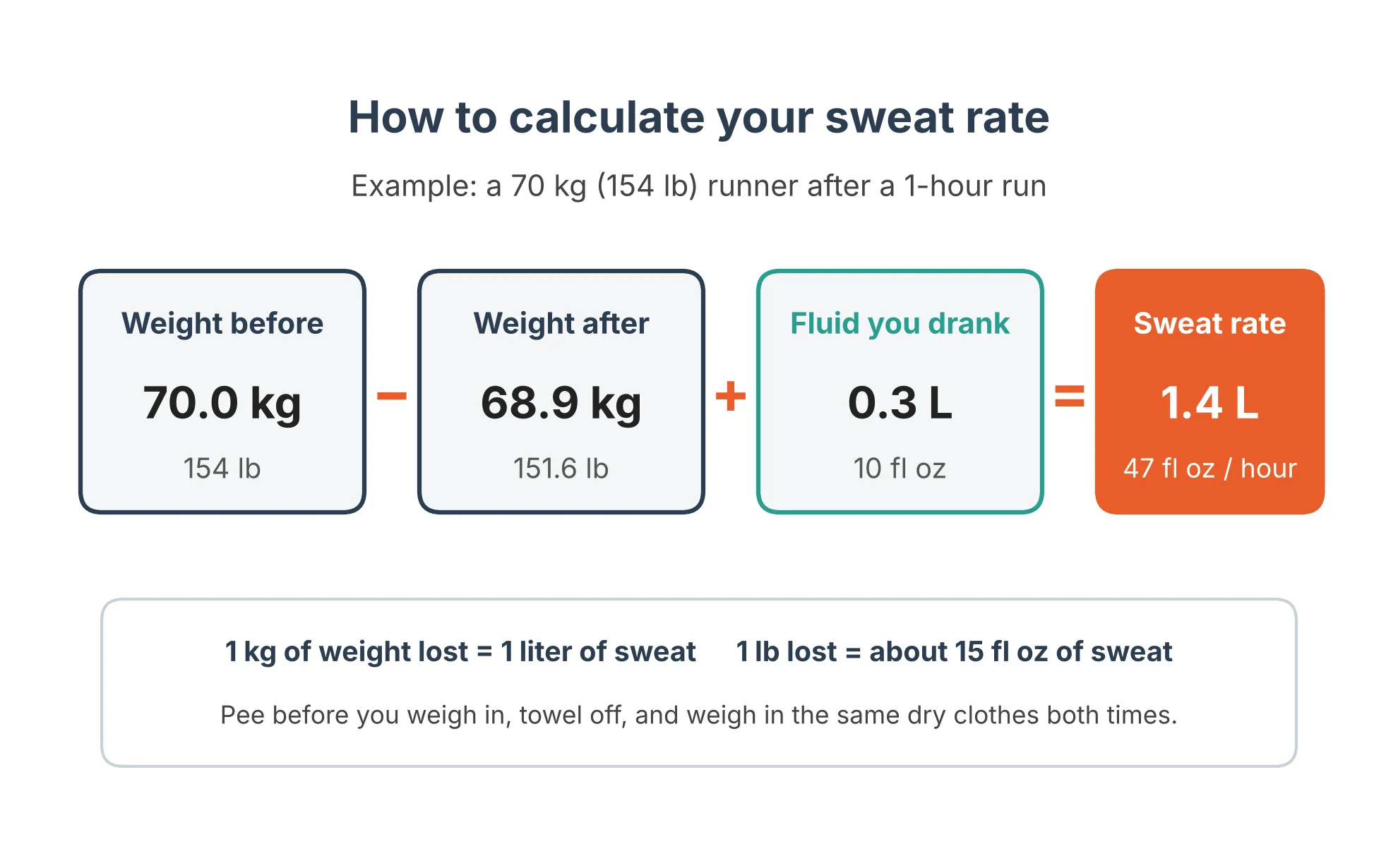
This is an approximation. Food eaten, toilet stops, and moisture in clothing can affect the calculation. More importantly, estimated sweat rate is not a target you must replace exactly. Some body-mass loss during a long run is expected. Trying to match a high measured sweat rate litre for litre could leave you uncomfortable or overdrinking, especially when conditions or effort differ from the test run. Use measurements from comparable runs to judge whether your access plan is plausible, then check how you feel and recover.
For example, suppose a two-hour easy run in mild weather leaves you kg lighter after you drink L, with no toilet stop. Your estimated sweat loss is L, or L per hour. For a similar 2½-hour run, you might arrange access to roughly a litre of fluid and drink according to thirst across the run, with a refill option if conditions or your needs differ. The calculation helps you avoid carrying far too little; it does not require you to finish a litre or replace every estimated loss.
Account for sodium without treating salt as protection
Sweat contains sodium as well as water, but both the amount of sweat and its sodium concentration vary. For many ordinary training runs, normal meals and fluids are a sensible starting point. During longer, hotter sessions—particularly if you sweat heavily—some sodium in a sports drink or food may be useful. You can check the sodium per serving on drink, gel, or food labels when putting your plan together.
Read the “Practical Applications” section of the Gatorade Sports Science Institute’s Assessing Hydration in the Laboratory and Field. It connects individual variation to fluid and sodium choices and includes an important warning about sports drinks.
Assessing Hydration In The Laboratory And Field - Gatorade Sports Science Institute
Read the “Practical Applications” section to see why sodium choices should accompany, rather than replace, a sensible fluid plan.
Under “Practical Applications,” read the bullet list from individual variability and safety, ending with the warning that sports drinks do not make runners immune to exercise-associated hyponatremia. Focus especially on the note that symptoms of dehydration and overhydration can overlap.
Sodium does not cancel out excessive drinking. Sports drinks still contain fluid, and salt tablets are not permission to drink beyond thirst or to pursue a rigid volume. Nor do you need to add large amounts of salt simply because a run is called a “long run.” If you repeatedly have unusually heavy sweat losses, questions about sodium intake, or a medical condition affecting fluid balance, seek individualized advice from a qualified sports dietitian or clinician rather than guessing at a supplement dose.
Keep the carbohydrate plan from the previous lesson in view. If a drink supplies carbohydrate, count the amount you actually drink toward your hourly carbohydrate intake. If thirst leads you to drink less than expected, carry another carbohydrate source rather than forcing down fluid to meet the fuel calculation.
Put the strategy into a usable form
A practical long-run plan should state what you will do and what would make you change course. For a 2½-hour easy run, it might read:
“I will start normally hydrated and carry two bottles, with a known refill point on the route. I will take comfortable amounts when thirsty rather than finish the bottles by a deadline. If it is hotter than expected, I will slow down and use the refill point; if fluids are unavailable, I will shorten or change the route. For a hot, sweaty run, I may use a drink or food containing sodium that I have already tolerated in training. I will record what I drank, the conditions, and how I felt afterward.”
Your own version should reflect your run duration, likely conditions, what you can carry, and actual access points. If you have sweat-loss estimates from comparable runs, use them to check the plan’s practicality—not to override thirst. On later runs, change one feature at a time so you can tell whether a different amount, drink, or access arrangement helped.
Finally, know when the plan stops being a plan. Stop running and seek prompt medical assessment if you develop a significant headache, repeated vomiting, or worsening dizziness or illness during or after a prolonged run. Dehydration, heat illness, and low blood sodium can have overlapping symptoms; do not assume that drinking more water or taking salt is the right treatment. Confusion, collapse, seizure, or impaired consciousness requires emergency help.
Key takeaways
Plan access to fluid, then drink responsively rather than to a universal hourly quota. Conditions can change your needs, while an optional sweat-loss measurement provides context—not a mandate to replace every litre. Include sodium sensibly for longer, sweatier conditions if appropriate, but remember that neither a sports drink nor salt prevents the harm of overdrinking. Stop and get help when concerning symptoms appear instead of trying to diagnose them mid-run.
In the next lesson, you will plan familiar meals before a marathon, including a race-morning breakfast that works alongside the fueling and drinking choices you have tested in training.