Hello. This module is about adjusting a marathon plan when your recovery does not match what the schedule expects. A balanced training week is a starting point, not an instruction to complete every run regardless of how you feel.
In this lesson, you will set up a brief recovery log and use it to make one of three decisions: train as planned, reduce the load, or seek professional assessment. The aim is to notice meaningful patterns early—especially developing injury and possible inadequate energy intake—without treating every tired day as a crisis.
Make the log useful, not elaborate
A recovery log works best when you can keep it going during an ordinary training week. Spend a minute each morning recording the same five areas, then add a short note after a run if something changed.
| Area | What to record |
|---|---|
| Sleep | Approximate duration and whether you woke feeling rested |
| Fatigue | How drained you feel before training and during everyday tasks |
| Soreness | Where it is, whether it is general or localized, and whether it affects walking or running |
| Mood | Your usual outlook, irritability, or loss of interest in training |
| Performance | Whether a familiar easy run feels about normal, unexpectedly hard, or impossible to complete comfortably |
You can use simple descriptions or a consistent 1–5 scale. If you use numbers, write down what each end means; otherwise, a “5” for fatigue can easily be confused with a “5” for feeling well. Beside these entries, note the session you did and any obvious context, such as a demanding workday, illness, or hot weather. You do not need a wearable device or a target heart rate to begin.
The comparison is primarily with your own usual pattern, not another runner’s scores. One difficult night may explain a tired morning. Several entries showing worsening sleep, rising fatigue, lower mood, and harder-feeling easy runs tell a different story.
Read this University of Brighton article by podiatry lecturer Dao Tunprasert for two complementary ideas: how running pain can develop, and why a short wellness log is more informative than training volume alone.
In “Understanding Your Body’s Warning System,” read the pain progression, from the explanation of tissue repair through the numbered list. Then, in “Your Secret Weapon: Wellness Monitoring,” continue through “Practical Takeaways for Runners”: read the monitoring discussion. Focus on changes across several entries rather than trying to turn a wellness score into an injury prediction.
The article’s pain sequence is a useful warning model, not a set of stages you must wait to pass through. Localized pain that disappears after warming up still belongs in your log; its temporary disappearance does not prove that the tissue is ready for more running.
Decide when ordinary fatigue calls for less training
Training creates fatigue; recovery allows you to adapt. The practical distinction is whether fatigue is proportionate and resolving, or is accumulating while running becomes harder. An unusually hard long run may leave your legs tired the next day without indicating a serious problem. If you are sleeping and functioning normally, soreness is mild and improving, and easy running still feels easy, it is reasonable to continue with the planned easy training.
Move to a reduced-load decision when several signals worsen together or fail to improve: for example, sleep has been poor, your legs remain unusually heavy, your mood is lower, and a familiar easy route feels markedly harder. Cancel the next hard session or long run, and choose rest or a shorter, genuinely easy run instead. Record whether the extra recovery helps before resuming demanding training. Do not try to “earn back” the missed work.
The Hidden TRUTH About Overtraining Syndrome: What Athletes Miss
Watch “The Hidden TRUTH About Overtraining Syndrome: What Athletes Miss” from Dr. Mark Heisig | Healthy On Purpose for a distinction between short-lived fatigue and a prolonged decline that does not resolve with rest.
Watch the fatigue spectrum. Notice that a brief dip followed by a rebound is different from weeks of persistently poor performance. Treat the categories as a way to understand severity over time, not as diagnoses you can assign from a few log entries.
Overtraining syndrome is not a synonym for a tiring week. Persistent fatigue and declining performance also have other possible causes, including illness, injury, and inadequate food intake. If performance and day-to-day energy keep deteriorating despite reducing training and allowing recovery, arrange a clinical assessment rather than repeatedly adjusting the schedule on your own.
Recognize patterns that need assessment
A log can tell you when not to rely on a lighter week alone. Pain deserves particular attention when it becomes focal, recurs in the same place, increases during a run, changes your stride, or begins to hurt while walking or at rest. Stop the run rather than testing whether you can push through it; seek assessment from a qualified clinician before returning to impact running if the pain persists or suggests a bone or other significant injury. Sudden severe pain or an inability to bear weight warrants prompt medical attention.
Fatigue can also signal that training demands exceed the energy available to support both exercise and normal body functions. Relative energy deficiency in sport (RED-S) can affect runners of any sex. It is not ruled out by a particular body size, and the log cannot diagnose it.
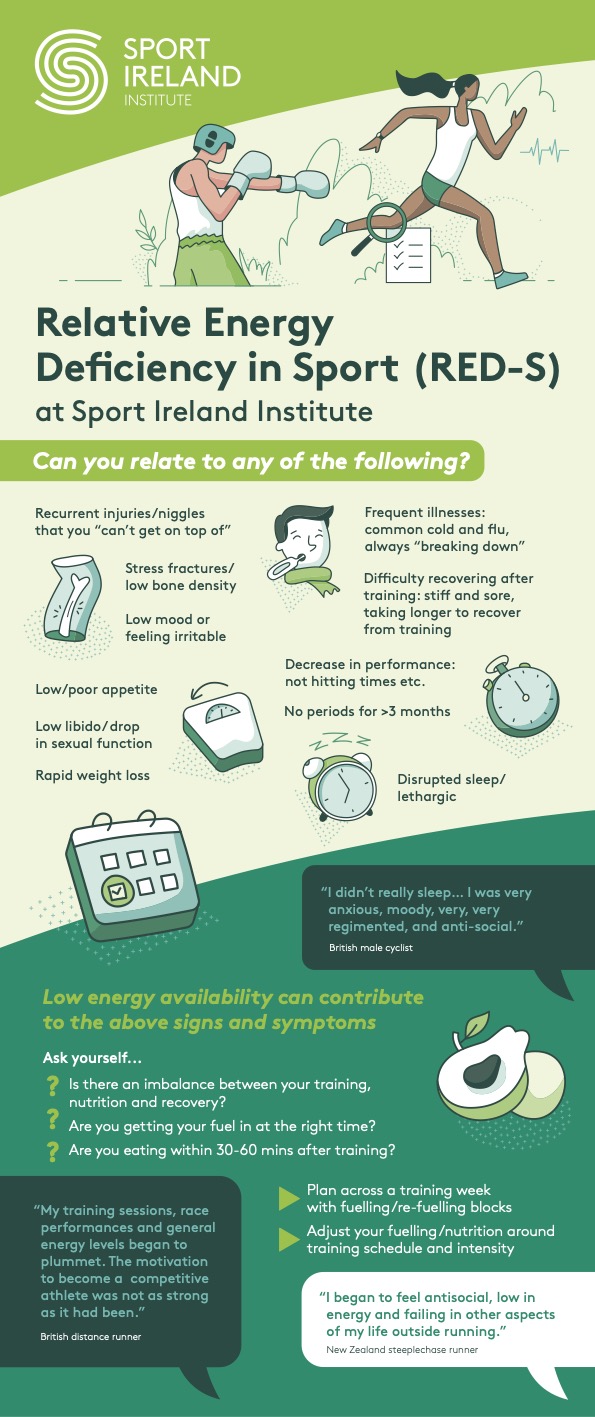
Use the infographic to look for clusters and persistence, not a required checklist. Concerning patterns include recurring injuries or illnesses, unusual difficulty recovering, declining performance, marked fatigue, mood or sleep changes, rapid or unexplained weight loss, and missed or disrupted menstrual periods if applicable. Low energy availability may occur without an intentional diet. If these signs appear—especially alongside increasing training or restricted eating—reduce training demands and seek assessment from a healthcare professional; a sports dietitian can help evaluate whether intake supports training. Do not wait for every sign on the infographic to appear.
OVERTRAINING SYNDROME | Sports Medicine Today
Read the Sports Medicine Today overview to see why persistent performance decline and fatigue merit an assessment rather than a self-diagnosis.
In “What is it?” and “Symptoms,” read the description and signs. In “Sports Medicine Evaluation,” read the assessment description. Notice that the clinician considers training, symptoms, and diet and may investigate other explanations. The later treatment timelines are not instructions for choosing your own rest period.
If chest pain, fainting, confusion, collapse, or unusually severe breathlessness occurs during exercise, stop and seek emergency help. A recovery log is not a tool for deciding to continue through those symptoms.
Turn the entries into a decision
Use the strongest warning sign, not an average score. A good mood does not cancel out focal pain, and one normal-feeling run does not erase a persistent decline.
- Train as planned: Your recent entries are near your usual pattern; ordinary soreness is improving; no concerning pain or symptoms are present. Keep easy sessions easy.
- Reduce load and reassess: Fatigue, sleep, mood, soreness, or easy-run effort has worsened, particularly across multiple days. Replace demanding running with rest or less easy running, then check whether the pattern improves.
- Seek professional assessment: Pain is persistent or increasingly localized; fatigue or performance keeps worsening despite recovery; or signs suggest illness or inadequate energy intake. Stop the activity provoking concerning pain while you seek advice. Emergency symptoms require emergency help instead.
Consider how the distinction works in practice. After a long run, you sleep well, have mild soreness in both legs that eases, and your next easy run feels normal: the log supports continuing with the planned easy week. In contrast, if several nights of poor sleep accompany low mood and unexpectedly hard easy runs, reducing the next sessions is more sensible than completing a hard workout. If that same log also shows worsening pain in one spot on your shin, the focal pain changes the decision: stop impact running and seek assessment rather than simply running fewer kilometres.
Key takeaways
Record sleep, fatigue, soreness, mood, and easy-run performance consistently enough to see change over time. Continue when recovery is following your usual pattern; reduce training when several signals worsen; seek assessment when symptoms persist, suggest injury, or point to inadequate energy intake. A log supports decisions, but it does not diagnose their cause.
The next lesson uses recent consistency and recovery to choose the following week’s running load, including when to make it an easier week.