Hello! Welcome to the first lesson in our module on Fine-Tuning Language Models.
Introduction
In the previous module, we focused on improving the performance of our AI systems by enhancing the retrieval component in Retrieval-Augmented Generation (RAG). We saw how better chunking, embedding models, and retrieval strategies could lead to better answers. However, sometimes the limitation isn't the context we provide, but the base model's ability to interpret that context or follow instructions for a highly specialized task.
This module introduces a powerful new set of tools to address this: fine-tuning. Fine-tuning allows us to modify the behavior of the language model itself.
Today's lesson directly addresses this module's first learning outcome: to explain the difference between full fine-tuning and parameter-efficient fine-tuning (PEFT). We will explore:
- The core concept of fine-tuning as a form of transfer learning.
- The traditional approach: full fine-tuning, where every parameter in the model is updated.
- The modern, more practical approach: Parameter-Efficient Fine-Tuning (PEFT), which achieves similar results with a fraction of the resources.
- The critical trade-offs between these two methods, helping you decide which tool is right for the job.
Understanding this distinction is fundamental for any AI engineer, as it directly impacts project cost, development speed, and deployment strategy.
What is Fine-Tuning?
Before we compare the two main strategies, let's establish what fine-tuning is. Large Language Models like GPT or Llama are first pre-trained on a massive, general-purpose dataset (like a large portion of the internet). This gives them a broad understanding of language, facts, and reasoning.
Fine-tuning is the process of taking one of these pre-trained models and training it further on a smaller, task-specific dataset. This specializes the general model to become an expert in a particular domain or skill.
From a software engineering perspective, you can think of the pre-trained model as a powerful, general-purpose library or framework. Fine-tuning is like writing your own application-specific code that uses this framework to solve a unique business problem.
The following video provides a great historical context for fine-tuning and highlights the challenges that led to the development of more efficient methods.
LLM (Parameter Efficient) Fine Tuning - Explained!
Watch this section from CodeEmporium's video 'LLM (Parameter Efficient) Fine Tuning - Explained!' to understand the concept of fine-tuning through transfer learning and the main drawbacks of the traditional approach.
Watch from 03:10 to 05:39. Pay close attention to the four cons mentioned: time/expense, storage, and especially 'catastrophic forgetting'. These problems are the primary motivation for PEFT.
Full Fine-Tuning: The Comprehensive Approach
As the name implies, full fine-tuning updates all the parameters (or weights) of the pre-trained model. If you're fine-tuning a 7-billion parameter model like Llama 3 8B, you are training all 8 billion parameters on your new dataset.
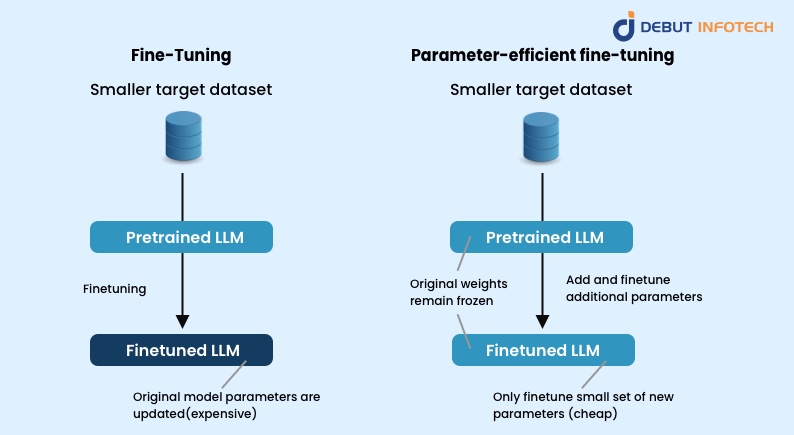
To get a deeper understanding of the principles, advantages, and disadvantages of this method, please read the following section from a detailed report on fine-tuning strategies.
Fine-Tuning Strategies: When to Use PEFT, LoRA, or Full ...
This article from Datasumi provides a thorough breakdown of the full fine-tuning process, its benefits, and its significant drawbacks.
Read the section titled 'III. Full Model Fine-Tuning: The Comprehensive Approach'. Focus on understanding the following points: Advantages: Why this method can achieve the highest accuracy and allow deep customization. Disadvantages: The concepts of high resource demands (computational cost), catastrophic forgetting, and deployment challenges.
Summary of Full Fine-Tuning
| Pros | Cons |
|---|---|
| Highest Performance Potential: Can achieve state-of-the-art results by deeply adapting the entire model. | Extremely High Cost: Requires immense GPU memory (often >12x the model size) and long training times, translating to high infrastructure costs. |
| Deep Customization: Effective for teaching a model entirely new skills (e.g., converting natural language to a custom DSL) or for complex reasoning tasks. | Catastrophic Forgetting: The model can "forget" its general knowledge while specializing, becoming less capable outside its new, narrow domain. |
| Prompt Efficiency: Can bake complex instructions into the model, allowing for shorter and simpler prompts at inference time. | Large Storage Footprint: Each fine-tuned task creates a full-sized copy of the model, making it difficult to manage and deploy dozens of specialized models. |
For you as a backend engineer, the cons are particularly resonant. It's like needing to provision a massive, dedicated server cluster for every minor feature variant and storing a complete, multi-gigabyte application binary for each one. It's powerful but often impractical.
Parameter-Efficient Fine-Tuning (PEFT): The Efficient Alternative
The extreme costs of full fine-tuning led researchers to ask: Can we get most of the benefits of fine-tuning without paying the full price? The answer is Parameter-Efficient Fine-Tuning (PEFT).
The core idea of PEFT is simple but powerful:
- Freeze the weights of the large pre-trained model. Do not update any of its billions of parameters.
- Inject a very small number of new, trainable parameters into the model.
- Train only these new parameters on your task-specific data.
This means instead of updating 7 billion parameters, you might only update a few million (less than 0.1% of the total).

There are several PEFT methods, but a classic one that's easy to visualize is using Adapter Layers. This involves inserting small, new neural network layers in between the existing frozen layers of the transformer model.
The following video provides an excellent explanation of what PEFT is and uses the adapter method to illustrate how it works in practice.
LLM (Parameter Efficient) Fine Tuning - Explained!
Let's continue with the CodeEmporium video. This segment defines PEFT and then uses the 'adapter' method to give a concrete example of how you can fine-tune a model by only training a tiny fraction of the parameters.
Watch the following two clips: What is PEFT? (05:39 - 06:24): A concise definition of PEFT as the solution to the problems of full fine-tuning. Adapters Explained (07:34 - 16:22): This is a key section. Follow the explanation of how small 'adapter' layers are inserted into the transformer architecture. Understand how freezing the main model and only training these small adapters drastically reduces the computational and storage burden.
Summary of PEFT
| Pros | Cons |
|---|---|
| Highly Efficient: Drastically reduces GPU memory, storage, and training time, making fine-tuning accessible on consumer-grade hardware. | Potential Performance Ceiling: For extremely complex tasks requiring new reasoning skills, PEFT might not match the peak performance of full fine-tuning. |
| Mitigates Catastrophic Forgetting: By leaving the base model untouched, it preserves general knowledge and reasoning abilities. | Slightly More Complex: Introduces new concepts and hyperparameters specific to the PEFT method being used (e.g., rank in LoRA). |
| Portable and Scalable: The trained parameters are just a small "adapter" file (a few megabytes), not a full model copy (many gigabytes). You can have one base model and swap in different adapters for different tasks. |
This approach is analogous to a plug-in architecture in software. You have a large, stable core application (the frozen LLM), and you can dynamically load small, lightweight plug-ins (the PEFT adapters) to add specialized functionality.
Test your understanding!
You are tasked with creating 20 different chatbots for an e-commerce company. Each bot specializes in a different product category (e.g., electronics, apparel, furniture). You have access to one server with a high-end GPU.
Which fine-tuning approach, full fine-tuning or PEFT, would be more practical and why? Consider deployment and resource management.
Show answer
PEFT would be the far more practical approach.
Here's why:
- Storage: With full fine-tuning, you would need to store 20 complete copies of the LLM, each potentially 15-140 GB in size. With PEFT, you store the single base model once and 20 small adapter files (a few hundred megabytes in total). This is a massive difference in storage cost.
- Deployment & Resource Management: To serve all 20 bots, a full fine-tuning approach would require loading 20 different large models into memory, which is impossible on a single server. With PEFT, you can load the single base model into GPU memory once and then dynamically load the tiny adapter for the specific product category as needed. This is vastly more efficient and scalable.
Head-to-Head Comparison and Decision Framework
Now that we understand both approaches, let's look at a direct comparison to solidify the trade-offs and build a practical framework for choosing between them.
Fine-Tuning Strategies: When to Use PEFT, LoRA, or Full ...
Let's return to the Datasumi article for a direct, data-driven comparison and a clear decision framework.
Please read the following two sections: VI. Comparative Analysis: This section provides a fantastic head-to-head comparison across computational efficiency, data efficiency, and performance trade-offs. It quantifies the differences. VII. Decision Framework: This translates the comparison into a practical guide on when to choose each strategy based on your project goals and resources.
Conclusion
In this lesson, we've unpacked the crucial difference between the two primary paradigms of model customization: full fine-tuning and parameter-efficient fine-tuning (PEFT).
Key Takeaways:
- Full Fine-Tuning updates all model parameters. It offers the highest potential performance for complex tasks but comes at a staggering cost in terms of computation, time, and storage. It also risks "catastrophic forgetting."
- Parameter-Efficient Fine-Tuning (PEFT) freezes the base model and trains only a small number of new parameters. It provides comparable performance for most tasks at a fraction of the cost, making it highly efficient, scalable, and the default choice for most modern applications.
- The choice between them is an engineering trade-off. It depends on your specific goals (peak performance vs. good-enough performance), resources (unlimited budget vs. constrained hardware), and deployment strategy (one critical model vs. many specialized models).
For most practical applications you will build as an AI Engineer, PEFT will be your go-to method. It democratizes the ability to customize powerful LLMs without needing access to a supercomputer.
Next Up:
We've used "Adapters" as a conceptual example of PEFT. In the next lesson, we will dive deep into LoRA (Low-Rank Adaptation), the most popular and influential PEFT method used today. We'll explore the linear algebra that makes it so efficient and prepare to implement it ourselves.