Introduction
Welcome to your first lesson. As you begin the "Quadratic Equations" chapter of your Cengage book, we'll start with a foundational technique essential for the JEE Advanced: Vieta's formulas. This lesson focuses on using these formulas to find the value of symmetric functions of roots—expressions like or —without needing to calculate the roots themselves. Mastering this skill allows you to solve complex problems efficiently, a key strategy for the exam.
Vieta's Formulas for Quadratic Equations
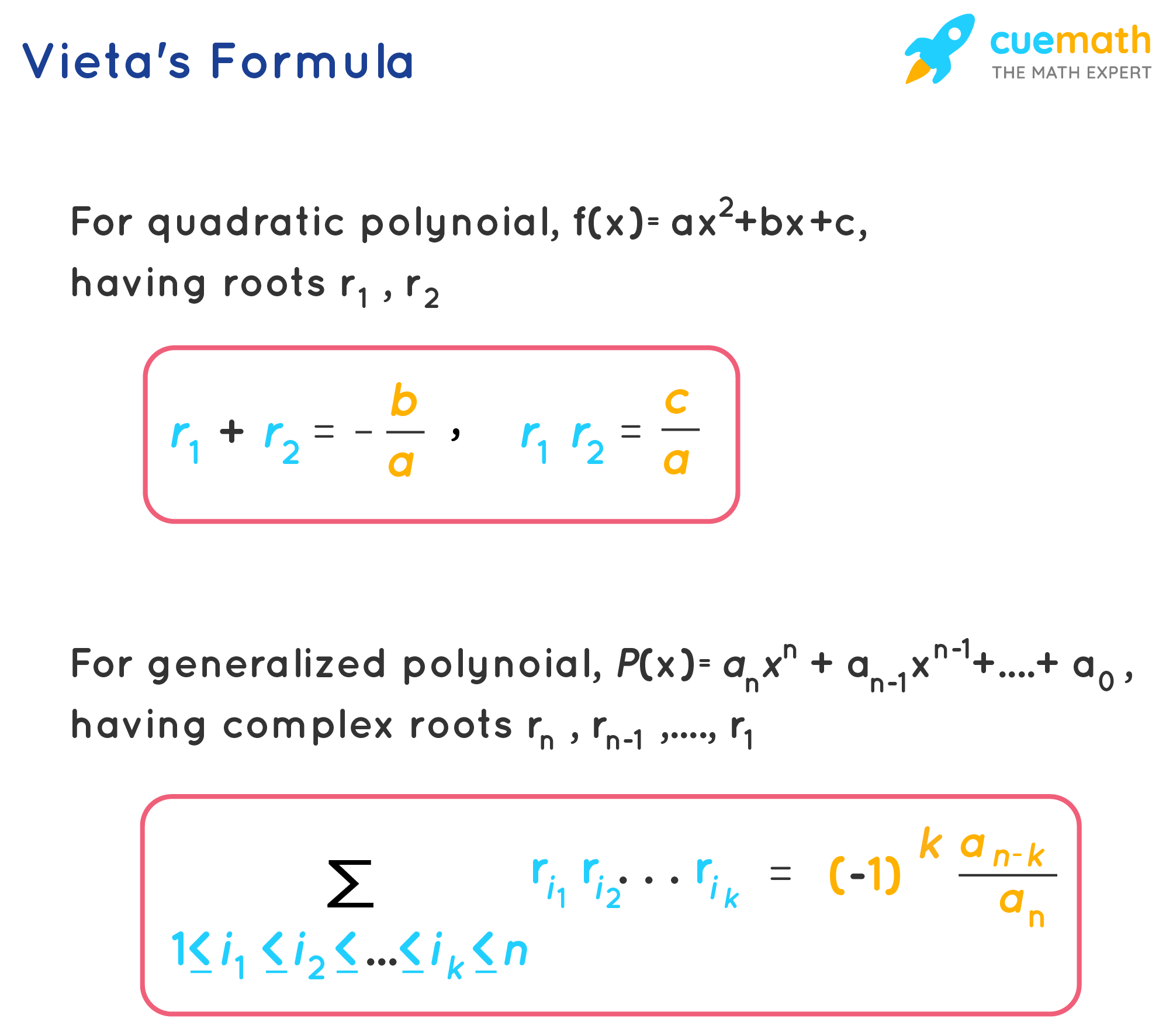
At its core, Vieta's formulas provide a direct relationship between the coefficients of a polynomial and the sums and products of its roots. For a general quadratic equation with roots and , the formulas are straightforward.
To get started, let's review these fundamental rules and see them in action.
This guide provides a concise introduction to Vieta's formulas and their direct application.
Please read the section titled Vieta's Formulas (Sum and Product of Roots). Focus on the two main formulas for the sum and product, and carefully follow the calculations in Solved Example 5. This example demonstrates how to compute various symmetric expressions using only the sum and product of the roots.
The image below gives a quick visual summary of the formulas for both quadratic and higher-degree polynomials. We'll explore the generalized version later in the lesson.
Working with Symmetric Functions of Roots
A function of the roots, like , is symmetric if its value remains unchanged when the roots are interchanged. For example, is symmetric because it's the same as . However, is not symmetric.
The key to solving these problems is to express the given symmetric function in terms of the elementary symmetric polynomials: and . You've already seen this in the previous reading with .
Let's watch a video that works through another common symmetric function, .
Vieta's Formulas - Mastering AMC 10/12
This video demonstrates how to use algebraic identities along with Vieta's formulas to find the value of a cubic symmetric function.
Watch the segment from the example problem. Pay close attention to how the identity for (R+S)^3 is used to isolate R^3+S^3 and how the values for the sum (R+S) and product (RS) are substituted to find the final answer.
This technique of using algebraic identities is fundamental. Here are the most common identities you'll need, which are also listed in the "JEE Prep Guide" resource you looked at earlier.
| Expression | Formula in terms of and |
|---|---|
| $ | \alpha - \beta |
Extending to Higher-Degree Polynomials
Vieta's formulas are not limited to quadratics. They can be generalized for any polynomial of degree . For a polynomial with roots , the formulas follow a distinct pattern:
- Sum of the roots (taken one at a time):
- Sum of the products of the roots (taken two at a time):
- Sum of the products of the roots (taken three at a time):
- ...
- Product of all roots:
The sign alternates, starting with a negative. Let's see how this pattern works for cubic and quartic equations.
Vieta's Formulas - Mastering AMC 10/12
The same video continues by explaining the generalization of Vieta's formulas to higher-degree polynomials, a concept frequently tested in JEE Advanced.
Watch from this section. The presenter first explains the general pattern for any polynomial, then applies it to a cubic and a quartic equation. Notice the alternating sign (-, +, -, + ...) applied to the coefficient ratios.
Now, let's see how these generalized formulas can be used with a clever identity to solve a problem that would otherwise be very difficult.
Vieta's Formulas - Mastering AMC 10/12
This final segment from the video solves for R^3+S^3+T^3 for a cubic equation.
Watch the problem explained from this timestamp. The crucial step is the use of the conditional identity: if R+S+T=0, then R^3+S^3+T^3 = 3RST. This is a powerful shortcut that comes directly from applying Vieta's formulas.
JEE Advanced Problem-Solving Patterns
In the JEE Advanced, you'll often encounter problems where the expression to be evaluated involves powers of roots in a sequence. A common and powerful technique is to use the fact that the roots themselves must satisfy the original equation.
Let's tackle a typical JEE Advanced problem.
Quadratic Equation JEE Advanced Previous Year Questions With ...
This document contains solved problems from past JEE Advanced papers. We will focus on the first question, which is a classic application of Vieta's formulas.
Read Question 1 and its solution. The problem defines a_n = \alpha^n – \beta^n for the roots \alpha, \beta of x^2-6x-2 = 0, and asks for the value of (a_{10}-2a_8)/2a_9. The key insight in the solution is using the fact that since \alpha is a root, it must satisfy the equation: \alpha^2 - 6\alpha - 2 = 0, which means \alpha^2 = 6\alpha + 2. The same applies to \beta. Pay close attention to how this substitution is used to simplify the expression from powers of 10 and 8 down to a power of 9, leading to a simple cancellation.
This method of creating a recurrence relation is extremely useful.
For a final challenge, it's valuable to see how Vieta's formulas can be integrated with other mathematical concepts, such as infinite geometric progressions. The following video discusses a problem of this type from a past JEE Advanced exam. You don't need to work through the entire problem now, but watching the setup will give you a sense of the level of integration you should aim for.
Toughest Question of JEE Advanced | Quadratic Equations | Arvind Kalia Sir
This video tackles a multi-concept JEE Advanced question. We'll focus on the part that combines Vieta's formulas with an infinite geometric progression (GP).
Watch the first part of the solution, from this segment. Observe how the summation is first split into two separate infinite GPs, one for \alpha and one for \beta. Then, see how the sum and product of the roots (\alpha+\beta and \alpha\beta) are substituted into the simplified expression derived from the GP formula. This shows how foundational concepts remain critical even in very complex problems.
Practice Problems
To solidify your understanding, try solving these problems from the provided resource. They cover different scenarios where Vieta's formulas are applicable.
Quadratic Equation JEE Advanced Previous Year Questions With ...
This is the same resource with solved PYQs.
Work through the following questions. Try to solve them on your own before reading the solution. Question 8: Deals with complex conjugate roots. Remember that if a quadratic with real coefficients has a complex root, its conjugate is also a root. Question 12: Combines Vieta's formulas with properties of Arithmetic Progressions (A.P.). Question 15: The roots are given as trigonometric values. You'll need to use the tan(A+B) formula.
Conclusion
In this lesson, you've learned how to apply Vieta's formulas to solve problems involving symmetric functions of roots, a cornerstone of polynomial theory for the JEE.
Key takeaways from our session:
- For a quadratic equation , the sum of roots and the product .
- Complex symmetric expressions can be evaluated by rewriting them in terms of and using algebraic identities.
- Vieta's formulas extend to higher-degree polynomials with a predictable, alternating sign pattern.
- A powerful problem-solving technique involves substituting the root back into the polynomial equation itself to simplify expressions, often creating a recurrence relation.
In the next lesson, we will move to a different aspect of quadratic equations: solving inequalities using the wavy curve method. This graphical technique is essential for determining the intervals where a polynomial or rational function is positive or negative.