Introduction
Welcome to the final lesson in our module on Quadratic Equations. We've built a strong foundation, moving from Vieta's formulas and inequalities to finding the range of rational functions. Today, we'll synthesize these skills to tackle one of the most important and frequently tested topics for JEE Advanced: solving problems with parametric quadratic equations.
Our goal is to determine the range of a parameter (like m or k) for which the roots of a quadratic equation satisfy specific conditions regarding their location on the number line. In previous lessons, we used the discriminant, , to understand the nature of the roots (real, imaginary, equal). Now, we'll combine discriminant analysis with other graphical properties to control the position of these roots. This is a powerful technique that relies on translating visual, graphical conditions into algebraic inequalities.
The Graphical Toolkit for Locating Roots
Consider the quadratic equation . The core of this topic is understanding the graph of the corresponding parabola. For consistency, we will always work with the assumption that the leading coefficient , meaning the parabola opens upwards. If you encounter a problem with , simply multiply the entire equation by -1 to make the leading coefficient positive (this does not change the roots).
The key features of the parabola that we will use are:
- The Discriminant (): Determines if the parabola intersects the x-axis () or not ().
- The Vertex's x-coordinate (): The axis of symmetry of the parabola.
- The Value of the function at a point (): Tells us if the point is above (), below (), or on () the x-axis.
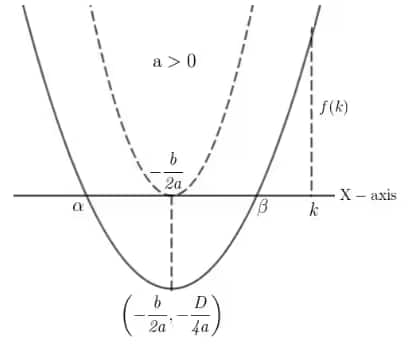
Let's break down the most common scenarios into a systematic set of conditions.
Scenario 1: Both Roots are Greater than a Number
For both roots, and , of to be greater than a number (with ), three conditions must be met simultaneously:
- : The roots must be real. (We use to include the case of equal roots).
- : The vertex (the midpoint of the roots) must be to the right of .
- : The value of the function at must be positive, ensuring is not between the roots.
The Unacademy notes on Quadratic Equations provide an excellent walkthrough of this case with a solved example.
[PDF] Quadratic Equations | Unacademy
These notes clearly break down the conditions for various root location scenarios. We will use it as a primary guide for the different "types" of problems.
Start at the heading Location of roots. Read through the explanation and conditions for Type-1, where both roots are greater than a specified number. Pay close attention to the solved example for this case and how all three conditions are applied and their results intersected to find the final range for the parameter.
Scenario 2: A Number Lies Between the Roots
This is a simpler but very important case. For a number to lie between the roots and (i.e., ), only one condition is needed (assuming ):
If the parabola opens upwards and its value is negative at , it must cross the x-axis on both sides of to go back up. This single condition cleverly implies that (two distinct real roots exist) and that they are on either side of .
[PDF] Quadratic Equations | Unacademy
Now, let's look at the next case in the same document.
In the "Quadratic Equations" notes, find Type–2, which covers the case where a number lies between the roots. Study the simple condition f(d) < 0 and the accompanying solved problem to see it in action.
Scenario 3: Both Roots Lie in an Interval
This is a combination of the logic from Scenario 1. For both roots to be between and (with ), we need to ensure the roots are real, the vertex is within the interval, and the function is positive at both and .
The following resource provides a clear example of this scenario.
[PDF] Quadratic Equations | Unacademy
Let's continue with the Unacademy notes.
Find Type-3 in the notes, which details the conditions when both roots are within an interval. Review the four conditions and the worked example.
Scenario 4: Exactly One Root Lies in an Interval
This is a classic JEE problem type with a subtle trap. The most straightforward condition is that the function values at the endpoints have opposite signs:
This means one endpoint is above the x-axis and one is below, guaranteeing the parabola crosses the axis exactly once between them.
The Trap: What if one of the roots is exactly or ? The condition does not account for this. A complete solution must also check the cases where or . If, for example, , you must then check if the other root lies within the interval .
The Unacademy notes handle this perfectly.
[PDF] Quadratic Equations | Unacademy
This is the final and most nuanced case we'll study from this document.
Find Types–5 in the notes, which addresses the condition for exactly one root in an interval. Notice how the solution is split into two parts: Case-I for f(d)f(e) < 0, and Case-II where the roots could be the endpoints themselves (f(d)=0 or f(e)=0). This comprehensive approach is crucial for JEE Advanced.
Practice Problems
Now, let's apply this framework to some JEE-level problems.
Problem 1: Find the number of integral values of m for which the quadratic expression (1 + 2m)x^2 – 2(1 + 3m)x + 4(1 + m) is always positive for all .
- Hint: For a quadratic to be always positive, the parabola must open upwards and never touch or cross the x-axis. What does this imply for the leading coefficient
aand the discriminantD? You can find a similar problem worked out in the Allen problem set.
This document contains a collection of past JEE Main questions.
Find Question 9 and its solution. The problem is this one. The solution can be found on page 4, under Ans. (2). Compare their steps to your logic.
Problem 2: Find the set of all integral values of c for which one root of the equation (c–5)x^2–2cx + (c–4) = 0 lies in the interval (0,2) and its other root lies in the interval (2,3).
- Hint: This means the number
2lies between the roots. Additionally, the roots are separated by the numbers0and3. What does this imply about the signs of , , and ? - Specifically,
0and2must contain one root, and2and3must contain the other. This translates to two conditions: and . Notice that the leading coefficient(c-5)is a parameter itself. You may need to consider cases for its sign, or you can find a way to combine the inequalities that makes the leading coefficient's sign irrelevant.
Solution to Problem 2
Let $f(x) = (c–5)x^2–2cx + (c–4)$. The problem states one root is in $(0,2)$ and the other is in $(2,3)$. This implies that the number 2 lies between the roots.Graphically, this means the parabola must cross the x-axis between 0 and 2, and again between 2 and 3.
This requires the function values at 0, 2, and 3 to have alternating signs.
Let's analyze the conditions:
f(0)f(2) < 0: Ensures exactly one root between 0 and 2.f(2)f(3) < 0: Ensures exactly one root between 2 and 3.
Let's calculate the values:
f(0) = c - 4f(2) = 4(c-5) - 4c + (c-4) = 4c - 20 - 4c + c - 4 = c - 24f(3) = 9(c-5) - 6c + (c-4) = 9c - 45 - 6c + c - 4 = 4c - 49
Now apply the conditions:
(c - 4)(c - 24) < 0=>(c - 24)(4c - 49) < 0. The roots are and . This inequality holds for .
We need the intersection of both conditions. The intersection of and is .
The integral values of c in this interval are {13, 14, 15, ..., 23}.
The number of elements is .
The solution is demonstrated in problem 4 of the Allen PDF.
Conclusion
Mastering the location of roots is the final piece of the puzzle for the chapter on quadratic equations. It is a topic that beautifully blends algebraic manipulation with graphical intuition.
Key Takeaways:
- Problems involving the location of roots of a parametric quadratic equation are solved by setting up a system of inequalities for the parameter.
- Always begin by ensuring the leading coefficient is positive ().
- The essential tools are the discriminant (), the vertex's x-coordinate (), and the function's value at the interval boundaries ().
- Be mindful of subtleties, especially the difference between strict inequalities (intervals like
(d,e)) and non-strict ones (intervals like[d,e]), and the special cases where a root might coincide with an interval boundary.
This concludes our intensive study of Quadratic Equations. In the next lesson, we will begin the second module of our course: Sequences and Series. We'll start with Arithmetic Progressions (AP), revisiting concepts you've seen before but with the depth and problem-solving focus required for the JEE Advanced.