Welcome back. In the previous lesson, John identified Jesus’ body—not the Jerusalem temple building—as the temple Jesus said would be raised in three days. The Lateran’s dedication feast then turns to 1 Corinthians 3, where Paul calls a community of believers God’s temple. This lesson traces his reasoning and distinguishes the people who worship from the church building that serves their worship.
Paul is addressing a divided community
Paul writes to Christians who have been aligning themselves with different teachers. He does not begin his building imagery by describing stone walls. He describes people whose faith is being cultivated: Paul planted, Apollos watered, and God gave the growth. Then he changes the image: “you are God’s field, God’s building.” The point is that the community belongs to God, not to the minister whom one group happens to favor.
Read the passage before following the image further. In 1 Corinthians 3:9, the feast’s reading begins with the words “you are God’s field, God’s building”; verses 5–8 supply useful context for them.
1 Corinthians, CHAPTER 3 | USCCB
Read 1 Corinthians 3 on the United States Conference of Catholic Bishops website to see how Paul's image of a building becomes an assertion about God's temple.
Under “The Role of God’s Ministers,” read verses 5–11, from ministers to foundation. Skim verses 12–15 to keep the sequence of thought, then read verses 16–17, from temple to holiness. Finally, at the footnotes below the chapter, find the note for 3:17 and read from the holiness note, stopping before its cross-references. Attend to who “you” refers to throughout.
Paul calls himself a builder, but not the owner of the building. He says that he laid a foundation and that others build upon it; the foundation is Jesus Christ (verse 11). That qualification matters. If a group treats its preferred teacher as the source of its identity, it mistakes a worker for the foundation. Paul’s building image instead gives the Corinthians a shared identity grounded in Christ.
“You” means the people together
English uses “you” for one person and for many people, so verse 16 can sound like an address to each reader in isolation: “you are the temple of God.” Here Paul is addressing the Corinthians together. His earlier “you are God’s building” names the community; “you are the temple of God” identifies what is holy about that community. The Spirit of God dwells in you, he says—not in an edifice under construction in Corinth, but among the people addressed by his letter.
This short video makes the plural “you” audible and distinguishes this passage from another place where Paul speaks about the body.
How are you God's temple? (1 Corinthians 3:16-17)
Watch “How are you God's temple? (1 Corinthians 3:16-17)” from The Word of the Lord Endures Forever for a concise explanation of Paul's communal address.
Watch the communal reading. Notice why the speaker renders “you” as “y’all,” then how he distinguishes 1 Corinthians 3 from Paul’s discussion of the individual body in 1 Corinthians 6.
The distinction does not mean that individual persons are unimportant, or that Paul never speaks of their bodies in relation to the Holy Spirit. It means that 1 Corinthians 3:16–17 is not primarily a statement about an individual’s body. Reading its “you” as communal preserves Paul’s concern here: what happens when members of one congregation divide against and damage one another?
Verse 17 gives that concern its weight: “If anyone destroys God’s temple, God will destroy that person.” Paul’s warning is severe because the community is holy—set apart as belonging to God, as the USCCB note explains. In context, his words are not chiefly a warning against damaging masonry. They warn against treating the people God is building as something one may tear apart.
The worshipping people and their place of worship
Calling the community God’s temple does not make a dedicated church building pointless. The Catechism of the Catholic Church holds both claims together: the faithful are “living stones” gathered into a spiritual house, and visible churches make the life of that community perceptible in a particular place. Read its account of who celebrates and where they gather.
Part Two Section One Chapter Two | USCCB
Read the Catechism's short passages on the celebrating assembly and the place of worship to connect Paul's language with the purpose of a visible church.
In “The celebrants of the sacramental liturgy,” read paragraphs 1140–1141, from the whole community. In “IV. Where Is the Liturgy Celebrated?”, read paragraphs 1179–1180: begin with the opening sentence about worship “in Spirit and in truth,” then follow people and place to the end of paragraph 1180. Finally, read the summary in paragraphs 1197–1199, from Christ and churches. Focus on what the people are and what the building makes visible.
This gives “temple” and “church” related but distinct uses. In Paul’s passage, the temple is the community in which God’s Spirit dwells, founded on Christ. A visible church is a place made for that community’s prayer and liturgy. It is not “simply” a convenient room, as the Catechism says: its very visibility expresses the Church gathered there. But its walls are not the people, and an impressive building cannot substitute for their life together.
The Lateran offers a concrete way to hold the distinction in view. In this photograph, people gather for an outdoor religious service in front of the basilica. The building remains Rome’s cathedral; the gathering illustrates why its significance cannot be reduced to its façade.
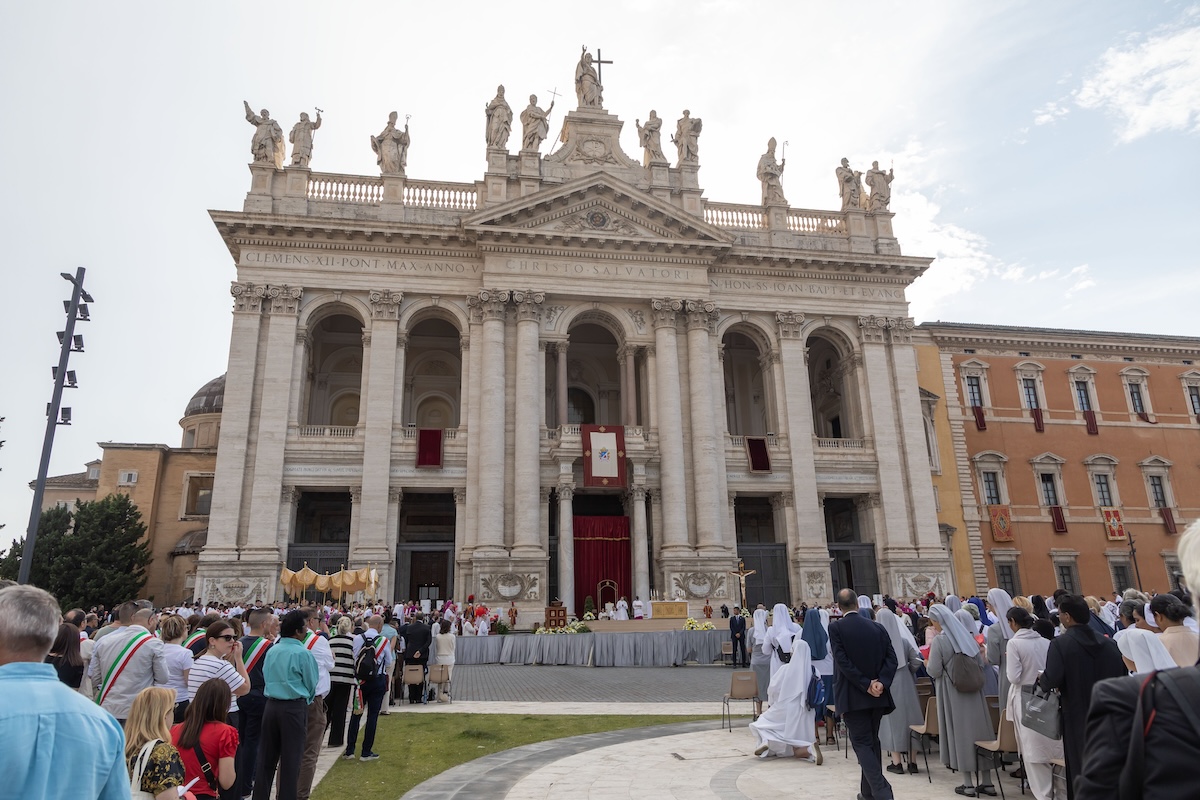
Paul is not assigning cathedral status to any gathering wherever it meets. The Lateran’s status as Rome’s cathedral belongs to its role as the church of the Bishop of Rome. His point addresses a different question: who is God building into a holy dwelling? In 1 Corinthians 3, his answer is the community, with Christ as its foundation and God’s Spirit dwelling in it.
Conclusion
Paul moves from “God’s building” to “God’s temple” to impress on a divided community its shared holiness. The “you” of 1 Corinthians 3:16–17 is communal; the foundation is Christ, and the Spirit dwells among the people. A dedicated church building gives that community a place to worship and makes its presence visible, but it does not replace the living community Paul describes.
The next lesson returns to the Lateran’s dedication feast as a celebration shared beyond Rome. It will consider why a cathedral with a particular place and history can serve as a sign of unity for Catholics worldwide.