Hello! Welcome to the first lesson in our course.
Given your familiarity with Agrippa's De Occulta Philosophia, you've already engaged with a rich, complex system of spiritual beings. Agrippa's work was a monumental attempt to synthesize classical, Neoplatonic, and Kabbalistic ideas, reclaiming a vision of intermediary spirits far more nuanced than the one that dominated medieval Christian thought.
To fully appreciate Agrippa's project and the intellectual traditions he drew upon, we must first go back to the source. This lesson will explore the very origins of the concept of the intermediary spirit in Western thought. Our goal is to define the Greek term 'daimon' and distinguish it from the later Christian 'demon.' We will investigate what the Greeks originally meant by daimon and then trace the historical and theological journey that transformed this morally neutral concept into a term for pure malevolence. This foundation will be crucial for understanding everything that follows in our study.
The Original Greek Daimon: A Neutral Intermediary
The modern English word "demon" carries an exclusively negative and frightening connotation. However, its Greek ancestor, daimon (δαίμων), was a much more complex and morally neutral term. To understand its original meaning, let's begin with its etymology and early philosophical role.
Please watch the first few minutes of the following video, which provides an excellent overview of the concept.
Origin of the Daimon: Birth of a Spirit Guide
This video, 'Origin of the Daimon', introduces the fundamental characteristics of the Greek daimon, including its etymological roots and its function as an intermediary spirit.
Please watch from the beginning until the 3:35 mark. Focus on the explanation of the word's origin and the description of the daimon's morally neutral role as an executor of divine will and fate.
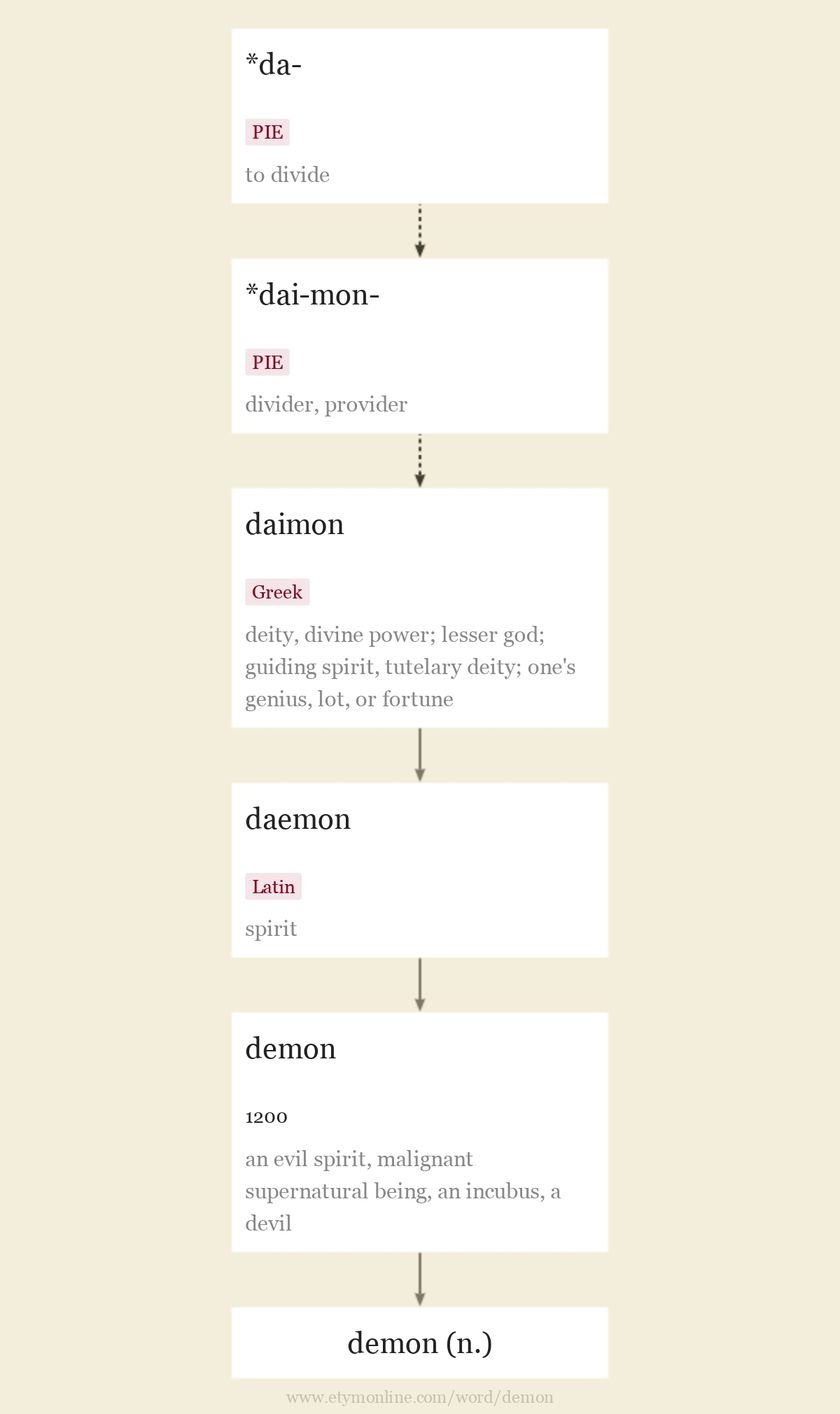
As the video explains, the term daimon is thought to derive from the Greek verb daiesthai, meaning "to divide" or "to distribute." This etymology is key: a daimon was originally seen as a distributor of destiny, an agent that allots to each person their share of fate, both good and bad.
This entity was not inherently evil. It was an intermediary, occupying the space between the mortal and divine realms. Its role was functional, not based on a moral alignment in the way we now think of "good" and "evil." Think of it as a force of nature or a cosmic functionary.
The following chart provides a powerful visual summary of the word's long journey and radical shift in meaning.
To further solidify this initial understanding, let's look at a brief textual analysis of the daimon's place in early Greek culture.
The Evolution of the Demon from Antiquity to Early Christianity
The following excerpt from the academic paper 'The Evolution of the Demon' discusses how the daimon was conceived by the foundational Greek poets, Homer and Hesiod.
Please read the subsection titled 'Magic, Religion, and the Daimon'. It begins on page 16. Pay close attention to how the term is used not always to name a specific being, but sometimes to describe a divine action or an occult power, and how Hesiod later defines them as the spirits of the men of the Golden Age.
In Homer, a daimon can be a vague, unseen divine power or even a synonym for a god (theos). In Hesiod, the daimones are more clearly defined as the benevolent spirits of the deceased men of the Golden Age, who now act as guardians for humanity. In neither case are they presented as intrinsically evil. They are simply part of the fabric of a cosmos filled with spiritual powers and presences.
Test your understanding!
Based on what you've learned, if an ancient Greek farmer's crops were suddenly ruined by a blight, would they necessarily conclude that an evil daimon was responsible? Explain your reasoning.
Show answer
Not necessarily. An ancient Greek would likely see it as the work of a daimon or a god, but without the automatic assumption of "evil." The action could be punishment for a forgotten offering, the impersonal execution of a difficult fate, or simply the work of a chthonic (earthly) spirit whose nature is harsh. The key is that the daimon was seen as a cause or agent, but its morality was ambiguous or neutral, unlike the purely malevolent "demon" of later thought.
The Transformation: From Daimon to 'Demon'
How did this neutral, intermediary spirit become the embodiment of evil? The transformation was not sudden but a gradual process of linguistic and theological reinterpretation driven by the rise of monotheism.
1. The Linguistic Shift in Translation
The first crucial step occurred when Jewish scholars in the 3rd to 1st centuries BCE translated the Hebrew Bible into Greek. This translation is known as the Septuagint.
The Evolution of Demons: The Theological Politics of Language
This essay, 'The Evolution of Demons: The Theological Politics of Language', provides a concise explanation of the first step in the daimon's 'demonization': translation.
Please read the section titled 'The Problem of Translation'. It clearly explains how the neutral Greek word 'daimon' was chosen to translate the negative Hebrew term 'shedim', beginning the association with evil.
As the reading explains, by using daimon to translate Hebrew terms for foreign idols and malevolent spirits (shedim), the Septuagint infused the Greek word with a negative connotation it did not originally have. This was a pivotal moment. The New Testament authors, writing in Greek and heavily influenced by the Septuagint, continued this usage. In the Gospels, daimonion (a related term) almost always refers to an "unclean spirit" that causes affliction and must be exorcised.
2. The Theological Solidification by Augustine
While the negative association grew over centuries, it was the 5th-century Christian theologian Augustine of Hippo who cemented the 'demon' in Western thought. His hugely influential work, De Civitate Dei (The City of God), provided the definitive theological framework that would dominate the Middle Ages and beyond.
The Evolution of the Demon from Antiquity to Early Christianity
Let's return to 'The Evolution of the Demon' to see how it frames Augustine's crucial contribution.
Please read the first half of the subsection 'The Daimon and Christianity' (pages 60-65), focusing on the paragraph that describes Augustine's argument in 'City of God'.
For Augustine, the complex spiritual hierarchy of the Neoplatonists (which you've seen traces of in Agrippa) was dangerously misguided. He flattened this hierarchy into a stark dualism: there is the City of God (inhabited by God, angels, and the faithful) and the City of Man (under the sway of the Devil and his demons). There is no middle ground. In this worldview, the pagan gods and the daimones that served as their intermediaries could only be one thing: fallen angels, malevolent liars who masqueraded as divinities to lead humanity astray.
To hear this argument in Augustine's own words, please watch the following short clip from an audio recording of City of God.
On Demons - St. Augustine's City of God (Book IX)
This excerpt from an audiobook of Augustine's 'City of God' reveals his reasoning for why the word 'demon' has an inescapably bad meaning, contrasting it with 'angel'.
Please watch the segment from 1:03:52 to 1:07:12. Augustine directly addresses the different connotations of 'demon' and 'angel' and links the nature of demons to knowledge without charity—that is, pride.
Augustine's argument was decisive. By declaring all pagan gods and intermediary spirits to be demons, he effectively closed the door on the classical and Neoplatonic understanding of the daimon. The neutral distributor of fate was now an enemy combatant in a cosmic war.
Conclusion
This lesson has laid a critical foundation for our course. We have traced the journey of a single, powerful word and the concept it represents.
Key Takeaways:
- The ancient Greek
daimonwas a morally neutral term for an intermediary spirit, a distributor of fate, a divine power, or a personal genius. It was not inherently evil. - The transformation into the purely malevolent
demonbegan with a linguistic choice: the use of daimon in the Septuagint to translate Hebrew terms for evil spirits and idols. - This negative association was adopted by New Testament writers and solidified by early Christian theologians, most influentially Augustine of Hippo. In his work The City of God, he redefined all pagan gods and their intermediaries as fallen angels, or demons, engaged in a war against God.
This process of "demonization" is essential to understanding the intellectual climate Agrippa and other Renaissance thinkers were working in. Their revival of Neoplatonic daimonology was a conscious effort to look past Augustine's dualism and recover a more ancient, complex, and philosophically rich view of the spirit world.
In our next lesson, we will delve deeper into the pre-philosophical world of the daimon by exploring its depiction in the foundational epics of Greek literature: Homer's Iliad and Odyssey. We will see how these stories established enduring models for the interaction between humans and these powerful, unpredictable spiritual forces.