Introduction
Welcome to the first lesson of our module on thermodynamics, a cornerstone of chemical engineering. In previous modules, we've explored chemical equilibrium, understanding what the final state of a reaction mixture is. Now, we begin to answer the more fundamental question of why reactions happen, why they release or consume energy, and what drives them toward equilibrium.
This lesson introduces the First Law of Thermodynamics. This is not a new concept to you from your physics studies, but we will approach it from the perspective of a chemist and chemical engineer. Our goal is to state the first law and use it to calculate changes in a system's internal energy (). This law is essentially a statement of the conservation of energy, a principle that governs everything from simple heat transfer to the complex energy balances in a chemical plant.
We'll begin by defining internal energy and the two ways it can change: through the transfer of heat () and work (). A significant part of our lesson will be dedicated to carefully defining the sign conventions for these terms, which can be a common point of confusion.
The First Law: An Accounting of Energy
The First Law of Thermodynamics is a universal principle stating that energy cannot be created or destroyed, only transferred or converted from one form to another.
To apply this, we must first define our terms. In thermodynamics, we divide the universe into two parts: the system (the part we are studying, like a chemical reaction in a beaker) and the surroundings (everything else). The first law can be expressed by stating that the total energy of the universe is constant.
The First Law of Thermodynamics - Internal Energy, Work ...
This first section from Chemistry LibreTexts formalizes the relationship between the system, the surroundings, and the universe.
Please read the brief introductory section, focusing on the two equations presented. Note how this relationship implies that any energy gained by the system must be lost by the surroundings, and vice-versa.
As you just read, this relationship is given by:
This means any change in the energy of our system () must be met by an equal and opposite change in the energy of the surroundings (). This is the bedrock of energy balance calculations in engineering.
Internal Energy, Heat, and Work
The energy contained within a system is called its internal energy, symbolized by . It is the sum of all the microscopic kinetic and potential energies of the molecules that make up the system. We are almost always interested in the change in internal energy, , rather than its absolute value.
A system's internal energy can change in only two ways:
- Heat (): Energy transferred due to a temperature difference between the system and its surroundings.
- Work (): Energy transferred when a force moves an object over a distance. In chemistry, this often involves the expansion or compression of a gas.
This leads us to the most common mathematical statement of the first law:
Here, is the change in the system's internal energy, is the net heat transferred to the system, and is the net work done on the system.
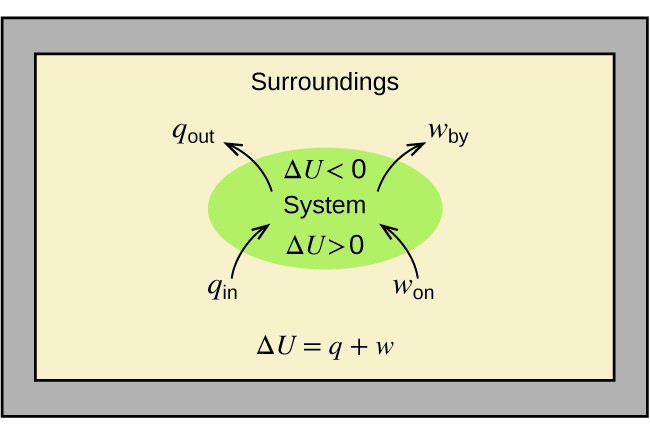
A crucial concept to grasp is that while depends only on the initial and final states of the system, the values of and depend on the specific path taken to get from one state to another. For this reason, is called a state function, while and are path functions.
Imagine traveling from a city at sea level to a mountain peak at 3000 m. Your change in elevation is fixed at +3000 m (a state function). However, the fuel you burn and the time it takes (analogous to work and heat) will be very different if you take a direct, steep road versus a long, winding one (path functions).
The Critical Importance of Sign Conventions
To use the equation correctly, we must be rigorous with our signs. The convention used in chemistry and adopted by IUPAC is defined from the system's point of view.
The following video provides an excellent and thorough explanation.
First Law of Thermodynamics, Basic Introduction - Internal Energy, Heat and Work - Chemistry
This video from The Organic Chemistry Tutor clearly explains the sign conventions for heat and work in chemistry.
Please watch the segment from the introduction of the equation to the end of the sign convention summary. Pay close attention to the distinction made between the chemistry and physics conventions, and the reasoning behind them based on the system's perspective.
To summarize the key rules for the chemistry convention ():
-
Heat ():
- : Heat flows into the system (an endothermic process). The system's energy increases.
- : Heat flows out of the system (an exothermic process). The system's energy decreases.
-
Work ():
- : Work is done on the system (e.g., a gas is compressed). The system's energy increases.
- : Work is done by the system (e.g., a gas expands, pushing a piston). The system's energy decreases.
A Note on Different Conventions
Your past engineering studies might have used a different form of the first law, . This is not a contradiction; it's simply a different definition of work.
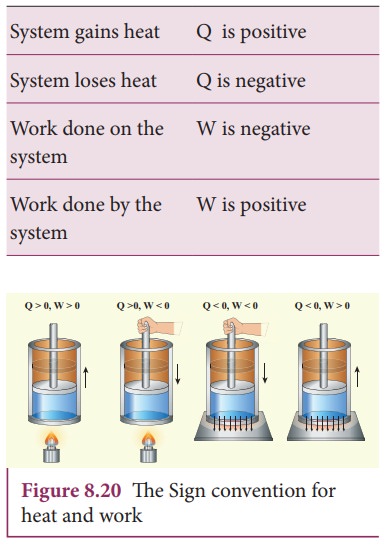
The image above illustrates the convention where work done by the system is positive because it's the desired output of a heat engine. In that context, in the equation represents work done by the system.
In our course, we will consistently use the chemistry convention:
where is the work done on the system. This is the standard in modern chemical engineering. Recognizing this distinction is key to correctly interpreting equations from different fields.
The following short video was created specifically to address this common point of confusion.
Physics: Viewer's Request: Thermodynamics #3: Why Do We Use (delta)U=Q-W and (delta)U=Q+W ?
This video directly explains why both forms of the equation exist.
Watch the full video from the beginning. The speaker clearly articulates that the difference is entirely based on whether 'W' is defined as work done by the gas or work done on the gas.
Calculating Change in Internal Energy: An Example
Let's apply these concepts to a problem.
The First Law of Thermodynamics - Internal Energy, Work ...
This text provides a formal definition of the first law equation and a worked example of its application.
First, read the paragraph that formally introduces the equation \Delta U_{sys} = q + w. Then, carefully study Example \PageIndex{1}. Focus on how the signs for q and w are determined from the problem description.
Let's break down the logic from the example you just read:
Problem: A sample of gas in a cylinder is compressed, and during this process, 140 J of energy is transferred from the gas to the surroundings as heat. The work done on the gas is 284 J. What is the total change in the internal energy () of the gas?
-
Analyze Heat (): "140 J of energy is transferred from the gas to the surroundings". Since energy is leaving the system, is negative.
-
Analyze Work (): "The gas is compressed". Compression means work is being done on the system. Therefore, is positive. We are given the value.
(In the next lesson, we will learn to calculate this value from pressure and volume changes.) -
Apply the First Law:
The internal energy of the gas increased by 144 J. Even though the system lost energy as heat, the larger amount of energy it gained from the work being done on it resulted in a net increase in its internal energy.
Conclusion
In this lesson, we have established the foundation for our study of thermodynamics. We've defined the First Law of Thermodynamics as a statement of energy conservation and expressed it with the central equation .
Key Takeaways:
- First Law of Thermodynamics: The energy of the universe is constant. For a system, any change in its internal energy () comes from exchanges of heat () or work () with the surroundings.
- The Equation: is the mathematical statement of the first law.
- Sign Convention is Key: We use the standard chemistry/IUPAC convention where energy entering the system is positive.
- Heat absorbed by the system: .
- Work done on the system: .
- State vs. Path Functions: Internal energy () is a state function, meaning is independent of the path taken. Heat () and work () are path functions; their values depend on the specific process.
In our next lesson, we will focus specifically on work. We will derive and apply the formulas for calculating the work of expansion or compression for an ideal gas, a critical calculation for analyzing engines, pumps, and reactors in chemical engineering.