Introduction
Welcome to a new module focused on the states of matter. Having spent the last several lessons on "chemical accounting"—learning to quantify substances in reactions and solutions—we will now shift our perspective. Instead of just counting molecules, we'll begin to explore how they behave, starting with gases. The empirical gas laws, which you may have encountered before, describe macroscopic properties like pressure and volume. But why do gases follow these laws?
This lesson addresses that fundamental question. We will delve into the Kinetic Molecular Theory (KMT), a powerful microscopic model that explains the observable behavior of gases. By the end of our session, you will be able to describe the core principles of this theory and use them to explain the properties of gases, providing the theoretical foundation for the gas laws we will explore next. This aligns perfectly with your goal to understand not just the "how" but also the "why" behind chemical principles.
The Postulates of the Kinetic Molecular Theory
At its heart, the Kinetic Molecular Theory is a set of simple assumptions about the nature of gas particles (atoms or molecules). These assumptions, or postulates, build a mental model of an "ideal gas" that allows us to understand its behavior from the ground up.
The video below from the "Professor Dave Explains" channel provides a concise and clear introduction to these five core ideas.
Kinetic Molecular Theory and its Postulates
This video breaks down the five postulates of the Kinetic Molecular Theory in an easy-to-digest, animated format. It sets the stage for understanding how these microscopic assumptions lead to macroscopic observations.
Please watch from the beginning to the end of the fifth postulate. As you watch, focus on creating a mental picture for each of the five key assumptions about gas particles.
To solidify these concepts, here are the five postulates of the Kinetic Molecular Theory:

- Constant, Random Motion: Gas particles are in continuous, rapid, and random motion, traveling in straight lines until they collide with other particles or the container walls.
- Negligible Volume: The volume of the individual gas particles is considered zero compared to the total volume of the container. Essentially, a gas is mostly empty space.
- Pressure from Collisions: The pressure exerted by a gas is the result of countless collisions between the gas particles and the walls of their container.
- No Intermolecular Forces: Gas particles are assumed to exert no attractive or repulsive forces on one another. Their collisions are "perfectly elastic," meaning no kinetic energy is lost during a collision.
- Kinetic Energy and Temperature: The average kinetic energy of the gas particles is directly proportional to the absolute temperature of the gas (measured in Kelvin). This is a crucial link: on a microscopic level, temperature is a measure of the average motion energy of the particles.
Your background in systems engineering involves creating models to predict behavior. KMT is a classic example of this in the physical sciences—a simplified model whose predictive power for gas behavior is remarkable.
Explaining Gas Properties with KMT
The true power of this theory is its ability to explain the relationships between pressure (P), volume (V), temperature (T), and the amount of gas (n), which are known as the gas laws.
Let's return to the "Professor Dave Explains" video to see how the postulates logically lead to these laws.
Kinetic Molecular Theory and its Postulates
This segment of the video demonstrates how the postulates you just learned provide a solid "why" for the empirical gas laws discovered through experiments.
Now, watch the remainder of the video, from where you left off to the end. Pay close attention to how he connects the microscopic behavior of particles to the macroscopic relationships of Boyle's Law, Charles's Law, and Amontons's Law.
To reinforce these connections, the following text provides a slightly more detailed explanation.
8.5 The Kinetic-Molecular Theory – Chemistry in Everyday Life
This reading from "Chemistry in Everyday Life" methodically walks through how KMT accounts for the major gas laws, including two not covered in the video (Avogadro's and Dalton's).
Please read the two sections under the heading "The Kinetic-Molecular Theory Explains the Behavior of Gases, Part I". The text starts with Boyle's law and continues into the next short section explaining Avogadro's and Dalton's laws.
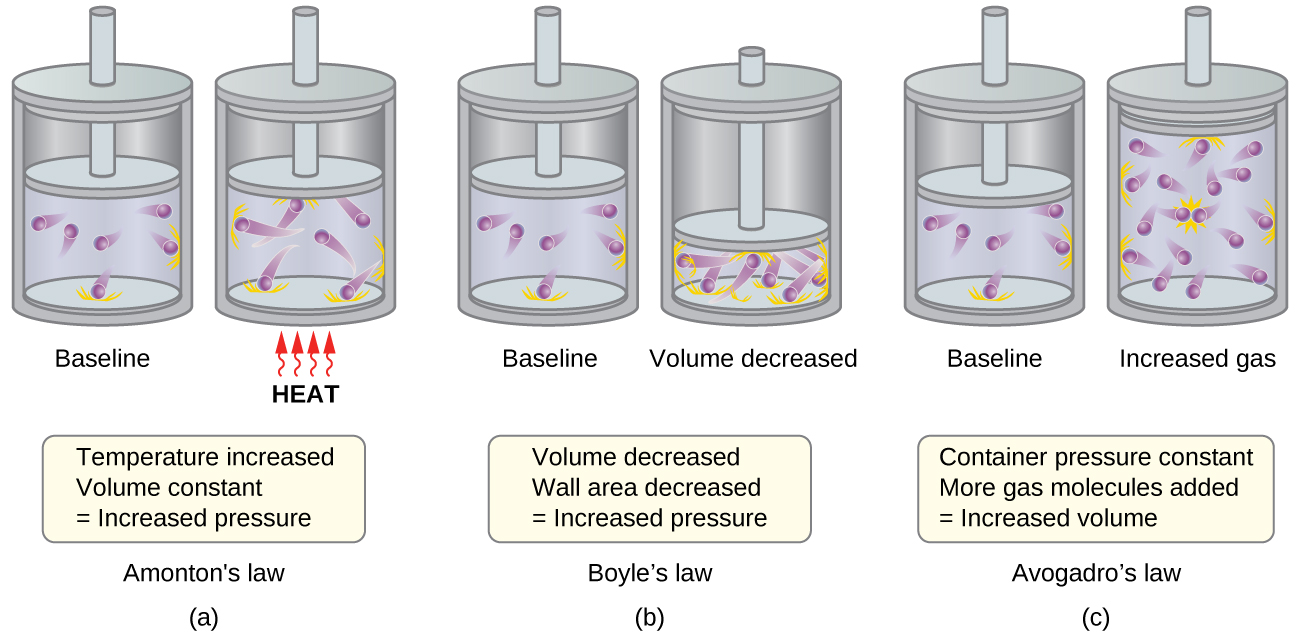
Let's visualize these relationships. The image below shows three common gas laws interpreted through the lens of KMT.
A Deeper Look: Temperature and Molecular Speed
The fifth postulate—that average kinetic energy is proportional to temperature—is the most quantitative part of the theory. From your physics and math background, you know that the kinetic energy of a single particle is given by , where m is mass and u is speed.
Since temperature reflects the average kinetic energy, it implies a connection between temperature and the average speed of the gas molecules. However, in any gas sample, there's a statistical distribution of speeds—some molecules move very fast, some move slowly, and most are somewhere in the middle. The video below explains how we derive a representative speed for gas molecules, called the root-mean-square (RMS) speed, and how to calculate it.
21 - Kinetic Molecular Theory of Gases Explained (Chemistry & Physics), Part 1
This "Math and Science" video delves into the relationship between temperature, kinetic energy, and molecular speed, culminating in a practical formula for calculating the RMS speed. The presenter's approach is great for understanding the logic without getting lost in complex mathematical proofs.
First, watch the segment on kinetic energy and temperature to reinforce this central idea. Then, jump to the section on RMS speed. Pay close attention to two critical points: The final, practical equation: u_{rms} = \sqrt{\frac{3RT}{M}}. The specific units required for this equation: the gas constant R must be 8.314 J/(mol·K), and the molar mass M must be in kilograms per mole (kg/mol). This is a common pitfall, as molar mass is usually given in g/mol.
This equation beautifully connects the microscopic world to the macroscopic:
- is a microscopic property (the typical speed of a single molecule).
- T and M are macroscopic properties (the temperature of the bulk gas and its molar mass).
The equation shows that at a given temperature, lighter gas molecules (smaller M) move faster than heavier gas molecules. This makes intuitive sense: if two particles have the same kinetic energy, the less massive one must be moving faster.
Conclusion
In this lesson, we have moved beyond simple observation to build a theoretical model that explains why gases behave as they do. You've learned that the simple assumptions of the Kinetic Molecular Theory—treating gases as collections of tiny, non-interacting particles in constant, random motion—provide a powerful framework for understanding gas properties.
Key Takeaways:
- The Kinetic Molecular Theory (KMT) is a microscopic model based on five main postulates that describes the behavior of an ideal gas.
- Macroscopic properties like pressure and temperature are manifestations of microscopic events: pressure from particle collisions with walls, and temperature as a measure of the average kinetic energy of the particles.
- The empirical gas laws (Boyle's, Charles's, etc.) can be logically derived from the postulates of KMT.
- The root-mean-square (RMS) speed () provides a way to quantify the typical speed of gas molecules and shows that molecular speed increases with temperature and decreases with molar mass.
Now that we have established the theoretical underpinnings of gas behavior, our next lesson will introduce the Ideal Gas Law (). This single, elegant equation synthesizes the individual gas laws and will become one of the most important tools in your chemical engineering toolkit.