Introduction
Welcome to the next step in our exploration of gases. In previous lessons, we built a strong foundation using the Ideal Gas Law () and Dalton's Law to describe the behavior of pure gases and their mixtures. These laws are powerful, but they operate on a set of simplifying assumptions—that gas particles have no volume and exert no forces on one another. As you might suspect, the real world is a bit more complicated.
This lesson directly addresses that complexity. Our goal is to explain the conditions under which real gases deviate from this ideal behavior. We will explore why these deviations occur by examining the two key assumptions of the ideal gas model that break down in reality. Finally, we'll introduce the van der Waals equation, a more sophisticated model that provides a quantitative description of real gases, a crucial tool for an engineer who needs accurate predictions for real-world systems.
The Limits of Idealism
The ideal gas model provides an excellent approximation of gas behavior under many common conditions. However, its assumptions begin to fail under two specific circumstances: high pressure and low temperature.
Why? Let's revisit the core assumptions of an ideal gas and see how they compare to a real gas.

As the chart shows, the two critical differences are:
- Molecular Volume: Real gas particles (atoms and molecules) occupy a finite, physical volume. In contrast, ideal gas particles are treated as point masses with zero volume.
- Intermolecular Forces: Real gas particles exert attractive forces on each other (you may recall these from our module on bonding as London dispersion forces, dipole-dipole forces, etc.). Ideal gas particles are assumed to have no interactions whatsoever.
Under conditions of low pressure, gas particles are far apart. The volume of the particles themselves is negligible compared to the total volume of the container, and the distance between them is too large for intermolecular forces to have any significant effect. Similarly, at high temperature, particles have high kinetic energy, easily overcoming any weak attractive forces.
However, when you increase the pressure, you force the particles closer together. The volume they occupy is no longer negligible compared to the container's volume. And when you decrease the temperature, their kinetic energy drops, making them more susceptible to the effects of intermolecular attractions. It is under these conditions—high pressure and low temperature—that real gases deviate significantly from ideal behavior.
Visualizing Deviation: The Compressibility Factor
To quantify and visualize this deviation, we use a value called the compressibility factor (Z). It's defined as the ratio:
For a mole of an ideal gas, should always equal 1, regardless of the pressure. Therefore, a plot of Z versus pressure for an ideal gas would be a straight horizontal line at Z = 1. For real gases, this is not the case.
The following video provides an excellent graphical explanation of how real gases deviate from this ideal line.
10.4 Real Gases & the Van der Waals Equation | General Chemistry
This video from Chad's Prep clearly illustrates how the compressibility factor plot reveals the behavior of real gases.
Please watch the first section of the video, from the introduction of the graph. Pay close attention to the explanation for why the curves for real gases dip below the ideal line at moderate pressures and rise above it at very high pressures.
As the video explained, the shape of the Z vs. P curve is a result of the competition between the two non-ideal effects:
- Attractive Forces (Dominant at moderate pressures): When particles are brought closer, attractive forces pull them together. This reduces the force of their collisions with the container walls, leading to a lower pressure than an ideal gas would have. This causes Z to dip below 1.
- Molecular Volume (Dominant at high pressures): At very high pressures, particles are crowded so tightly that repulsive forces from their own volume become dominant. This "excluded volume" effect means the pressure is higher than an ideal gas would have under the same compression. This causes Z to rise above 1.
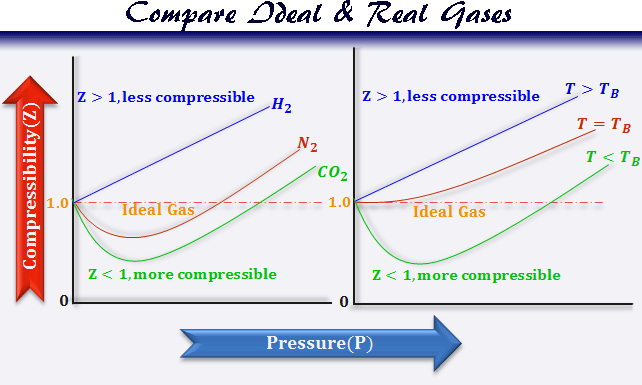
The graphs above further illustrate this:
- Left panel: Notice that gases with stronger intermolecular forces and larger molecules (like CO₂) deviate much more significantly than simpler ones like hydrogen (H₂).
- Right panel: As temperature increases, the gas behaves more ideally (the curve flattens out closer to Z=1). This is because the higher kinetic energy allows the molecules to overcome the attractive forces more easily.
Modeling Reality: The Van der Waals Equation
Explaining the deviation is one thing; predicting it is another. Your engineering background in systems and data analysis involves creating models to describe real-world phenomena. In 1873, Johannes van der Waals proposed a modification to the ideal gas law to do just that for real gases.
The van der Waals equation adjusts the pressure and volume terms of the ideal gas law to account for intermolecular forces and molecular volume. The following article breaks down the construction of this equation beautifully.
Van der Waals equation (gas law for real gases) | tec-science
This article from tec-science methodically builds the van der Waals equation by introducing each correction term separately.
First, read the section Taking into account the attractive force. This explains the pressure correction term, \frac{an^2}{V^2}. Next, read the section Taking into account the volume. This explains the volume correction term, nb. Finally, read the section Van der Waals equation to see how these two corrections are integrated into the final equation.
To summarize, the van der Waals equation is:
Here:
- The term adds back the pressure that is "lost" due to intermolecular attractions. The constant a is a measure of the strength of these attractions.
- The term subtracts the volume occupied by the gas particles from the total container volume. The constant b is related to the size of the gas particles.
The constants a and b are empirically determined for each gas. A gas with small values for a and b will behave more like an ideal gas.
A Practical Example: Engineering Safety
This might seem like a purely academic correction, but for an engineer, the difference can have serious consequences. Let's consider a practical scenario involving the storage of compressed gas.
10.9: Real Gases - Deviations from Ideal Behavior
This example from Chemistry LibreTexts demonstrates the importance of using the correct gas law for a real-world safety calculation.
Please read Example \PageIndex{1}, starting from the problem description the strategy and solution. Compare the pressure calculated by the ideal gas law versus the van der Waals equation.
As you saw, the ideal gas law predicted a pressure of 43.1 atm, which exceeds the cylinder's rupture pressure of 40 atm. Based on this, you would have to reject the design. However, the van der Waals equation, which more accurately accounts for the attractive forces in chlorine gas, predicts a pressure of only 28.2 atm—well within the safety limit. In a real industrial setting, using the wrong model could lead to unnecessarily expensive decisions or, in the other direction, catastrophic failure.
Extreme Deviation: Liquefaction
The most extreme deviation from ideal behavior is liquefaction, the condensation of a gas into a liquid. This occurs when a gas is cooled and compressed to the point where intermolecular forces are strong enough to overcome the kinetic energy of the molecules, causing them to clump together. The ideal gas law, which ignores these forces, cannot predict this phenomenon at all. The van der Waals equation, however, is able to model this phase transition. The ease with which a gas can be liquefied is related to its van der Waals constant a—gases with large a values (strong attractions) liquefy more easily. This process is fundamental to chemical engineering, used for storing fuels like Liquefied Natural Gas (LNG) and for separating gases from the air.
Conclusion
Today we've moved beyond the idealized world of perfect gases to understand how real gases behave. We've established that the simple models break down under specific conditions and explored the physical reasons for this.
Key Takeaways:
- Real gases deviate from ideal behavior at high pressure and low temperature.
- These deviations are caused by two factors ignored by the ideal gas law: the finite volume of gas particles and the intermolecular attractive forces between them.
- The compressibility factor (Z) quantifies this deviation. The shape of a Z vs. P plot reveals the interplay between attractive forces (causing ) and molecular volume (causing ).
- The van der Waals equation is a more accurate model for real gases, introducing correction terms for both molecular volume () and intermolecular forces ().
- Understanding these principles is essential for accurate and safe engineering design, especially in high-pressure applications.
In this lesson, we discussed the transition from a gas to a liquid. In our next session, we will formalize this by learning how to read phase diagrams, which are graphical maps that show the conditions of temperature and pressure under which a substance exists as a solid, liquid, or gas.