Introduction
In our previous lesson, we explored the integrated rate laws, which connect reactant concentration to time through equations derived from calculus. This allowed us to predict how much of a substance remains after a certain period. Building directly on that foundation, this lesson introduces a highly practical and intuitive concept in chemical kinetics: the half-life of a reaction, denoted as .
The half-life is the time required for the concentration of a reactant to decrease to half of its initial value. It's a fundamental metric used in fields ranging from nuclear chemistry (describing radioactive decay) to pharmacology (determining drug dosage intervals), aligning with your goal of creating substances that impact human health. We will derive the half-life equations for zero-, first-, and second-order reactions directly from the integrated rate laws you've already mastered and then apply these new tools to solve quantitative problems.
What is Half-Life?
At its core, the concept is simple. If you start with 100 grams of a substance, its half-life is the time it takes for only 50 grams to remain. For a chemical reaction, it's the time until the reactant's concentration is halved.
Let's formalize this. The half-life, , is the time at which the concentration at that time, , is equal to exactly half of the initial concentration, .
This simple condition is the key to deriving the specific half-life formula for each reaction order. The following video provides excellent step-by-step derivations for each one, starting from the integrated rate laws we covered last time. As you watch, notice how this one substitution unlocks each formula.
Integrated Rate Law and Half-Life (AP Chemistry)
This video, "Integrated Rate Law and Half-Life" from Siebert Science, clearly demonstrates how to derive the half-life expressions for zero-, first-, and second-order reactions.
Watch the derivation for a zeroth-order reaction, followed by the derivation for a first-order reaction. Finally, observe the process for a second-order reaction. Focus on the two key steps in each derivation: substituting \frac{1}{2}[A]_0 for [A]_t and then algebraically solving for t.
The Half-Life Equations and Their Dependencies
As you saw in the video, the derivations yield a unique equation for each reaction order. These are essential tools for a chemical engineer.
- Zero-Order:
- First-Order:
- Second-Order:
The most significant difference between these equations is their dependence on the initial concentration, . This dependence provides a powerful diagnostic tool for determining reaction order from experimental data.
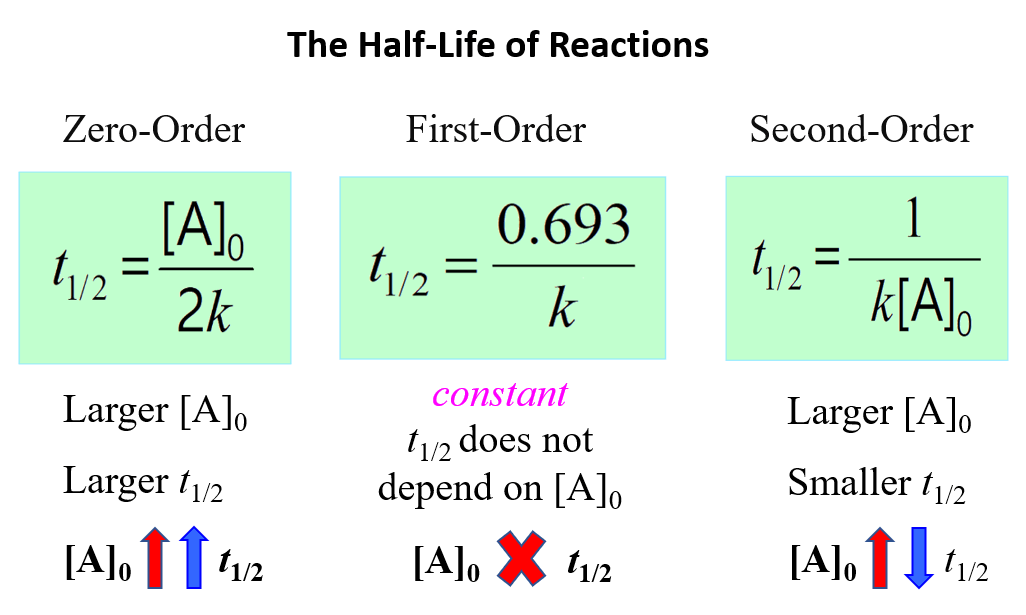
Let's break down the relationships shown in the image:
- Zero-Order: The half-life is directly proportional to the initial concentration. If you start with more reactant, it takes longer for half of it to react. Each successive half-life is shorter than the previous one because the "initial" concentration for that interval is lower.
- First-Order: The half-life is constant and independent of the initial concentration. This is a unique and defining characteristic. Whether you start with 10 M or 0.1 M, the time it takes for the concentration to halve is the same. This is why first-order processes like radioactive decay are described by a constant half-life (e.g., the half-life of Carbon-14 is ~5730 years, regardless of how much you start with).
- Second-Order: The half-life is inversely proportional to the initial concentration. If you start with a higher concentration, the reaction proceeds faster, and the half-life is shorter. Each successive half-life is longer than the previous one.
The following video segment reinforces these crucial conceptual differences with a helpful multiple-choice question.
Integrated Rate Laws - Zero, First, & Second Order Reactions - Chemical Kinetics
This segment from The Organic Chemistry Tutor's video, which we used in the last lesson, provides an excellent conceptual check on the properties of half-life for each reaction order.
Watch the walk-through of the multiple-choice question starting from this point. Pay close attention to the reasoning for why each statement about the half-lives of different orders is true or false.
Applying Half-Life Calculations
Now that you understand the theory, let's put it into practice. Solving problems involving half-life often involves one of two main tasks: calculating the half-life itself, or using half-life information to find other parameters like the rate constant or reaction order.
The following document presents a series of worked problems. Your background in data analysis and strategy will be useful here, as choosing the correct equation and problem-solving path is key.
Unit 12: Chemical Kinetics Half Lives
This worksheet from ChemistryTalk.org provides several clear, practical examples of half-life calculations.
First, examine Problem 7 on page 4. This problem asks you to determine the reaction order when given the initial concentration, rate constant, and half-life. Notice the strategy: plug the given values into each of the three half-life equations to see which one holds true. Next, look at Problem 6 on page 3. This problem shows how to calculate the half-life when you are not given the rate constant directly. The solution first uses the integrated rate law from our previous lesson to find k, and then uses k to find the half-life. This is a common two-step process. Finally, consider the Challenge Question (Problem 8) on page 4. This problem requires you to find the half-life of a first-order reaction using only initial and final concentrations over a set time. The solution involves conceptually determining how many half-lives have passed. This demonstrates a deep understanding of what half-life represents, especially for first-order reactions where it's constant.
Conclusion
In this lesson, we defined the concept of half-life and derived the specific equations for zero-, first-, and second-order reactions. By understanding how to calculate and how it depends on initial conditions, you have gained another powerful tool for analyzing and predicting the behavior of chemical reactions.
Key Takeaways:
- The half-life () is the time it takes for a reactant's concentration to fall to half its initial value.
- The half-life equation is unique for each reaction order:
- Zero-Order: (depends directly on )
- First-Order: (is constant, independent of )
- Second-Order: (depends inversely on )
- This dependence on initial concentration is a key characteristic that can be used to experimentally determine the order of a reaction.
So far in our study of kinetics, we've treated the rate constant, k, as a fixed value for a given reaction. However, k is highly dependent on temperature. In our next lesson, we will explore this relationship using the Arrhenius equation. This will introduce the critical concept of activation energy, the minimum energy required for a reaction to occur, and complete our foundational model of reaction rates.