Introduction
Welcome to a new module! In our study of thermochemistry, we focused on the energy states of reactants and products, essentially looking at the "before" and "after" of a chemical reaction. Now, we shift our focus to the journey itself: how fast do these changes happen? This question is the domain of chemical kinetics, and to answer it, we need a powerful mathematical language—the language of differential equations.
This module will equip you with the foundational skills to use this language. Your previous studies in Calculus 2 likely introduced you to some of these concepts, but we will build them from the ground up to ensure a solid foundation. Today's lesson is the first and most crucial step: learning the vocabulary. We will focus on how to identify and classify ordinary differential equations (ODEs) based on their order and linearity. This classification is not just academic; it's the diagnostic step that tells us which mathematical tools to use to solve the equation, much like identifying a problem is the first step to designing a solution in engineering.
What is a Differential Equation?
At its core, a differential equation is an equation that relates a function to its derivatives. Instead of solving for a number (like in algebra), we solve for an entire function that describes how a quantity changes. Many fundamental laws of nature and engineering are expressed as differential equations because they describe change.
Let's begin with a formal introduction from an engineering-focused text.
Differential Equations for Engineers - Math.HKUST
This excerpt from a textbook by the HKUST Math Department will introduce you to the core concept of a differential equation and its various classifications.
Please read the first three paragraphs of Lecture 1, from the initial definition down to the discussion of the pendulum equation. Pay attention to the real-world examples (RLC circuit, pendulum) and the initial definitions of order, linearity, and the distinction between ordinary and partial differential equations.
As you just read, we can categorize differential equations in several ways. The first and most fundamental distinction is between ordinary and partial differential equations.
- An Ordinary Differential Equation (ODE) involves a function of only one independent variable (like time, ) and its derivatives. For example, the rate of change of a chemical concentration over time.
- A Partial Differential Equation (PDE) involves a function of two or more independent variables (like time and spatial position) and its partial derivatives. For example, how temperature changes throughout a metal bar over time.
In this course, we will focus almost exclusively on ODEs, as they are the starting point for modeling most systems in chemical engineering, from reaction rates to fluid flow in a pipe.
Classification 1: Order
The first way we classify an ODE is by its order. This is a straightforward concept: the order of a differential equation is simply the order of the highest derivative that appears in the equation.
For a clear explanation and examples, the following video is very helpful.
Differential Equations - 5 - Classification
This video from the channel The Lazy Engineer provides a concise explanation of what the order of an ODE means.
Watch the segment from the discussion of order. The presenter clearly illustrates first, second, and third-order equations.
So, to summarize:
- is a first-order ODE.
- is a second-order ODE.
- is a third-order ODE.
It's important not to confuse order with degree. The degree is the exponent of the highest-order derivative. While related, the order is the more fundamental classification that dictates the solution method.
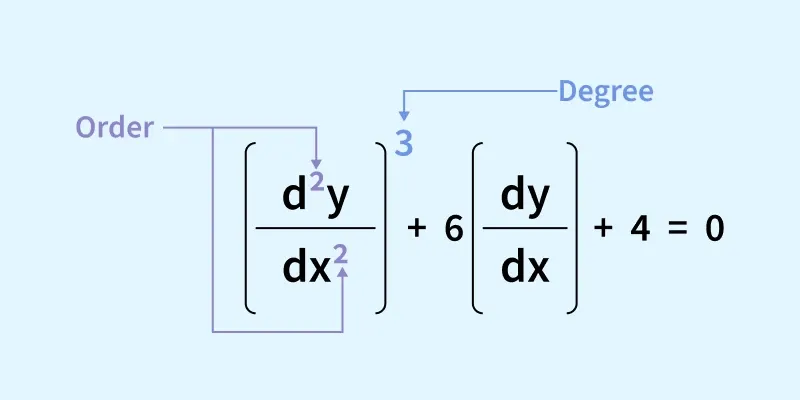
This image distinguishes between the order (the highest derivative, d²y/dx²) and the degree (the power to which that highest derivative is raised, 3) for the equation (d²y/dx²)³ + 6(dy/dx) + 4 = 0. This is a second-order, third-degree ODE.
For the vast majority of introductory applications, the degree will be 1. Our primary focus will always be on the order.
Classification 2: Linearity
The second, and more nuanced, classification is linearity. This property dramatically affects an equation's difficulty and how we solve it. An ODE is linear if the dependent variable (let's call it ) and all of its derivatives () appear in a "simple" way.
Specifically, for an equation to be linear, it must satisfy these conditions:
- The dependent variable and all its derivatives are raised only to the first power.
- The coefficients of and its derivatives are functions of the independent variable only (e.g., functions of or constants), not of .
- There are no other functions of the dependent variable, such as , , or .
If an equation violates even one of these conditions, it is non-linear.
Let's watch a detailed walkthrough of this concept.
Differential Equations - 5 - Classification
Returning to The Lazy Engineer's video, this next part provides a robust definition of linearity and then applies it to several examples, which is the best way to internalize the rules.
Watch from the section on linearity. First, focus on the general form and the two simplified rules he presents. Then, follow his classification of the four examples carefully, paying attention to why each one is linear or non-linear.
To reinforce this, let's look at a table that classifies a few equations, which comes from a helpful article by Krista King Math.

*This table shows three equations.
- y' - 2xy = x cos(y) is classified as 1st order and Non-linear.
- 5y'' - 2y' + 5y = 0 is classified as 2nd order and Linear.
- d⁴y/dx⁴ + eˣ(dy/dx) = 0 is classified as 4th order and Linear.*
Let's analyze why the first equation is non-linear. The term violates our rules because it contains a function of the dependent variable, . The other two equations are linear because the dependent variable and its derivatives appear only to the first power, and their coefficients are either constants or functions of the independent variable (like ).
Practice Your Skills
You now have the two main criteria for classifying ordinary differential equations. Let's put this knowledge into practice.
Differential Equations for Engineers - Math.HKUST
The "Differential Equations for Engineers" PDF includes a short practice quiz on this exact topic. This is an excellent way to test your understanding.
Go to the practice quiz at the end of Lecture 1. For the first four problems, try to determine if the equation is an ODE or a PDE, its order, and whether it is linear or non-linear. You can find the solutions in Appendix G of the document to check your work. Don't worry about question 5, as it's a PDE.
Conclusion
In this lesson, we took the first step into the world of differential equations by learning how to classify them. This is the foundational skill upon which all solution methods are built. Knowing an equation's type, order, and linearity is what allows an engineer or scientist to select the right approach to model a system's behavior.
Key Takeaways:
- A differential equation relates a function to its derivatives. We are focusing on Ordinary Differential Equations (ODEs), which involve a function of a single variable.
- The order of an ODE is the highest derivative present.
- An ODE is linear if the dependent variable and its derivatives appear only to the first power and are not inside other functions (like or ). Any coefficients must be constants or functions of the independent variable only.
- If an equation fails the test for linearity, it is non-linear.
As you saw mentioned in the videos, linear ODEs are particularly important in science and engineering. They are often easier to solve analytically and can successfully model a vast range of physical phenomena.
Now that you can properly identify and describe an ODE, our next lesson will begin the process of solving them. We will start with a common and fundamental type: first-order separable ODEs.