Introduction
In our previous lesson, we focused on quantifying the state of equilibrium by calculating the equilibrium constant, . This constant defines the specific ratio of products to reactants a reaction maintains once it reaches a state of balance. But what about a reaction that has just started, or is in the middle of reacting? How can we tell if it has reached equilibrium, and if not, which way it will proceed?
Today, we will answer that question by introducing the reaction quotient, . This powerful concept acts as a real-time snapshot of the reaction mixture. By comparing the value of at any given moment to the known equilibrium constant , you can predict the direction the reaction must shift to reach its final, stable equilibrium state. This is akin to evaluating a position in a chess game to determine the best move; you are assessing the current state to predict the system's next step.
Your goal for this lesson is to learn how to use the reaction quotient (Q) to predict the direction a reaction will shift to reach equilibrium.
The Reaction Quotient: A Snapshot in Time
The equilibrium constant, , is a special value that applies only when a reaction is at equilibrium. The reaction quotient, , is a more general concept. It is calculated using the exact same mathematical expression as , but with the concentrations or partial pressures of reactants and products at any point in time, not necessarily at equilibrium.
For a general reversible reaction:
The reaction quotient expressed in terms of concentrations () is:
Notice this is identical to the expression for . The crucial difference lies in the values you use:
- For , you use concentrations measured at equilibrium.
- For , you use concentrations measured at any moment.
The following resource provides a formal introduction to the reaction quotient.
4.2 – The Equilibrium Constant & Reaction Quotient – General Chemistry for Gee-Gees
This document from "General Chemistry for Gee-Gees" clearly defines the reaction quotient and distinguishes it from the equilibrium constant.
Please read the section titled "The Reaction Quotient, Q". Focus on understanding the definition of Q and the key difference between when to use Q and when to use K, as highlighted in the "CHM1311 Pointers" box.
Predicting the Direction of Reaction
The real utility of the reaction quotient comes from comparing its value to the equilibrium constant. This comparison tells us immediately whether the reaction is at equilibrium and, if not, in which direction it will proceed to get there.
There are three possible scenarios:
-
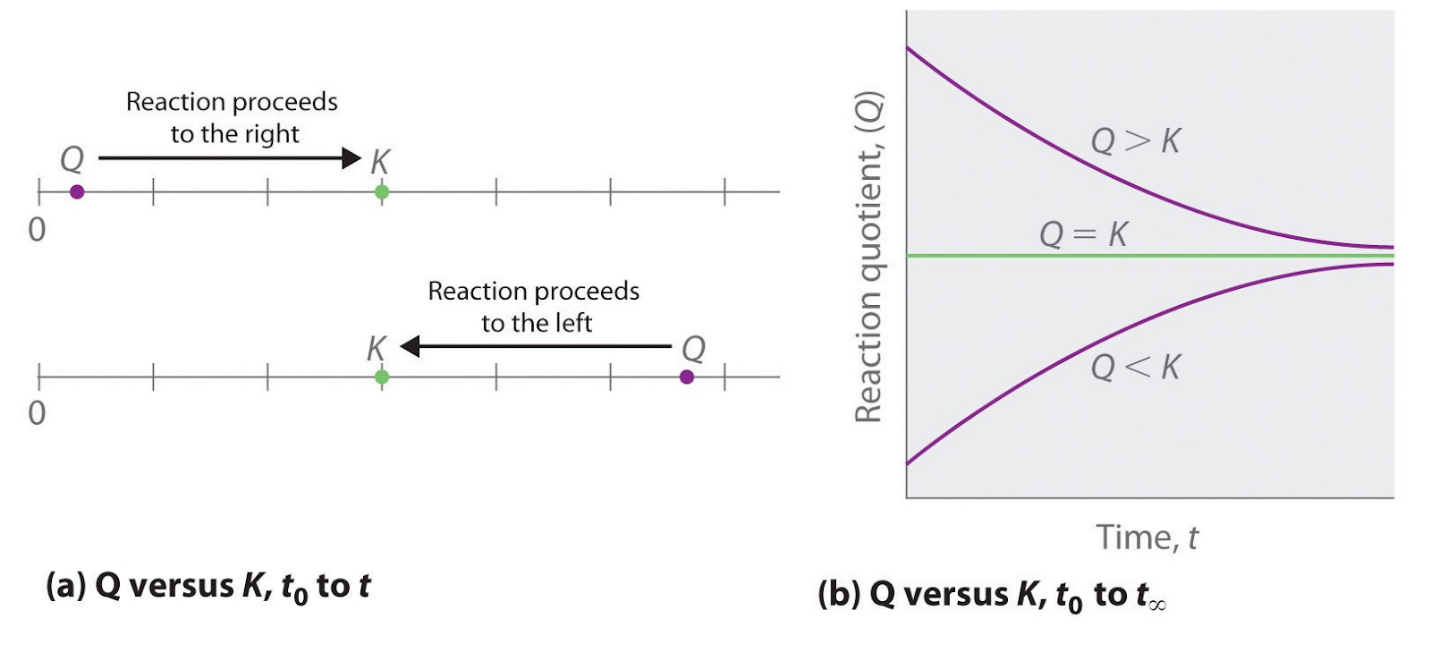
: The current ratio of products to reactants is smaller than the equilibrium ratio. This means there are too many reactants and not enough products. To reach equilibrium, the reaction will proceed in the forward direction (to the right), consuming reactants and forming products until increases to equal .
-
: The current ratio of products to reactants is larger than the equilibrium ratio. There are too many products and not enough reactants. To reach equilibrium, the reaction will proceed in the reverse direction (to the left), consuming products and forming reactants until decreases to equal .
-
: The current ratio of products to reactants is exactly equal to the equilibrium ratio. The system is at equilibrium, and there will be no net change in the concentrations of reactants or products.
The video below offers a great visual analogy to help remember these rules.
Reaction Quotient (K) and Equilibrium Constant (K) Problems & Examples. Which way the reaction shift
This "Conquer Chemistry" video uses a simple but effective "Pac-Man" analogy to illustrate the comparison between Q and K.
Watch from the explanation of the three rules. Notice how visualizing the inequality symbol as a mouth eating towards the larger value indicates the direction of the shift.
This relationship is clearly visualized in the following diagram. In panel (a), you can see that will always "move" along the number line toward . Panel (b) shows this process over time: if you start with or , the concentrations will adjust until the reaction quotient reaches the stable equilibrium value of .
Applying the Concept: Worked Examples
Let's solidify this concept by walking through the process of calculating and using it to predict a reaction's direction.
The following video works through three distinct examples, covering all possible scenarios (, , and ).
Reaction Quotient (K) and Equilibrium Constant (K) Problems & Examples. Which way the reaction shift
The same "Conquer Chemistry" video provides excellent, clearly explained worked examples.
Watch the problem-solving portion from the first example. Pay attention to how for each case, the given pressures are substituted into the Q_p expression, the result is compared to the given K_p, and a conclusion is drawn about the direction of the shift.
Now, let's look at another example in a text format. This problem-solving guide breaks down the process into clear, logical steps.
Chemical Equilibrium: Calculate Q, Compare to K - PASSchem
This resource from PASSchem provides a well-structured walkthrough of a typical problem.
Read through the example for the reaction 2\text{NH}_3(g) \rightleftharpoons \text{N}_2(g) + 3\text{H}_2(g). First, look at the problem statement. Next, review the Strategy Map, which outlines the general plan. Then, follow the detailed solution. Note how they first write the expression for Q_c, then plug in the given non-equilibrium concentrations, calculate Q_c = 25, and compare it to K_c = 17. Since Q_c > K_c, they correctly conclude the reaction must shift to the left. Finally, review the summary of rules under the "Guided Solution" to reinforce the logic.
The graph below provides a visual representation of what happens dynamically in a reaction. Graph (c) shows how the value of the reaction quotient changes over time, starting from zero (when only reactants are present) and increasing until it reaches the constant value of at equilibrium. Graphs (a) and (b) show the corresponding changes in the concentrations of the individual species that drive this change in .

Conclusion
You have now learned how to use the reaction quotient, , as a diagnostic tool to determine the status of a chemical reaction. By calculating from a set of momentary concentrations and comparing it to the equilibrium constant , you can confidently predict whether a reaction will proceed forward, backward, or if it has already reached its final state of balance.
Key Takeaways:
- The reaction quotient () has the same mathematical form as the equilibrium constant () but is calculated using concentrations or pressures at any moment, not just at equilibrium.
- Comparing to allows you to predict the direction of net reaction:
- If , the reaction shifts to the right (towards products).
- If , the reaction shifts to the left (towards reactants).
- If , the system is at equilibrium.
In our next lesson, we will combine the concept of reaction direction with the ICE tables you learned previously. This will allow us to calculate the specific concentrations of all species once equilibrium is actually reached, starting from any set of initial conditions.