Introduction
In our previous lesson, we developed a quantitative understanding of chemical equilibrium, using ICE tables to calculate the exact concentrations of substances once a reaction has settled. We also saw how the reaction quotient, , acts as a powerful predictor, telling us which direction a reaction must shift to reach that equilibrium state.
Today, we shift from quantitative calculation to qualitative prediction. We will explore Le Châtelier's principle, a foundational concept that allows us to predict how a system already at equilibrium will react when we disturb it. Think of it as a set of strategic rules for managing a chemical system. For a future chemical engineer, mastering this principle is like a chess master understanding how their opponent will react to a specific move. It's not just about knowing the state of the board (equilibrium concentrations), but about manipulating it to achieve a desired outcome, such as maximizing the production of a valuable chemical.
This lesson will focus on applying Le Châtelier's principle to predict how an equilibrium system responds to three main types of disturbances, or "stresses": changes in concentration, pressure, and temperature.

The Principle of Counteraction
At its core, Le Châtelier's principle is elegantly simple. It states that if a stress is applied to a system at equilibrium, the system will shift in a way that counteracts the stress.
A "stress" is any change that knocks the system out of its equilibrium state. From our last lesson, you know this means any change that makes the reaction quotient, , no longer equal to the equilibrium constant, . The "shift" is the net reaction (either forward or reverse) that occurs to bring the system back to a new equilibrium where once again equals .
The following resource provides an excellent, detailed explanation of the principle and the logic behind it. We will use it as our primary guide for this lesson.
15.2 Le Chatelier's Principle - Chad's Prep®
This article from Chad's Prep will serve as our foundation. It clearly defines the principle and connects it to the Q vs. K relationship we've already learned.
Please read the first two sections: What Is Le Chatelier's Principle? This part formally states the principle and defines what a "stress" is. How Do Q and K Predict Equilibrium Shift Direction? This section is a crucial bridge from our last lesson. It reinforces how comparing Q and K tells us which way the system must shift to restore equilibrium.
Stress 1: Changes in Concentration
The most direct way to stress an equilibrium is to change the concentration of a reactant or product. Le Châtelier's principle predicts the system will shift to partially counteract this change.
- If you add more of a substance, the equilibrium will shift to consume some of what you added.
- If you remove some of a substance, the equilibrium will shift to produce more of what you removed.
Let's continue with the reading to see how this works in practice.
15.2 Le Chatelier's Principle - Chad's Prep®
This part of the article explains the effect of concentration changes using both the Q vs. K logic and the simpler "counteract the stress" reasoning.
Please read the next two sections: How Does Concentration Affect Chemical Equilibrium? This section details what happens when you increase a reactant or decrease a product. Notice how adding a substance shifts the equilibrium away from it, and removing a substance shifts it toward it. Exception: Adding or Removing a Solid (or Liquid). This is a critical point. Pay close attention to why changing the amount of a pure solid or liquid does not stress the equilibrium and therefore causes no shift. It's because their concentrations are constant and do not appear in the equilibrium expression.
Stress 2: Changes in Pressure and Volume
For reactions involving gases, changing the pressure of the container is another common stress. Pressure and volume are inversely related (as you know from Boyle's Law), so decreasing the volume increases the pressure, and vice versa.
The principle here is that the system will shift to the side with the fewer moles of gas to relieve an increase in pressure (or decrease in volume). Conversely, it will shift to the side with more moles of gas to relieve a decrease in pressure (or increase in volume).
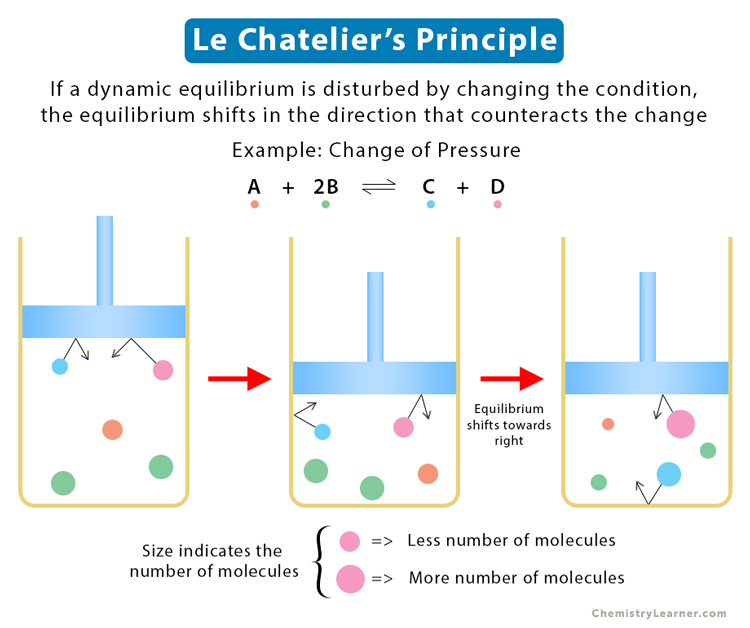
Let's explore the reasoning behind this rule and its important exceptions.
15.2 Le Chatelier's Principle - Chad's Prep®
This final reading from the Chad's Prep article explains the mechanics of pressure changes and highlights two classic "trick" scenarios that are important to understand.
Read the section How Do Pressure and Volume Affect Equilibrium?. Focus on these key points: How decreasing volume increases the molarity of all gaseous species, but affects the numerator and denominator of the Q expression differently if the moles of gas are unequal. The simple shortcut: "when volume decreases, the equilibrium shifts toward the side with fewer moles of gas." What happens if the moles of gas are equal on both sides. The crucial exception of adding an inert gas (like Argon) at constant volume. Understand why this increases the total pressure but does not cause a shift.
Stress 3: Changes in Temperature
Temperature is a unique stress. While changes in concentration and pressure temporarily disrupt the balance (change ) while stays the same, a change in temperature changes the value of the equilibrium constant itself.
To predict the shift, we can think of "heat" as a reactant or a product:
- For an endothermic reaction (), heat is consumed. We treat heat as a reactant.
- For an exothermic reaction (), heat is released. We treat heat as a product.
With this in mind, the rule is the same as for concentration:
- Increasing the temperature (adding heat) will shift the equilibrium away from the side with "heat."
- Decreasing the temperature (removing heat) will shift the equilibrium toward the side with "heat."
The following short video provides a very clear and concise explanation of all three stresses, and is especially good at visualizing the temperature effect.
This video from Professor Dave Explains offers a quick, animated summary of the entire principle.
Please watch the full video. Pay special attention to the segment on temperature, from the start of the temperature discussion to the end of the pressure discussion. It clearly shows how to treat heat as a reactant or product to predict the resulting shift.
Application in Chemical Engineering: The Haber-Bosch Process
Le Châtelier's principle isn't just an abstract concept; it is the strategic guide for some of the most important industrial processes in the world. The synthesis of ammonia () from nitrogen and hydrogen, known as the Haber-Bosch process, is a perfect case study.
As an aspiring chemical engineer, your job would be to manipulate this reaction to get the highest possible yield of ammonia. Let's analyze the variables:
- Pressure: The reactant side has 4 moles of gas (1+3), while the product side has 2 moles. Le Châtelier's principle tells us that high pressure will shift the equilibrium to the right, favoring the production of ammonia.
- Temperature: The reaction is exothermic ( is negative), so we can write it as . Le Châtelier's principle tells us that low temperature will shift the equilibrium to the right to produce more heat, again favoring ammonia production.
However, there's a trade-off, which is where engineering comes in. While low temperatures give a good yield at equilibrium, the rate of reaction is extremely slow. High pressure gives a good yield, but building and maintaining high-pressure reactors is very expensive and dangerous.
The following text explores how engineers balance these competing factors to make the process viable. It also clarifies the role of a catalyst.
17.4 Shifting Equilibria: Le Châtelier’s Principle – Enhanced Introductory College Chemistry
This excerpt from an online textbook provides a fantastic, real-world example of Le Châtelier's principle in action.
First, read the section that details the Haber process, starting from the discussion of industrial practice. Focus on the compromise between rate, yield, and cost that engineers must make. Next, read the short preceding section on catalysts: Catalysts Do Not Affect Equilibrium. This is a key point: a catalyst speeds up both the forward and reverse reactions, allowing the system to reach equilibrium faster, but it does not change the final equilibrium position or the value of K.
This optimization problem—balancing yield, rate, and cost by manipulating temperature and pressure—is a classic example of the strategic thinking required in chemical engineering.
Conclusion
Today, we've explored Le Châtelier's principle, a powerful tool for predicting how a chemical system at equilibrium responds to external stresses. You've learned to think strategically about how to manipulate a reaction to favor either products or reactants.
Key Takeaways:
- Le Châtelier's Principle: A system at equilibrium will shift to counteract any applied stress.
- Concentration Stress: Adding a substance shifts the equilibrium away from it; removing a substance shifts the equilibrium toward it. Adding/removing pure solids or liquids has no effect.
- Pressure Stress: Increasing pressure (or decreasing volume) shifts the equilibrium toward the side with fewer moles of gas. This only applies to reactions with an unequal number of gas moles on each side. Adding an inert gas at constant volume has no effect.
- Temperature Stress: Increasing temperature shifts the equilibrium in the endothermic direction; decreasing temperature shifts it in the exothermic direction. Temperature is the only stress that changes the value of the equilibrium constant, .
- Catalysts: Catalysts increase the rate at which equilibrium is reached but do not change the equilibrium position or the value of .
In our next lesson, we will cover a final piece of the equilibrium puzzle: the mathematical relationship between the two types of equilibrium constants we've seen, (based on concentration) and (based on partial pressure).