Hello! Welcome to your fourth lesson in the Foundations of System Architecture.
In our last lesson, we defined key quality attributes like performance, scalability, and reliability, and learned how to measure them using metrics like latency (P99) and throughput (RPS). A crucial point we touched on was that you can't maximize all of these attributes at once. For instance, optimizing for throughput might increase latency, and achieving extreme availability comes at a high cost.
This natural tension brings us to the very heart of the software architect's role. This lesson is dedicated to what is arguably the most fundamental concept in our field: architectural trade-offs. Your goal is to be able to communicate architectural rationale at a high level, and understanding trade-offs is the key to doing so. It's how you justify every major decision you make.
By the end of this lesson, you will be able to explain the concept of trade-offs, identify common examples, and understand how to analyze them in a structured way.
The First Law of Software Architecture
The core job of a software architect is not to find perfect, "magic bullet" solutions. They don't exist. The job is to understand the compromises and consequences of every decision. This is so fundamental that it's often called the "First Law of Software Architecture."
The First Law of Software Architecture: Understanding ...
Let's start with the article 'The First Law of Software Architecture' from the blog Dev Cookies. It succinctly introduces this core principle.
Please read the short introduction and the first section, 'Why Trade-offs Matter in Software Architecture'. This will frame our entire discussion.
As the article states, "Everything in software architecture is a trade-off." If you think you've found a solution with no downsides, it almost certainly means you haven't identified them yet.
To hear this explained by a leading expert, let's watch the opening of a talk by Neal Ford, a prominent author and software architect.
Modern Trade-off Analysis for Software Architecture - Neal Ford - DDD Europe
In this clip from his talk 'Modern Trade-off Analysis for Software Architecture', Neal Ford explains why trade-off analysis is the essence of an architect's job.
Watch from 00:36 to 03:14 and from 05:11 to 08:08. Pay close attention to: The 'First Law of Software Architecture'. The criteria he uses to distinguish an architectural decision from a design decision (strategic, high effort to change, significant trade-offs).
Ford's distinction is critical. Not every decision is architectural. A decision becomes architectural when the options have significant and conflicting trade-offs. Choosing to use microservices is architectural because it deeply impacts scalability, performance, complexity, and cost. Changing the color of a button is not.
A Catalog of Common Trade-offs
Trade-offs appear in every aspect of system design, from data storage and processing to user experience. The following video provides a rapid tour of some of the most common ones you'll encounter.
System Design Was HARD - Until You Knew the Trade-Offs
The channel ByteByteGo excels at creating short, visual explanations of complex topics. This video quickly covers several classic trade-offs.
Watch the entire video. As you watch, notice how each trade-off involves prioritizing one quality attribute (from our last lesson) over another.
Let's summarize the key trade-offs mentioned in the video and other common examples:
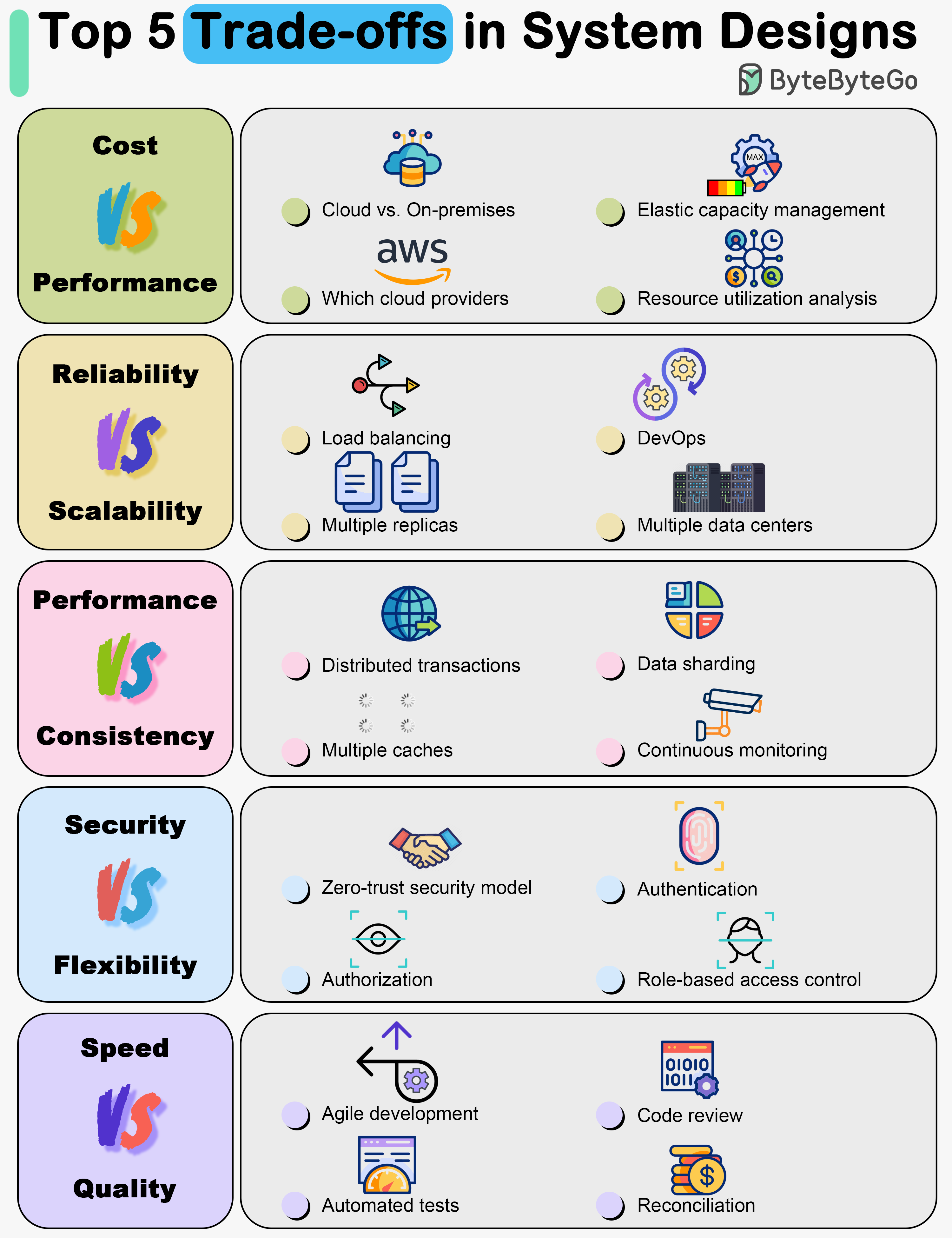
- SQL vs. NoSQL Databases: SQL offers strong consistency and structured data integrity. NoSQL offers high scalability and flexibility. You trade consistency for scalability.
- Normalization vs. Denormalization: Normalization in databases reduces data redundancy and improves data integrity. Denormalization (duplicating data) improves read performance by avoiding complex joins. You trade write efficiency and consistency for read speed.
- Performance vs. Scalability: As we discussed, a monolithic system might have lower latency (better performance) due to in-process calls, but a microservices system can handle more load (better scalability).
- Consistency vs. Availability (CAP Theorem): In a distributed system, you are forced to choose between ensuring all nodes have the same data (Consistency) and ensuring the system always responds (Availability) when a network partition occurs. A banking system prioritizes consistency; a social media feed prioritizes availability.
- Batch vs. Stream Processing: Batch processing is efficient for handling large volumes of data but introduces latency. Stream processing provides real-time results but is more complex to manage. You trade efficiency for immediacy.
- Security vs. Usability: Adding multi-factor authentication enhances security but adds friction to the user's login experience.
Test your understanding!
You are designing a system for a new e-commerce startup. The primary business goal is to launch as quickly as possible to capture market share. The initial product catalog is small and well-structured.
Which database type would you likely choose: a traditional SQL database (like PostgreSQL) or a flexible NoSQL database (like MongoDB)? What is the main trade-off you are making?
Show answer
A SQL database is the more pragmatic choice here.
- Rationale: The data is well-structured, and SQL's strict schema ensures data integrity from the start, which is crucial for product and order information. More importantly, relational databases are a mature, well-understood technology, which aligns with the goal of launching quickly. The team can be productive faster.
- Trade-off: You are trading future flexibility and potentially massive horizontal scalability (which the startup doesn't need yet) for simplicity, data integrity, and speed of development. You are accepting the "cost" of lower scalability in exchange for the "benefit" of a faster time-to-market.
How to Analyze and Document Trade-offs
Knowing that trade-offs exist is the first step. The work of an architect is to analyze them systematically and make a defensible choice. This involves connecting technical decisions back to business goals.
A Framework for Analysis
A good analysis isn't based on gut feelings; it's a structured process.
The First Law of Software Architecture: Understanding ...
Let's return to the Dev.to article, 'The First Law of Software Architecture'. It provides a clear, step-by-step framework for making these decisions.
Read section 3, 'How to Make Informed Architectural Trade-offs'. Pay attention to the five steps: Identify drivers, Compare options, Use frameworks, Prototype, and Document.
The key steps from the article are:
- Identify Drivers: What are the most important quality attributes for the business? Is it time-to-market? Low operational cost? High security?
- Compare Options: Lay out the pros and cons of each architectural option in a matrix, evaluating them against the identified drivers.
- Prototype and Validate: Don't just assume. Run small tests to gather real data on performance, complexity, or cost.
- Document and Communicate: This is perhaps the most crucial step for a consultant. You must record why a decision was made. A common tool for this is an Architecture Decision Record (ADR), a short document that captures the context, decision, and consequences for a single architectural choice.
A Concrete Example: Service Granularity
Let's see this analysis in action. We'll return to Neal Ford's talk, where he provides a brilliant, detailed framework for one of the hardest problems in microservices: how big should a service be? He introduces forces that pull you toward smaller services ("disintegrators") and forces that pull you toward larger services ("integrators").
Modern Trade-off Analysis for Software Architecture - Neal Ford - DDD Europe
This is the most detailed part of our lesson. Neal Ford provides a masterclass in trade-off analysis. He will discuss forces for breaking services apart and forces for keeping them together, followed by a specific trade-off analysis using a matrix.
Watch from 14:45 to 37:47. This is a dense but highly valuable segment. 14:45 - 23:46: Focus on the 'disintegrators'—reasons to break services apart (e.g., different rates of change, different scalability needs). 23:46 - 31:33: Focus on the 'integrators'—reasons to keep things together (e.g., database transactions, complex workflows). 31:33 - 37:47: Pay close attention to the matrix analysis of 'hydrated contract' vs. 'key-only'. This is a perfect example of a structured trade-off analysis.
This extended example illustrates the process perfectly:
- Drivers: He analyzes the options against drivers like scalability, performance, fault tolerance, and security.
- Options: He weighs the pros and cons of fine-grained services versus coarser-grained ones.
- Analysis: In the "hydrated contract" example, he explicitly maps out a matrix, showing how one option is better for performance, while the other is better for data consistency and avoiding coupling.
- Connecting to Business: He concludes by showing how the final choice must reconcile back to business drivers. If the business absolutely needs extreme scalability, you choose that option and accept that you now have to solve the resulting problems (like data consistency).
Conclusion
This lesson tackled the philosophical core of software architecture. The primary role of an architect is not to know all the answers but to understand the right questions and evaluate the compromises.
Key Takeaways:
- The First Law: Everything in software architecture is a trade-off. There are no perfect solutions, only solutions that are more or less optimal for a specific context.
- Identify Competing Forces: Architectural decisions involve balancing competing quality attributes like performance, scalability, cost, security, and maintainability.
- Analyze Systematically: The best way to make a decision is to identify business drivers, compare options against those drivers (often with a matrix), validate with data, and document the rationale in an Architecture Decision Record (ADR).
- Context is King: A "best practice" in one context is an "anti-pattern" in another. Your job is to provide objective analysis, not to evangelize a specific technology or pattern.
In our next lesson, we will begin exploring the fundamental patterns architects use to build systems. We'll start with the most ubiquitous one of all: the client-server architectural pattern and its variations. As we explore it, we will apply what you've learned today by analyzing its inherent trade-offs.