Hello! Welcome to your second lesson.
In our first lesson, we established the fundamental distinction between software architecture and software design. We learned that architecture concerns the strategic, high-level decisions that are costly to change, defining the "Why" behind a system's structure.
Now that we understand what architecture is, we'll focus on the "Who." This lesson explores the role and responsibilities of the software architect—the person accountable for those critical architectural decisions. Understanding this role in depth is essential for your goal of becoming an effective architecture consultant, as it defines the scope of services you will offer and the value you will provide to clients and teams.
From "Super Coder" to Strategic Leader
A common misconception is that a software architect is simply the most senior or experienced developer on a team. While deep technical expertise is a prerequisite, the role is fundamentally different. It requires a shift in focus from tactical implementation to strategic leadership.
An architect operates at the intersection of business goals, technical possibilities, and team capabilities. Their primary function is to create a technical vision that meets business needs and to guide the development teams in realizing that vision.
To start, let's explore the key characteristics that define an effective software architect.
The Path to Becoming a Software Architect
The video 'The Path to Becoming a Software Architect' by Coding Tech provides an excellent overview of the core traits of an architect. It introduces the concept of a 'T-shaped' professional, which is a useful model for thinking about the required knowledge base.
Watch the video from 00:55 to 05:19. Focus on the three main characteristics discussed: deep and broad technical knowledge (T-shaped), taking on responsibility for high-impact decisions, and advanced communication skills.
As the video highlights, the key characteristics are:
- T-Shaped Knowledge: Deep expertise in one or two areas, combined with a broad understanding of many other technologies. Your background in IT infrastructure gives you a strong vertical bar of the "T" in areas like networking and system reliability, which you can now broaden by developing the horizontal bar across software patterns and practices.
- High-Level Responsibility: Architects make the "expensive" decisions we discussed in the last lesson. A mistake in architecture can have massive cost and time implications, so the role carries significant accountability.
- Advanced Communication: An architect must be able to communicate effectively with diverse audiences: discussing business strategy with executives, negotiating requirements with product managers, and guiding developers on technical implementation. This is perhaps the most critical skill for a consultant.
The Core Responsibilities of a Modern Architect
Now, let's move from characteristics to a detailed breakdown of responsibilities. What does an architect actually do?
The role has evolved significantly. The old stereotype of an "ivory tower" architect who hands down diagrams from on high is obsolete. Today's architect is a hands-on leader who is deeply embedded in the agile development process.
The Evolving Role of the Software Architect
The article 'The Evolving Role of the Software Architect' from DraftKings Engineering offers a superb, modern perspective on these responsibilities. It frames the architect as a strategic partner to the business.
Please read the section titled 'The Architect’s Evolving Responsibilities (and Why They Aren’t Going Away)'. It's divided into three subsections. Focus on how the architect: Aligns technical decisions with business strategy. Embeds quality attributes (like scalability and security) into the system. Enables agility and continuous improvement.
Synthesizing from this article and other resources, we can group the architect's core responsibilities into three major areas:
1. Strategic Technical Decision-Making and Alignment
This is about bridging the gap between the business and the technology.
- Translate Business Goals: The architect works with stakeholders to understand business objectives (e.g., "We need to enter the European market") and translates them into a technical strategy (e.g., "We need a multi-region architecture that supports data sovereignty regulations like GDPR").
- Evaluate and Select Technology: They choose the appropriate languages, frameworks, databases, and platforms, constantly analyzing the trade-offs between cost, performance, team skills, and maintainability.
- Manage Complexity and Risk: They make the "big decisions" visible to business stakeholders, clarifying the costs and risks associated with different technical paths. This includes involvement in strategic initiatives like M&A technical due diligence or integrating major third-party systems.
2. System Design and Quality Attribute Stewardship
This is the "blueprint" creation part of the job.
- Define the Architecture: The architect designs the overall structure of the system, identifying the major components and the relationships between them.
- Embed Quality Attributes: A primary responsibility is to ensure the system meets its non-functional requirements (NFRs). These are the "-ilities" of a system: scalability, reliability, security, maintainability, etc. We will dedicate the next lesson entirely to this topic.
- Establish Technical Standards: They create and enforce standards for coding, tools, and platforms to ensure consistency and quality across teams.
3. Technical Leadership and Governance
An architect leads through influence, guidance, and mentorship.
- Guide and Mentor Teams: They act as a technical guide for development teams, ensuring that the implementation stays true to the architectural vision. They don't just dictate; they educate and persuade.
- Review and Validate: They review designs and critical pieces of code to ensure they align with the architecture and don't introduce long-term debt.
- Foster Continuous Improvement: They are constantly looking for ways to improve the architecture, pay down technical debt, and adapt to changing requirements, embodying agile principles.
The Architect's Role in Context
To further clarify the architect's position, it's helpful to compare it to other key roles in a project.
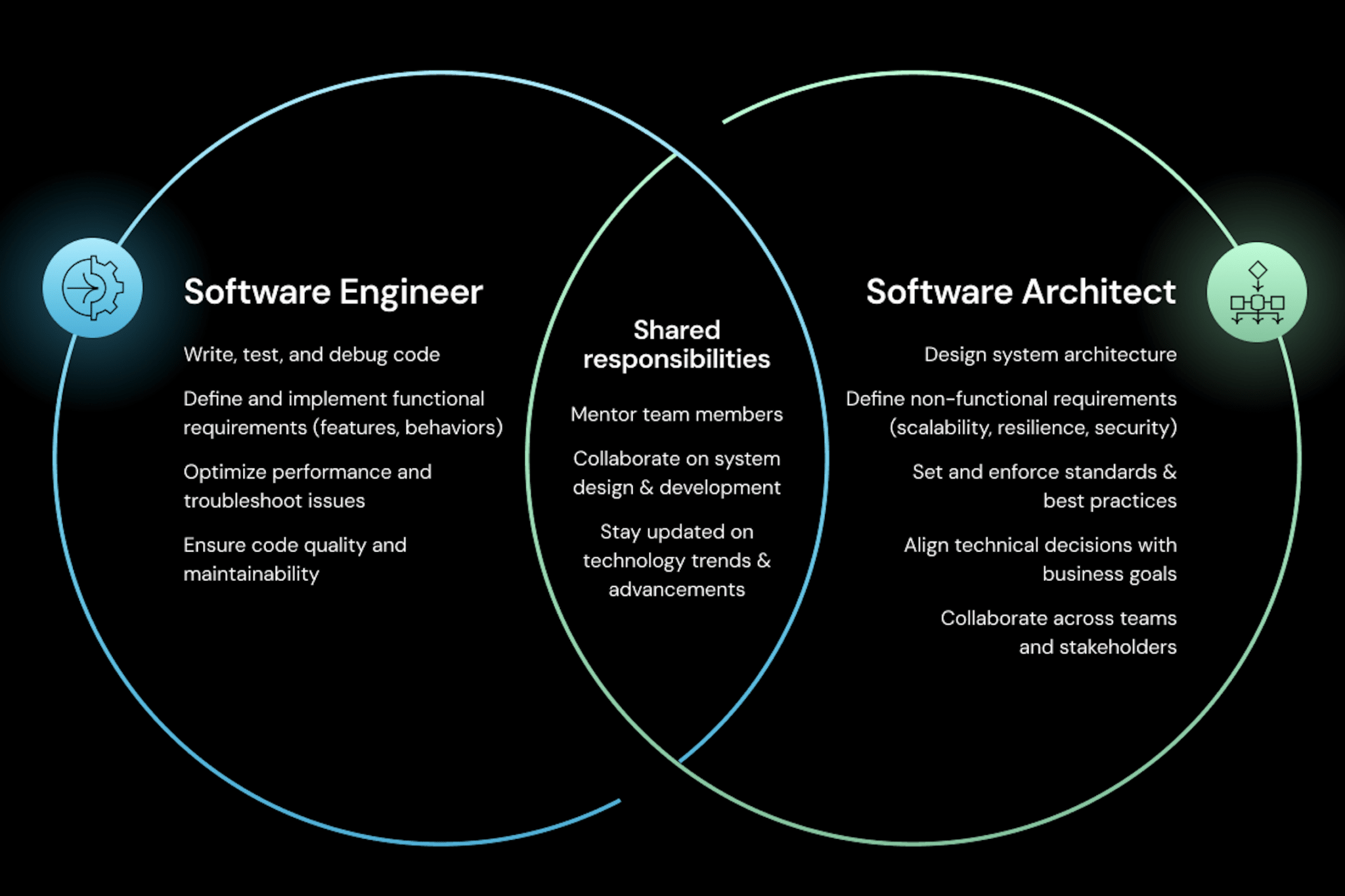
The article "The role, skills, and duties of a software architect" provides clear tables comparing the architect to a Tech Lead and a Project Manager.
The role, skills, and duties of a software architect
This article from Syndicode provides excellent side-by-side comparisons that clarify the architect's unique position.
Please read the sections 'Software architect vs. Tech lead/Senior engineer' and 'Software architect vs. Project manager'. Focus on the tables that contrast the responsibilities, scope, and time horizon of these roles.
In short:
- Architect vs. Tech Lead: The architect's scope is system-wide and long-term (strategic), while the tech lead's scope is team-specific and short-to-mid-term (tactical).
- Architect vs. Project Manager: The architect focuses on the technical health and vision of the project, while the project manager focuses on its operational health (budget, schedule, resources).
Test your understanding!
A project is falling behind schedule. One team suggests cutting corners on automated testing for a new feature to meet a deadline. Another person argues this will create long-term risks for system stability and maintenance.
Based on the role descriptions, who is more likely to be the one raising the long-term risk concern: the Project Manager, the Tech Lead, or the Software Architect? Why?
Show answer
The Software Architect is the most likely person to raise this concern.
- The Project Manager is primarily focused on delivering the project on time and on budget. While they care about quality, their immediate pressure is the schedule.
- The Tech Lead is concerned with the feature's implementation and the team's immediate delivery, so they might feel pressure to agree to the shortcut.
- The Software Architect's primary responsibility is the long-term health, maintainability, and reliability of the entire system. Cutting tests directly threatens these quality attributes, which are central to the architect's stewardship role. They are responsible for protecting the system from decisions that create significant technical debt and risk.
The Architect's Journey Through the SDLC
An architect's involvement isn't a one-time event. Their focus evolves throughout the Software Development Life Cycle (SDLC).

The following reading provides a detailed breakdown of the architect's activities at each stage.
The role, skills, and duties of a software architect
To see how these responsibilities play out in practice, let's examine the architect's role at each stage of the development lifecycle.
Read the section 'Software architect roles and responsibilities in the SDLC'. Pay attention to how the architect’s focus shifts from high-level planning in the beginning to guidance, validation, and evolution in the later stages.
Here is a summary of the architect's shifting focus:
- Pre-Development/Analysis: Understand business goals, define technical requirements, and create the initial architectural vision.
- Design/Prototyping: Create the high-level design, select technologies, and build proofs-of-concept to validate key decisions.
- Development: Guide the development teams, clarify the architecture, review code, and ensure standards are followed.
- Testing/QA: Work with QA to define testing strategies for non-functional requirements like performance and security.
- Deployment: Ensure the architecture is supported by the production infrastructure and that the deployment process is reliable.
- Post-Development/Maintenance: Monitor the system in production, plan for its evolution, and manage technical debt.
Conclusion
In this lesson, we have defined the multifaceted role of the software architect. Far more than just a senior coder, the architect is a strategic technical leader who bridges the worlds of business and engineering.
Key takeaways include:
- An architect is characterized by T-shaped knowledge, a high degree of responsibility, and excellent communication skills.
- Their core responsibilities involve strategic technical decision-making, designing the system's blueprint while embedding quality attributes, and providing technical leadership and governance.
- The role is distinct from that of a Tech Lead or Project Manager, operating at a broader, more strategic level with a long-term focus.
- An architect's involvement is continuous throughout the SDLC, adapting to the needs of each phase from initial conception to long-term evolution.
You now have a clear picture of both what software architecture is and what a software architect does. These two concepts are the bedrock of system design.
In our next lesson, we will dive deeper into one of the architect's most critical responsibilities: defining key quality attributes (e.g., performance, scalability, reliability) and their metrics (e.g., latency, throughput). This will be our first step into the concrete, measurable aspects of system design.