Hello! Welcome to your sixth lesson in the Foundations of System Architecture.
In our last lesson, we explored the client-server pattern and its tiered variations. We saw how the 3-tier architecture separates an application into Presentation, Application (Logic), and Data tiers. This separation is a powerful real-world example of a more fundamental design principle.
Today, we will formally explore that principle: separation of concerns (SoC). Understanding SoC is not just about organizing code; it's a core mental model for an architect. It’s how we tame complexity in large systems. Your goal is to explain this principle and how it helps us build systems that are easier to understand, maintain, and evolve.
1. What is Separation of Concerns?
At its heart, Separation of Concerns is a principle for managing complexity. It advises us to break down a system into distinct parts, where each part addresses a specific "concern" or responsibility with minimal overlap.
To get a foundational understanding, let's start with a well-written article that defines the term, its history, and its purpose.
This article from Embedded Artistry provides a concise and clear definition of Separation of Concerns, its origins, and what constitutes a 'concern' in software.
Please read the introduction and the sections titled 'History' and 'What are concerns?'. Focus on the core idea: localizing functionality into distinct modules to make the system easier to reason about.
As the article explains, a "concern" can be anything from a technical detail (e.g., "how do we talk to the database?") to a business function (e.g., "how do we process a customer's payment?"). The key is to avoid mixing these different concerns in the same part of the system.
Concerns can be separated along different axes. For instance, in web development, you've likely separated HTML (structure), CSS (presentation), and JavaScript (behavior). This is one form of SoC. However, modern component-based frameworks (like React or Vue) suggest a different separation: grouping the HTML, CSS, and JS for a single UI component (like a date picker) together.
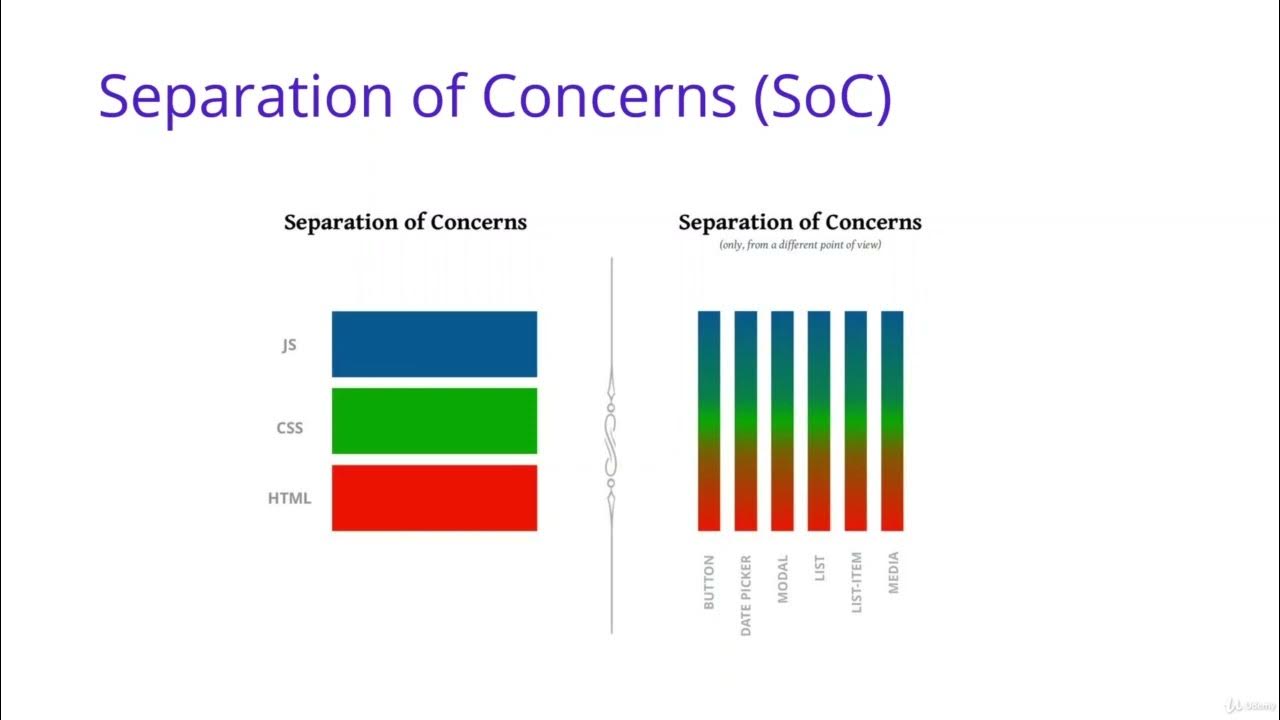
This illustrates a vital point: how you separate concerns is a critical architectural decision.
2. The Goal of SoC: High Cohesion and Low Coupling
Why do we go to the trouble of separating concerns? The goal is to create a system with two key qualities: high cohesion and low coupling. These two concepts are a fundamental yin-yang of software design.
- Cohesion: Measures how strongly related and focused the responsibilities of a single module are. In a highly cohesive module, all the elements belong together and serve a single, well-defined purpose.
- Coupling: Measures the degree of interdependence between different modules. In a system with low coupling, changing one module is unlikely to require changes in other modules.
A good architect constantly thinks about balancing these two forces. Let's watch a video that distills years of software development experience into these two core ideas.
SOLID Principles? Nope, just Coupling and Cohesion
This video from CodeOpinion argues that many design principles, including SOLID, are ultimately about managing coupling and cohesion. It's a pragmatic, experience-driven take that aligns with your goal of understanding the 'why'.
Watch from 00:38 to 02:53. Focus on the definitions of coupling and cohesion and how they apply at both a micro (classes) and macro (services) level. Pay close attention to the idea of 'functional cohesion'—grouping things by task, not by data.
Separating concerns helps us achieve this ideal state:
- By grouping related logic together, we increase cohesion.
- By creating clear boundaries between different concerns, we decrease coupling.
The benefits, as listed in the Embedded Artistry article you read earlier, are significant: improved modularity, better testability, easier maintenance, and the ability for teams to work independently.

3. Applying SoC: From System Architecture to Code
Separation of Concerns isn't just a high-level theory; it applies at every scale of a system, from the overall architecture down to the structure of a single function.
Macro-Level: Defining Service Boundaries
At the architectural level, SoC guides how we break a large system into smaller services (as in a microservices or service-oriented architecture). A common mistake is to separate services based on data entities, which can lead to high coupling. A better approach is to separate them based on business capabilities.
Let's return to the video to see a concrete example.
SOLID Principles? Nope, just Coupling and Cohesion
The video now demonstrates the pitfalls of data-centric separation versus the power of capability-based separation. This is a crucial insight for designing distributed systems.
Watch from 03:52 to 06:03. Notice how a single 'Product' entity service would create high coupling, as Sales, Purchasing, and Warehouse would all depend on it. Then, see how separating by capability (Sales handles price, Warehouse handles inventory) creates more cohesive, independent services.
This approach—defining boundaries around business capabilities—is a cornerstone of Domain-Driven Design, a topic we will encounter later in the course. Each service becomes highly cohesive because it's focused on a specific part of the business domain.
Micro-Level: Structuring Application Code
The same principle applies within a single application or service. How should you organize your code files and classes? A common approach in MVC frameworks is to have folders for Controllers, Models, and Views. This separates concerns by technical role.
However, as your application grows, this can lead to low cohesion—a Controllers folder with dozens of unrelated files. An alternative is to organize code by feature or capability, where all the code for a specific feature (its controller, model, view, etc.) lives together. This increases cohesion and makes it easier to work on a feature in isolation.
The ultimate expression of SoC within an application's code is arguably the Clean Architecture.
The Clean Architecture by Uncle Bob - The Clean Code Blog
Robert C. Martin's (Uncle Bob) blog post on 'The Clean Architecture' is a seminal work on applying SoC to create robust, maintainable, and testable applications. It separates business logic from technical details like databases and frameworks.
Read the entire article. It's dense but foundational. Focus on these key ideas: The Goal: To be independent of frameworks, UI, and databases. The Dependency Rule: Source code dependencies must always point inwards. The Layers: Understand the difference between inner circles (Policies/Business Rules like Entities and Use Cases) and outer circles (Mechanisms/Details like UI and Databases). Crossing Boundaries: How simple data transfer objects (DTOs) are used to communicate between layers without creating coupling.
The Clean Architecture is a powerful pattern because it enforces a strict separation between what your application is (the core business rules) and how it's delivered (the web framework, the database). This makes the core logic incredibly stable and easy to test, as it has no knowledge of the outside world.
Test your understanding!
You are designing the backend for an e-commerce website. A user action, "placing an order," involves several steps:
- Verifying the items are in stock.
- Processing the user's payment via a third-party gateway (like Stripe).
- Recording the order details in your database.
- Sending a confirmation email to the user.
How would you apply the principle of Separation of Concerns when structuring the services for these functions? Briefly describe the "concerns" you would identify and how you might group them into cohesive modules or services.
Show answer
A good approach would be to separate these functions based on their business capability, creating highly cohesive modules/services:
- Inventory Concern: This module's sole responsibility is managing stock levels. It would expose functions like
CheckStock(productID, quantity)andReserveStock(productID, quantity). - Payment Concern: This module would be an adapter for the external payment gateway. It handles all the complexity of communicating with Stripe, processing payments, and handling payment-related errors. Its concern is "money."
- Order Concern: This module is responsible for the core business logic of what an "order" is. It would orchestrate the process: call the Inventory module, then the Payment module, and if successful, create and save the final order record. Its concern is the "order lifecycle."
- Notification Concern: This module's responsibility is sending communications to the user. It would accept a message (e.g., "your order is confirmed") and handle the details of formatting and sending an email.
This separation ensures that a change in the payment provider (e.g., moving from Stripe to PayPal) only affects the Payment module. A change in the email template only affects the Notification module. The Order module, which contains the core business workflow, remains stable. This is a system with high cohesion and low coupling.
4. A Key Benefit: Enabling Asynchronous Communication
One of the most powerful architectural benefits of good SoC is that it naturally enables asynchronous communication. When you have highly cohesive services that own their own data (as we saw in the "Product" service example), they no longer need to synchronously call each other to get information.
This final clip explains how this works.
SOLID Principles? Nope, just Coupling and Cohesion
The final part of the video connects the dots between well-defined, cohesive services and modern asynchronous communication patterns like messaging and events.
Watch from 08:16 to 10:11. Understand how separating by capability removes the need for direct RPC calls. Instead of Sales telling Invoicing to create a bill, Sales can simply publish an OrderPlaced event that the Invoicing service can react to independently.
This is a profound shift. It decouples services not just in code, but also in time. This "temporal decoupling" is critical for building resilient and scalable systems, and it's a direct result of applying the principle of Separation of Concerns.
Conclusion
In this lesson, we demystified the principle of Separation of Concerns. It's the simple idea of not mixing different responsibilities in the same place, but it has far-reaching consequences for the quality of a software system.
Key Takeaways:
- Separation of Concerns (SoC) is a design principle for managing complexity by dividing a system into distinct parts with minimal functional overlap.
- The primary goal of SoC is to achieve high cohesion (elements within a module belong together) and low coupling (modules are independent of each other).
- SoC applies at all levels: from macro-architecture (defining service boundaries around business capabilities) to micro-architecture (structuring code within an application using patterns like the Clean Architecture).
- Effective SoC leads to systems that are more modular, testable, maintainable, and scalable.
- A key architectural benefit is that it enables asynchronous communication, which decouples services in time and improves system resilience.
In our previous lesson, we saw how a 3-tier architecture separates presentation, logic, and data. Today, we've learned the principle that drives that separation. Now, you are equipped to analyze different architectural styles based on how they apply this very principle.
In our next lesson, we will do exactly that, as we compare and contrast monolithic, service-oriented, and microservice architectures. We will see how each of these styles represents a different approach to separating concerns.