Hello! Welcome to your first lesson. I'm excited to start this journey with you into the world of AI-driven visual storytelling.
This course is designed to take you from creating short, individual clips to producing structured narrative videos. We'll begin today by building the most important foundation for any story: the 3-act structure.
Your goal is to create compelling videos of 1, 3, and even 5 minutes. To do that, you need a blueprint. The 3-act structure (Setup, Conflict, and Resolution) is that blueprint. It's a timeless framework used in everything from Hollywood blockbusters to viral TikToks. By the end of this lesson, you will be able to take a simple idea and outline it using this powerful narrative tool, preparing you to create more engaging and coherent videos.
Let's get started.
The Foundation: What is the 3-Act Structure?
At its heart, every satisfying story has a beginning, a middle, and an end. The 3-act structure simply gives these parts more specific jobs to do. Think of it as:
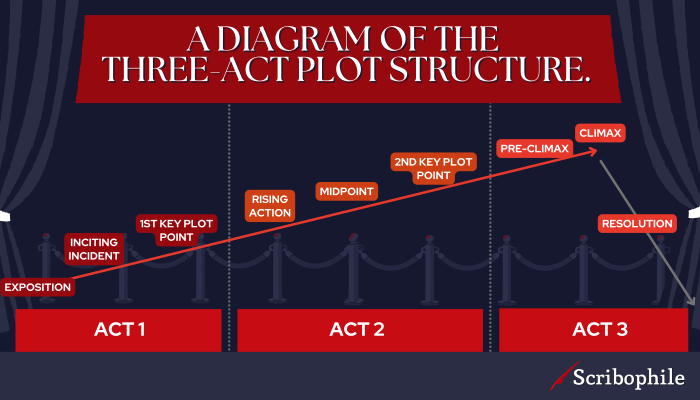
- Act 1: The Setup. This is the beginning. We meet the main character, understand their world, and see what their normal life is like. Then, something happens—an inciting incident—that disrupts this normal life and sets the story in motion.
- Act 2: The Conflict. This is the middle and the longest part of the story. The character tries to solve the problem or achieve the goal presented in Act 1. They face a series of escalating obstacles and challenges that test them, force them to grow, and build narrative tension.
- Act 3: The Resolution. This is the end. The conflict reaches its most intense point in the climax, where the main struggle is confronted head-on. After the climax, the story's central question is answered, loose ends are tied up, and we see the character in their "new normal," often changed by their journey.
This diagram provides a great visual overview of how these acts fit together and how the story's intensity typically rises and falls.
To get a clearer sense of these acts, let's look at how they are defined for short films.
Short Film Story Outline Structure
The following article from Open Screenplay provides a concise definition of each act specifically within the context of short films. It helps frame the structure for the kind of projects you'll be creating.
Please read the section titled '3 Act Story Structure for Short Films'. Focus on the definitions provided for Act 1, Act 2, and Act 3, and the alternative way of thinking about them: setup, expansion, and payoff.
Seeing the Structure in Action: Pixar's Piper
Theory is one thing, but seeing it applied is where it really clicks. We're going to analyze the Oscar-winning Pixar short film Piper to see how it masterfully uses the 3-act structure.
This video analysis breaks down the film's narrative beats and maps them to the classic story structure. As you watch, pay close attention to how the story sets up a problem, builds conflict, and delivers a satisfying resolution.
PIPER - How to Write a Short Film in 3 Acts
The video 'PIPER - How to Write a Short Film in 3 Acts' by Pietro Schito offers an excellent breakdown of a professional animated short. It will help you see how the abstract concepts of story structure translate into concrete visual moments.
Watch the video from 00:30 to 04:19. Notice how the analysis identifies these key moments: Act 1 (Setup): Introduction of Piper and her world, and the 'inciting incident' when her mother encourages her to find food (00:30 - 01:31). Act 2 (Conflict): Piper's struggles, the terrifying wave (a major obstacle), and her discovery of a new technique from her crab friends (01:31 - 03:17). Act 3 (Resolution): The climax where Piper uses her new skill to face the wave, and the resolution showing her transformation into a confident, capable bird (03:17 - 04:19).
As you saw, even a short, dialogue-free film like Piper has a robust structure. This structure is what makes Piper's journey from timid fledgling to confident provider feel so earned and emotionally resonant.
Adapting the Structure for 1-Minute Videos
A 6-minute Pixar short is one thing, but your immediate goal is to create compelling 1-minute videos. How can you fit a full three-act story into just 60 seconds?
The key is to be extremely efficient. You need to establish the setup, conflict, and resolution quickly and clearly. Let's look at a framework designed specifically for this kind of ultra-short-form content.
The Secret to Telling a Great Story — in Less Than 60 Seconds | Jenny Hoyos | TED
In this TED talk, viral video creator Jenny Hoyos presents her framework for telling a great story in under 60 seconds. You'll notice her method is a fast-paced, modern take on the classic 3-act structure.
Watch the video from 00:35 to 03:55. As you watch, map her framework to the 3-act structure: Start with a shocking question: This is the hook and the Setup (Act 1). It immediately establishes the character's goal. Take them on a journey with conflict: This is the Conflict (Act 2). The progression toward the answer is filled with obstacles. Provide a satisfying answer: This is the Resolution (Act 3), which serves as the payoff to the initial question.
Jenny Hoyos's approach demonstrates that even with a simple concept like making a burger, the 3-act structure creates a narrative that hooks the audience, builds tension, and delivers a payoff.
Planning Your Story's Timing
Now for the most practical part. If you have a 1-minute video, how many seconds should you devote to each act? A common guideline for story structure is to break down the time as follows:
- Act 1 (Setup): ~20-25% of the total time
- Act 2 (Conflict): ~50-60% of the total time
- Act 3 (Resolution): ~20-25% of the total time
This means the conflict is always the longest, most substantial part of your story.
The article from Open Screenplay that you looked at earlier has an excellent table that translates these percentages into actual seconds and minutes for short films.
Short Film Story Outline Structure
Let's return to the Open Screenplay article. This time, we'll focus on the section that provides a concrete timing breakdown. This is a crucial tool for planning your own projects.
Read the section titled 'Acts and Lengths'. Pay close attention to the table that shows the time breakdown for a 1-minute screenplay. We'll use this as a starting point for your first project.
Based on that resource, here is a practical guide for your target video lengths:
| Video Length | Act 1 (Setup) | Act 2 (Conflict) | Act 3 (Resolution) |
|---|---|---|---|
| 1 Minute | ~12-15 seconds | ~30-36 seconds | ~12-15 seconds |
| 3 Minutes | ~45 seconds | ~1.5 minutes | ~45 seconds |
| 5 Minutes | ~1 minute | ~3 minutes | ~1 minute |
This is not a rigid rule, but a powerful guideline. It ensures your story has a proper introduction, a meaty middle, and a concise conclusion.
Test your understanding!
Let's practice. Think of a simple story concept for a 1-minute video. For example: "A curious cat tries to steal a fish from a kitchen counter."
Using the 3-act structure, briefly outline what would happen in each act. Try to keep the time guidelines in mind.
- Act 1 (Setup - ~15s):
- Act 2 (Conflict - ~30s):
- Act 3 (Resolution - ~15s):
Show answer
Here's one possible way to structure that story:
- Act 1 (Setup - ~15s): We see a cozy kitchen. A fluffy cat, Patches, is napping on a rug. The owner places a delicious-looking raw fish on the counter and leaves the room. Patches wakes up, sees the fish, and his eyes go wide. (Character, world, and inciting incident are all established).
- Act 2 (Conflict - ~30s): Patches attempts to get the fish. First, he tries to jump directly onto the counter but slips and fails. Then, he tries pushing a stool over, but it's too heavy. Finally, he notices a hanging dish towel and tries to climb it. The towel starts to rip, creating tension. (Escalating obstacles and conflict).
- Act 3 (Resolution - ~15s): Just as Patches reaches the top, the owner walks back in. Patches freezes, caught in the act. The owner laughs, takes the fish, cuts a tiny piece, and gives it to Patches. Patches eats his small prize happily. (Climax and resolution - the question of whether he'll get the fish is answered, but not in the way he expected).
Conclusion
In this lesson, we've laid the cornerstone of your storytelling journey. You now have a fundamental framework to turn your creative ideas into structured narratives.
Here are the key takeaways:
- The 3-act structure (Setup, Conflict, Resolution) is a universal blueprint for building a compelling story.
- Act 1 introduces the character and their world, and kicks off the story with an inciting incident.
- Act 2 is the longest part, where the character faces escalating challenges in pursuit of their goal.
- Act 3 brings the conflict to a climax and delivers a satisfying resolution.
- This structure can be scaled to any length, and for a 1-minute video, a rough timing of 15s (Setup) / 30s (Conflict) / 15s (Resolution) is a great starting point.
Now that you understand the high-level structure of a story, our next lesson will zoom in. We will learn how to break down each act into smaller, more manageable 'narrative beats'. This will allow you to plan your video moment by moment, which is essential before you start writing prompts for your AI tools.