Hello! In our previous lessons, we focused on the physical aspects of playing guitar—training your fingers to find the right notes and move with precision. You've built a solid foundation for what to play and how to produce clean notes. Now, we'll pivot to an equally crucial dimension of music: when to play, and for how long.
This lesson introduces the fundamental concept of musical rhythm. Your goal is to be able to explain the basic note durations—the whole note, half note, and quarter note—and their silent counterparts, the rests. Given your background in engineering and software development, you can think of rhythm as the timing protocol or the logical framework that governs the sequence and duration of musical events. It's a system built on clear, mathematical relationships.
Rhythm as a System of Ratios
Before we look at the specific symbols, it's helpful to understand rhythm from a higher-level perspective. At its core, musical rhythm is simply the organization of sound in time. The system we use to notate this is built on a foundation of simple integer ratios, which defines how long one sound should last in relation to another.
The following article, "The Math in Music," provides an excellent introduction to this way of thinking.
The Math in Music | Part 1 - Rhythm | Ensemble Performing Arts
This article from the Ensemble Performing Arts blog frames rhythm as a mathematical construct, which provides a powerful mental model for understanding it.
Please read the first two main sections of the article. Start with The Basics of Rhythm to get a clear, concise definition. Then, continue to the section on Notes and Rests, which introduces the core idea that note durations are defined by their relationship to one another.
As the article points out, the entire system of rhythmic notation is based on these ratios. Let's now define the fundamental unit that underpins this system.
The Beat and Basic Note Durations
In music, the steady, underlying pulse is called the beat. It's the clock signal of a musical piece. All note durations are defined in terms of how many beats they last.
We'll start with three fundamental note values: the whole note, half note, and quarter note. The following video provides a clear and practical demonstration of how these notes are counted.
How to Count Basic Rhythms (Part 1)
This video from The Mento Zone introduces the most common note values and a system for counting them out loud, which is a crucial skill for developing a strong internal sense of time.
First, watch the section that introduces the quarter note. It's presented as the foundational unit that typically gets one beat. Next, watch the segment that explains the longer note values: the half note and whole note. Pay close attention to the method of "bouncing" your voice (e.g., "one-e-e-e") to feel the full duration of these sustained notes.
Let's summarize this hierarchical relationship. It's a simple binary division, much like how data types might represent different sizes in memory.
- Whole Note: This is the longest basic duration. It typically lasts for 4 beats.
- Half Note: As its name implies, it lasts for half the duration of a whole note. It lasts for 2 beats.
- Quarter Note: This lasts for half the duration of a half note. It is our baseline unit and lasts for 1 beat.
You can visualize this as a tree structure:
- 1 Whole Note
- 2 Half Notes
- 4 Quarter Notes
- 2 Half Notes
This logical, predictable structure is what makes musical time feel organized and coherent.
The Sound of Silence: Rests
Music is as much about the silence between notes as it is about the notes themselves. These periods of silence are called rests, and every note value has a corresponding rest of equal duration.
Before we learn the symbols, it's worth considering the role rests play in music. They aren't just empty space; they are an active component that creates punctuation, tension, and structure.
This article from Classical Guitar Corner explains the essential purpose of rests in creating musical expression.
Please read the introductory section, The purpose of rests. This will give you a conceptual appreciation for why silence is a deliberate musical choice.
Now, let's identify the rests that correspond to the notes we've learned. Each has a unique symbol.
The same article provides clear illustrations and descriptions for each type of rest.
Read the following three sections to learn to identify the symbols and their durations: Whole rests (4 beats of silence). Half rests (2 beats of silence). Pay close attention to the visual distinction between the whole and half rests—one "hangs" from the line, the other "sits" on it. Quarter rests (1 beat of silence).
Summary and Practical Application
We have now covered the three most fundamental notes and their corresponding rests. The image below provides a useful reference sheet that brings all these elements together.
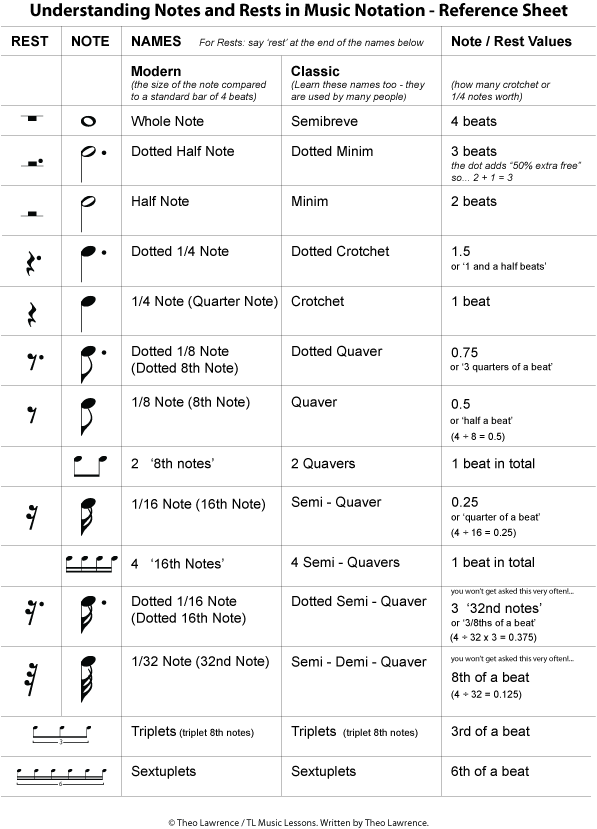
On the guitar, playing a rest isn't a passive activity. Since the strings of an acoustic guitar sustain naturally, you must actively stop them from vibrating to create silence.
Finally, let's look at how to translate the concept of a rest into a physical action on the guitar.
Read the short section titled Stopping one string. This explains the basic technique of using a finger to dampen a ringing string, which is how you will "play" a rest.
Conclusion
In this lesson, you've taken your first step into the rhythmic dimension of music. We've moved from the physical mechanics of playing notes to the logical system that governs their timing.
Key Takeaways:
- Rhythm is the mathematical organization of sound and silence over time.
- The beat serves as the fundamental unit of musical time.
- Basic note durations are defined by simple ratios: a whole note (4 beats), half note (2 beats), and quarter note (1 beat).
- Every note has a corresponding rest of the same duration, representing measured silence.
- On the guitar, executing a rest is an active technique of muting the strings.
In our next lesson, we will build directly on this foundation by exploring the 4/4 time signature. This is the framework that organizes these beats and note values into the "measures" you saw mentioned in the resources, giving a repeating structure to our rhythms. We will then combine this knowledge to begin counting a steady beat while playing.