Welcome to your next lesson! In our previous session, we focused on the crucial skill of transitioning smoothly between the open chords you've learned. We approached this systematically, like optimizing a physical algorithm, by focusing on economy of motion and using anchor fingers.
Today, we'll put those smooth transitions to work by adding a new layer of rhythmic complexity. Our goal is to perform strumming patterns using eighth notes to create more rhythmic interest. Up to now, we've mostly worked with quarter notes—one strum per beat. By subdividing that beat, we unlock a vastly more expressive and dynamic rhythmic vocabulary, which is the engine behind the sound of most popular music. Think of it as upgrading your system's clock speed; we're about to double the resolution of your rhythmic grid.
The Eighth-Note Framework: Your Rhythmic Operating System
In previous lessons, we counted a measure in 4/4 time as "1, 2, 3, 4," with each count representing a quarter note. To play eighth notes, we simply divide each of those quarter notes in half. We do this by adding an "and" between each beat.
So, our count becomes: "1 & 2 & 3 & 4 &".
This creates eight rhythmic slots per measure instead of four.

The most important concept for all strumming is what we can call the Principle of Constant Motion. Your strumming arm should move continuously down and up like a pendulum, even when you aren't hitting the strings. This steady motion is the foundation of good rhythm.
The rule is simple:
- Your hand moves down on the numbered beats (1, 2, 3, 4).
- Your hand moves up on the "ands" (&).
This creates a constant Down - Up - Down - Up motion for the entire measure. Strumming patterns are then created not by changing this motion, but by deciding when to let the pick make contact with the strings and when to miss them intentionally.
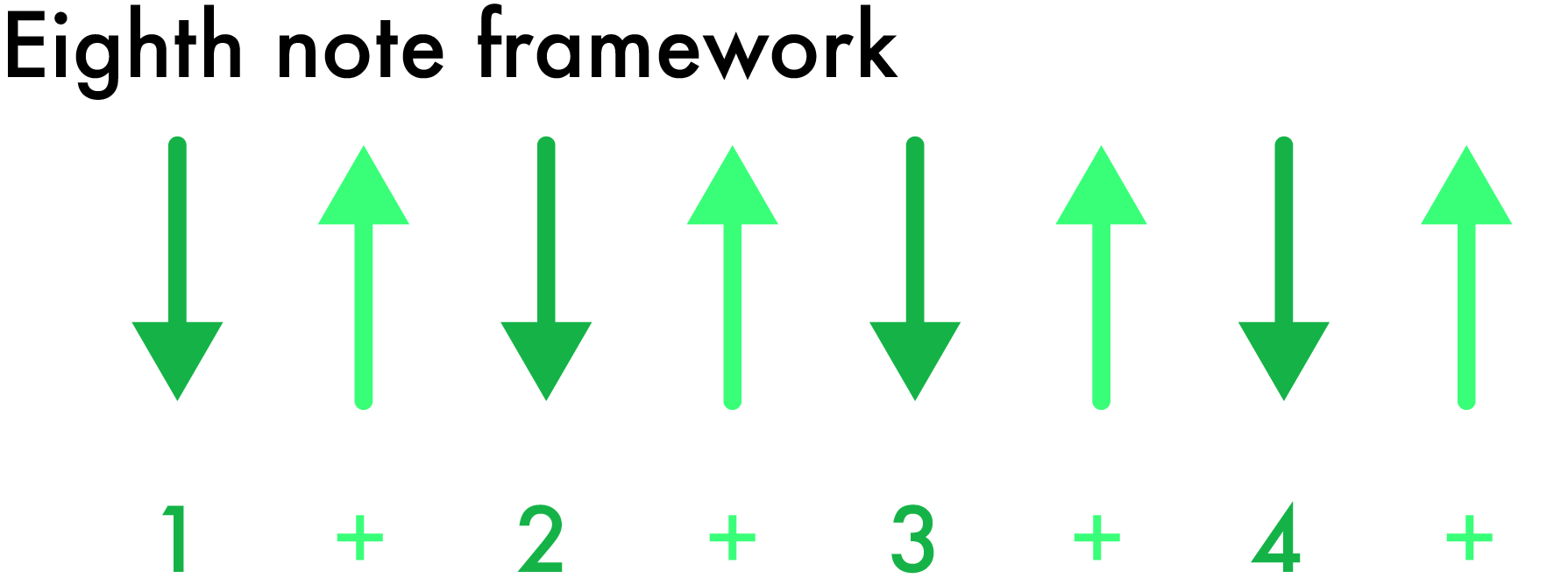
Let's watch a short video that breaks this down clearly.
Learn 8th Note Strumming Patterns with Accents | Beginner Guitar Lesson | Guitar Tricks
This video from Guitar Tricks provides a concise explanation of how to count and play eighth notes.
First, watch the section that explains counting eighth notes. Then, watch the demonstration of strumming eighth notes, where the instructor applies the down-on-the-beat, up-on-the-off-beat rule.
This idea of a constant underlying framework is central to mastering rhythm. It's much more efficient than memorizing dozens of patterns as unique sequences of movements.
How to master strumming as a beginner guitarist — Guitar Nutrition
This article from Guitar Nutrition explains this "framework" concept very well and introduces the idea of "intentional strumming," which aligns with your goal of understanding the theory behind your playing.
Please read the first section, The four strumming frameworks, to solidify the core idea. Then, read the sections What is intentional strumming? and How to practice strumming patterns. These will help you understand the goal: not just to copy patterns, but to internalize the rhythmic grid so you can eventually create your own variations.
Mechanics and First Patterns
With the theory in place, let's turn to the physical execution. Maintaining the "pendulum" motion requires a relaxed arm and wrist.
Stuart's Guide to Successful Strumming - Guitar Lessons with Stuart!
In this video, "Stuart's Guide to Successful Strumming," the instructor does an excellent job demonstrating what he calls the "pendulum principle."
Watch the first part where he introduces this principle and demonstrates straight eighth-note strumming. Pay close attention to how his arm keeps moving. Following that, watch the section on physical technique, which covers maintaining a loose wrist and holding the pick correctly for strumming.
Now, let's create our first real pattern. We'll do this by omitting strums from the full down-up framework. This is the key to creating rhythmic interest.
One of the most common strumming patterns in acoustic music is: Down, Down-Up, (skip), Up, Down-Up.
Let's map this to our eighth-note count:
| Count: | 1 | & | 2 | & | 3 | & | 4 | & |
|---|---|---|---|---|---|---|---|---|
| Strum: | D | D | U | U | D | U | ||
| Motion: | D | U | D | U | D | U | D | U |
Notice that your hand performs the full Down-Up motion on every beat. On the "&" of 1 and the downbeat of 3, your hand is still moving, but you simply don't let the pick hit the strings.
The following article breaks down this exact process of creating patterns by leaving out strums.
How to Make Up the Coolest Strumming Patterns | Beginner Guitar
This article from Play Guitar Academy demonstrates how to build interesting patterns by starting with a base and then modifying it.
Read the section The Classic Pattern. The pattern described here (D D U (rest) U D U) is precisely the one we are learning. Pay attention to the "Pro Tip" about even hand motion. Then, read the concluding section, Why This Works, which reinforces the power of understanding the underlying eighth-note grid.
Integration: Combining Strumming with Chord Changes
This is where your work from the last lesson pays off. How do you execute a smooth chord change while your hand is busy with a constant eighth-note pattern? There's a specific technique for this, and it's a game-changer.
The "secret" is to use the very last up-strum of a measure as your moment to switch. As you strum "up" on the "&" of 4, you lift your fretting hand off the strings. This creates a brief "open string" strum that is rhythmically correct and gives your fingers the time they need to travel to the next chord shape, landing just in time for the downbeat of "1" in the new measure.
Let's see this technique in action.
Stuart's Guide to Successful Strumming - Guitar Lessons with Stuart!
We'll return to Stuart's video, as he demonstrates this exact technique.
Watch the final section of the video from this crucial tip on changing chords. He explains how on the last "up" strum, you lift your fingers to prepare for the next chord.
This "lift and switch" method is the algorithm for fluid chord changes within strumming patterns.
Practice Routine (~20 minutes)
Set a metronome to a slow tempo (around 60-70 BPM).
-
Warm-up: The Pendulum Drill (5 minutes)
- Fret an E minor chord.
- Play a continuous, straight eighth-note pattern:
D U D U D U D Ufor the entire measure. - Focus entirely on keeping your wrist loose and your arm moving in a constant, relaxed pendulum motion. Count "1 & 2 & 3 & 4 &" out loud.
-
Pattern Development (5 minutes)
- Stay on the E minor chord.
- Now, practice the main pattern for this lesson:
D - D U - U D U. - Your primary goal is to feel your hand continuing the motion on the skipped strums (the '&' of 1 and the '3'). This is the most important skill to develop.
-
Integration Test (10 minutes)
- Use the chord progression: G -> C -> Em -> D
- Play one full measure of the
D - D U - U D Upattern for each chord. - Apply the "lift and switch" technique on the "&" of 4 to change chords.
- On the G chord measure, as you play the final up-strum, lift your fingers and move towards the C shape.
- Land the C chord on beat 1 of the next measure. Repeat for C to Em, and so on.
- Your goal is not speed, but clean chords and uninterrupted rhythm. It is better to be slow and correct than fast and sloppy.
Conclusion
Today we moved beyond simple downstrums and unlocked a new rhythmic dimension with eighth notes. You've learned that complex patterns aren't random, but are built upon a logical and constant framework of motion.
Key Takeaways:
- Eighth-note rhythm is counted "1 & 2 & 3 & 4 &".
- The Principle of Constant Motion is key: your strumming hand moves down on the beats and up on the "ands," like a pendulum.
- Interesting strumming patterns are created by intentionally skipping strums while maintaining this constant motion.
- To change chords smoothly, lift your fretting hand on the last up-strum of the measure to give yourself time to move to the next shape.
In our next lesson, we will delve deeper into creating rhythmic feel. We will formally explore syncopation—the art of accenting the off-beats—and learn how to use muted strums to add a percussive quality to your playing.