Welcome to your seventh lesson. In our previous discussion, we profiled the various threat actors that populate the cybersecurity landscape, focusing on who they are and why they attack. Now, we shift our focus from the "who" to the "how."
This lesson introduces the Cyber Kill Chain, a foundational framework that models the sequence of actions an adversary must take to achieve their objectives. Your goal for this lesson is to be able to map an attack scenario to the seven distinct stages of this chain. For an aspiring SOC Analyst, this skill is indispensable. It transforms a complex intrusion from a single overwhelming event into a logical progression of steps, each providing an opportunity for detection and defense.
Understanding the Attack Lifecycle
A successful cyberattack is rarely a single action. It is a campaign, a series of calculated moves. The Cyber Kill Chain, developed by Lockheed Martin, provides a model to understand this lifecycle. It visualizes an attack as a sequence, and crucially, an adversary's failure at any stage can break the entire chain of attack.
The video below, from cybersecurity professional Adam Goss, offers a concise introduction to the framework and its purpose.
The Cyber Kill Chain Explained: Map & Analyze Cyber Attacks!
This video explains the origin and purpose of the Cyber Kill Chain framework.
Watch the initial segment from the beginning up to the start of the stage-by-stage breakdown. Pay close attention to how it's used as a structured analytical tool for intrusion analysis and reporting.
The framework consists of seven stages that an adversary must progress through. The following image provides a high-level overview of these stages.
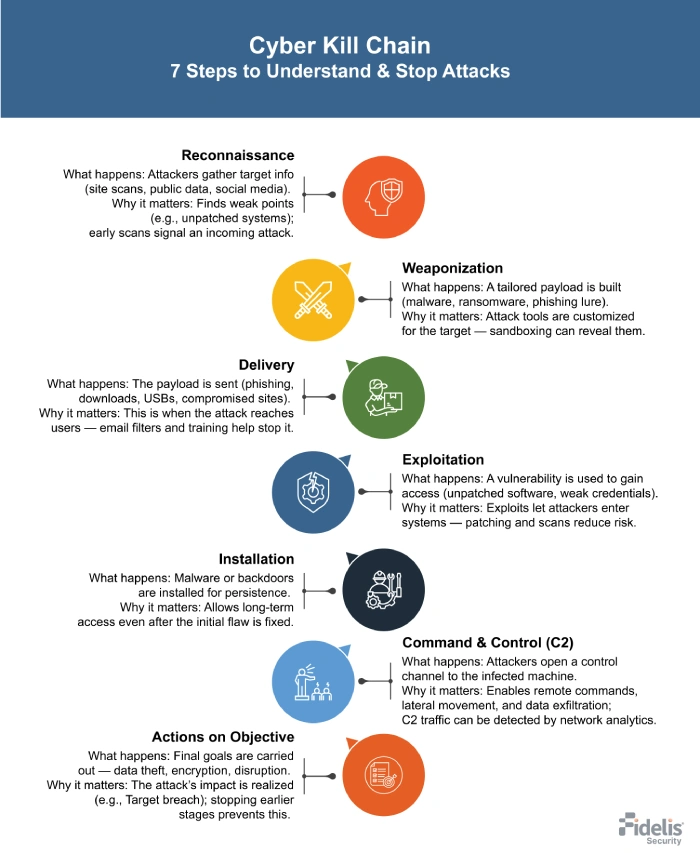
Now, let's explore each of these stages in detail.
The Seven Stages of the Cyber Kill Chain
To fully grasp the model, we will walk through each of the seven stages. As you go through them, think like both an attacker and a defender. What must the attacker accomplish at each step? And what opportunities does that create for a SOC analyst to detect or block their activity?
This next segment of the video you just watched provides an excellent walkthrough of all seven stages.
The Cyber Kill Chain Explained: Map & Analyze Cyber Attacks!
This part of the video details what occurs in each of the seven stages.
Watch the segment from "The first stage is reconnaissance" to the end of the "actions on objectives" description. This will give you a clear, sequential understanding of the entire attack lifecycle.
To reinforce these concepts, let's look at them again through a slightly different lens. The following article walks through the same seven stages using a running scenario of a fictional attacker named "Megatron." This narrative approach helps solidify the practical meaning of each phase.
TryHackMe Cyber Kill Chain Room
This article from Medium provides detailed explanations of each stage of the Cyber Kill Chain with concrete examples and definitions.
Read through the descriptions for each of the seven stages, from Task 2 (Reconnaissance) through Task 8 (Actions on Objectives). Focus on the definitions of key terms like OSINT, weaponizer, payload, lateral movement, persistence, and C2 beaconing.
Let's briefly summarize the stages and their defensive implications:
- Reconnaissance: The attacker gathers information about the target.
- Defense: Minimize public exposure of technical details. Monitor for unusual network scanning.
- Weaponization: The attacker couples an exploit with a payload to create a deliverable weapon (e.g., a malicious PDF).
- Defense: This stage is often invisible to defenders. The focus is on preparing for the next stages.
- Delivery: The weapon is transmitted to the target (e.g., via a phishing email).
- Defense: Email filtering, web proxies, and user training are key to blocking delivery attempts.
- Exploitation: The weapon's code is triggered, taking advantage of a vulnerability to execute on the target's system.
- Defense: Patch management, endpoint security (antivirus/EDR), and user access controls can prevent or contain exploitation.
- Installation: The attacker installs malware or a persistence mechanism to maintain access over time.
- Defense: Monitor for unexpected new files, services, or registry key modifications.
- Command & Control (C2): The malware establishes a communication channel back to the attacker.
- Defense: Network monitoring for unusual outbound connections (beaconing), especially using firewall and proxy logs.
- Actions on Objectives: The attacker uses their access to achieve their goal (e.g., data theft, encryption).
- Defense: Internal network monitoring, data loss prevention (DLP) tools, and incident response playbooks.
Applying the Model: The Target Data Breach
Now for the central goal of this lesson: mapping a real-world attack to the Kill Chain. Let's analyze the infamous 2013 Target data breach, a landmark case study in cybersecurity.
The following resource provides a concise summary of how this attack unfolded.
Cyber Kill Chain Model Breakdown and How It Works?
This article from SentinelOne provides several examples of famous cyberattacks mapped to the Kill Chain.
Read the paragraph titled "Target Data Breach (2013)". As you read, try to mentally place each action into one of the seven stages we just discussed.
Let's break down the Target breach together, mapping it to the Kill Chain:
- Reconnaissance: Attackers identified a third-party vendor (Fazio Mechanical, an HVAC company) that had network access to Target. This was their weak point of entry.
- Weaponization: They crafted phishing emails containing malware.
- Delivery: They sent these phishing emails to employees at Fazio Mechanical.
- Exploitation: An employee at the HVAC company was tricked, allowing the attackers to steal network credentials that were valid for Target's network. They used these credentials to gain their initial foothold.
- Installation: The attackers installed memory-scraping malware onto Target's Point-of-Sale (POS) systems—the cash registers.
- Command & Control (C2): The malware on the POS systems communicated with the attackers' external servers, sending them the stolen data.
- Actions on Objectives: The attackers successfully exfiltrated 40 million credit card numbers and 70 million customer records.
By breaking the attack down this way, you can see how a failure at any point could have stopped the breach. If Fazio's employees had been trained to spot the phishing email (Delivery), or if Target had segmented its network so a vendor couldn't access POS systems (Installation/Lateral Movement), the outcome would have been very different.
Limitations and What Comes Next
The Cyber Kill Chain is a powerful model, but it's not perfect. It was created in 2011 and is primarily focused on traditional malware attacks that penetrate a network perimeter. It is less effective at describing insider threats or attacks that don't follow this linear path.
TryHackMe Cyber Kill Chain Room
This section of the Medium article discusses the limitations of the traditional Kill Chain.
Read the conclusion. Note the critique that it doesn't handle insider threats well and has not been updated to reflect the evolution of TTPs (tactics, techniques, and procedures).
This is a perfect lead-in to our next topic. While the Kill Chain provides a high-level strategic overview of an attack's phases, modern defense requires a more granular understanding of specific adversary behaviors.
Conclusion
In this lesson, you've learned how to deconstruct a cyberattack into a logical sequence using the Cyber Kill Chain framework. This is a fundamental skill for security analysis, providing a structured way to investigate, report on, and ultimately defend against intrusions.
Here are your key takeaways:
- The Cyber Kill Chain is a seven-stage model describing the lifecycle of a cyberattack: Reconnaissance, Weaponization, Delivery, Exploitation, Installation, Command & Control, and Actions on Objectives.
- It serves as an analytical model for defenders, highlighting that an attack's success depends on completing each stage in sequence.
- Disrupting the adversary at any single stage can break the chain and prevent the attack from succeeding.
- Mapping real-world incidents, like the Target breach, to the Kill Chain provides a clear narrative of how an attack occurred and where defenses could have been applied.
- While foundational, the model has limitations, particularly with modern threats and insider attacks.
What's Next?
The Kill Chain gives us the "what" and "when" of an attack's phases. In our next lesson, we will dive deeper into the specific "how" of adversary actions. We'll introduce the MITRE ATT&CK framework, a comprehensive knowledge base of adversary tactics and techniques. This framework complements the Kill Chain by providing the granular, technical detail needed for modern threat detection and response.