Welcome back! In our first lesson, we established the CIA triad as the fundamental goal of cybersecurity—protecting the Confidentiality, Integrity, and Availability of information. We're defending our systems for a reason, and the triad gives us that reason.
Today, we'll build the vocabulary to describe how those systems can be attacked. To be an effective SOC analyst, you must speak the language of security with precision. Misusing terms can lead to confusion and miscommunication when seconds count. This lesson will focus on four of the most fundamental and often confused terms: threats, vulnerabilities, risks, and exploits. By the end, you'll be able to differentiate between them clearly and use them correctly to describe any security scenario.
A Tale of Four Terms: An Analogy
The relationship between these four terms can be tricky at first. Let's begin with a short, clear video from IBM Technology that uses a simple analogy—a bank robbery—to introduce the concepts before applying them to IT. This will give you a strong intuitive grasp before we dive into the formal definitions.
Threats Vulnerabilities and Exploits
Please watch this video, "Threats Vulnerabilities and Exploits," which masterfully breaks down these concepts.
Watch the entire video, paying close attention to how each term is defined first in the context of the bank and then in the IT context. Threat: The action or actor that could cause harm. Vulnerability: The weakness in the system. Exploit: The method used to take advantage of the weakness. Risk: The potential for loss.
As the video illustrates, these concepts are linked in a logical chain. A threat (or threat actor) uses an exploit to take advantage of a vulnerability, which creates risk.
Formalizing the Concepts
Now that you have the general idea, let's lock in the definitions. As a SOC analyst, you'll need to be precise, so we'll examine each term more closely. The following infographic provides a great visual summary of the core relationship.
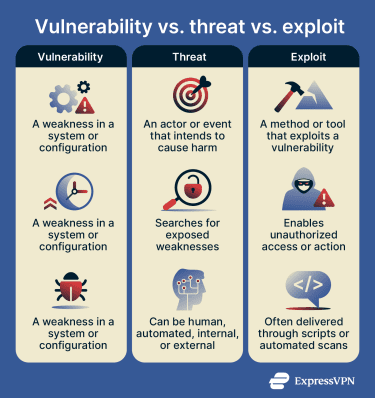
Let's break down this relationship further.
1. Vulnerability: The Flaw or Weakness
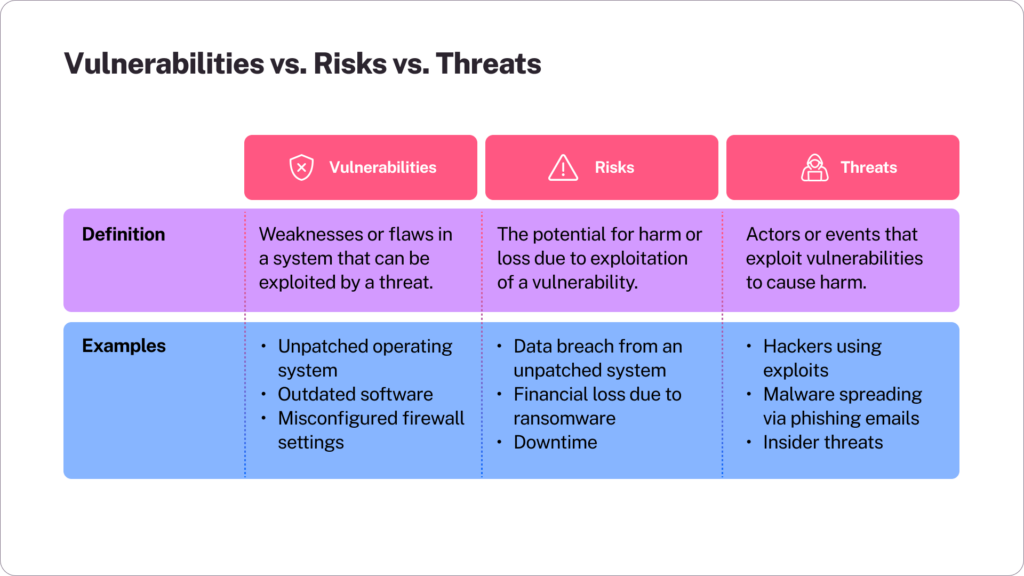
A vulnerability is a weakness, flaw, or gap in a system's security. It's the "unlocked door" or the "open window" in the analogy. On its own, a vulnerability is passive; it doesn't cause harm by itself. It's simply a condition that could potentially be taken advantage of.
These weaknesses can be technical or human. The following article from SAFE Security gives excellent examples of both, tying them to well-known cyber incidents.
What Is a Vulnerability in Cybersecurity?
This article provides concrete examples that bring the concept of vulnerabilities to life.
Read the section titled Examples of Vulnerabilities. As you read, notice how a simple issue like an "unpatched software" vulnerability led to the massive WannaCry ransomware attack.
Common categories of vulnerabilities include:
- Unpatched Software/Systems: Like the Windows vulnerability exploited by WannaCry.
- Misconfigurations: Such as leaving a cloud database open to the public internet.
- Weak Credentials: Using default or easily guessable passwords.
- Lack of Encryption: Transmitting sensitive data in plaintext.
- Human Error: An employee susceptible to a phishing email.
2. Threat: The Actor or Event
A threat is any person or event that has the potential to exploit a vulnerability and cause harm. In our analogy, the threat is the "burglar." In cybersecurity, a threat is often carried out by a threat actor—a person or group.
What drives a threat actor? Understanding their motivation is key to predicting their actions, a crucial skill for a SOC analyst. This next video explores the three factors that drive a threat: Motive, Opportunity, and Mean (or capability).
Understanding Threats, Risks, and Vulnerabilities for CC & Security+ Success
This video from Prabh Nair offers a detailed breakdown of what constitutes a "threat."
Watch the segment from the beginning until he transitions to the next topic. Focus on the discussion of Motive, Opportunity, and Mean. This framework is essential for threat analysis.
As the video explains:
- Motive: The reason for the attack (financial gain, espionage, ideology, revenge).
- Opportunity: The situation that allows the attack to occur (the existence of an unpatched, internet-facing server).
- Mean (Capability): The skills and tools the actor possesses to carry out the attack.
3. Exploit: The Method or Tool
An exploit is the specific code, script, or technique that a threat actor uses to take advantage of a specific vulnerability. It's the "crowbar" used to pry open the weak window frame.
An exploit is the bridge between the threat actor and the vulnerability. Many vulnerabilities exist that have no known exploit; these are less urgent. But once an exploit is developed and shared, the race is on to patch the vulnerability before it's widely abused.
The following reading details the typical steps an attacker follows to leverage an exploit.
Cybersecurity Vulnerabilities: Exploits, Threats, & Risks
This article from miniOrange outlines the lifecycle of an attack, showing how an exploit fits into the larger picture.
Read the section titled How Vulnerabilities Are Exploited. Notice that the "Exploitation" step is just one part of a longer process that includes reconnaissance, weaponization, and delivery.
4. Risk: The Potential for Loss
Finally, we arrive at risk. Risk is the potential for loss or damage when a threat exploits a vulnerability. It combines two critical factors:
- The likelihood (or probability) that the event will happen.
- The impact (or severity) of the damage if it does happen.
Risk = Likelihood x Impact
This simple formula is the foundation of all security decision-making. We can't fix every vulnerability, so we use risk to prioritize. A vulnerability on a critical server containing customer data (high impact) that has a publicly available exploit (high likelihood) represents a very high risk and must be fixed immediately.
This table provides a final, clear comparison of these three core concepts, with risk being the outcome of their interaction.
Putting It All Together: A SOC Analyst's View
Let's walk through a scenario from a SOC analyst's perspective:
- Asset: A public-facing web server for an e-commerce company.
- Vulnerability: The server is running an outdated version of the Apache web server software, which has a known remote code execution vulnerability (CVE-2021-41773).
- Threat Actor: A financially motivated cybercrime group. Their motive is to steal credit card data. They have the mean (skills and tools) to scan the internet for this vulnerability. The server's presence on the internet provides the opportunity.
- Exploit: The group uses a specific Python script that sends a crafted HTTP request to the vulnerable server, allowing them to run commands on it.
- Risk: The high-impact risk is that the threat actor will use their access to steal the entire customer credit card database, leading to massive financial loss, regulatory fines, and reputational damage. This violates the Confidentiality and Integrity of the data.
Your job as a SOC analyst would be to detect the exploit in progress (e.g., by seeing suspicious commands in the server logs via your SIEM) and initiate an incident response to contain the threat and mitigate the risk.
Conclusion
In this lesson, we dissected the precise vocabulary used to describe security weaknesses and attacks. Mastering these terms is non-negotiable for a career in cybersecurity.
Here are the key takeaways:
- A Vulnerability is a passive weakness or flaw in a system.
- A Threat is an active agent or event that could cause harm.
- An Exploit is the specific tool or technique used by a threat to leverage a vulnerability.
- Risk is the potential for loss, calculated by considering the likelihood of an attack and the impact it would have.
You can remember the core relationship like this: A threat actor launches an exploit against a vulnerability to create an effect, which poses a risk to the organization.
What's Next?
Now that we understand the CIA triad (what we protect) and the language of attacks (how we fail to protect it), our next lesson will focus on the solutions. We will classify the different types of security controls—preventive, detective, corrective, and more. These are the specific measures we implement to manage risk by reducing vulnerabilities, deterring threats, and detecting exploits.