Ciao! Welcome back to our journey into Italian. In the last lesson, we took a deep dive into the verbs sapere (to know a fact/skill) and potere (to be able to/have permission). You learned how to conjugate them and, crucially, when to use each one.
Today, we'll put that knowledge into action. This lesson is all about one of the most practical skills for any traveler: asking for help. We will focus on two essential phrases that use the very verbs you just learned:
Può aiutarmi?(Can you help me?)Sai dov'è...?(Do you know where... is?)
By the end of this lesson, you will be able to confidently approach someone on the street in Italy to ask for assistance or directions, combining the vocabulary and grammar we've covered so far.
1. Getting Attention: Scusi vs. Scusa
Before you can ask your question, you need to politely get someone's attention. In Italian, this is done with "Excuse me," but you must choose between the formal and informal versions. This is a vital distinction in Italian culture.
Directions in Italian: essential phrases, pronunciation, and ...
This article provides a concise explanation of the difference between the formal 'Scusi' and the informal 'Scusa'. Mastering this is the first step to a polite interaction.
Please read the first main section, titled 'How do I ask for and understand directions in Italian?'. Focus on the first paragraph which explains when to use 'Scusi' versus 'Scusa'.
To summarize the key point:
- Use
Scusi(SKOO-zee) with strangers, older people, or in formal settings (shops, hotels). This corresponds to the formal "you" (Lei). - Use
Scusa(SKOO-zah) with friends, family, and people your own age. This corresponds to the informal "you" (tu).
When in doubt, always use Scusi. It's polite and will never be considered incorrect.
2. Asking for General Help: Può aiutarmi?
Now that you have someone's attention, you might need to ask for general help. This is a perfect use case for the verb potere (to be able to), as you are asking if someone has the possibility or willingness to assist you.
The phrase is Può aiutarmi? (Can you help me?). Let's break this down:
Può: This is the formalLeiconjugation ofpoterethat we learned.aiutarmi: This is a compound word. It's the infinitive verbaiutare(to help) combined with the pronounmi(me). In Italian, object pronouns can often be attached directly to the end of an infinitive verb.
The informal version, which you would use after Scusa, is Puoi aiutarmi?. Here, puoi is the tu form of potere.
You will very often see or hear this phrase with a slightly different word order:
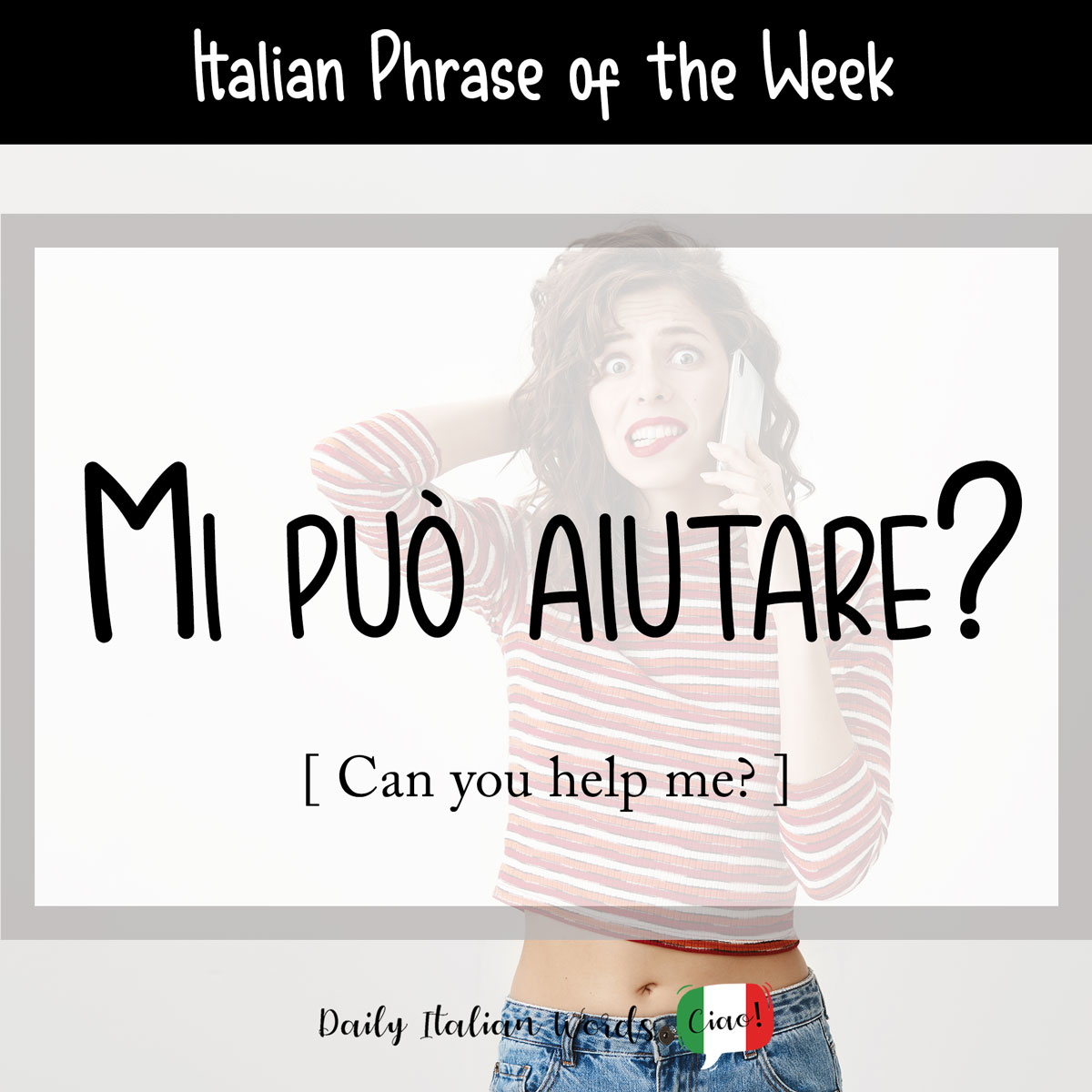
So, your two key phrases for asking for help are:
- Formal:
Scusi, può aiutarmi? - Informal:
Scusa, puoi aiutarmi?
3. Asking "Do you know where...?": Sai dov'è...?
More often than not, you'll need to ask for specific information, like the location of your hotel or the nearest metro station. This is where the verb sapere (to know a fact) comes in.
This next resource provides a fantastic, context-rich explanation of how to form this question. It uses a short dialogue which aligns with your preference for learning phrases first, followed by a clear grammatical breakdown.
Italian Verb Sapere (To Know): When and How to Use It
Let's explore how to use 'sapere' to ask for locations. This article section features a dialogue and then carefully explains the difference between the informal 'Sai dov'è...?' and the formal 'Sa dov'è...?'.
Read the section that begins with the dialogue between Matteo and Katie (starts with 'K: Sai dov'è quel posto...?'). Focus on the breakdown of the phrase 'Sai dov'è...?' and the explanation of its formal equivalent, 'Sa dov'è...?'.
To recap the core of that reading:
- The question structure is:
sapere(conjugated) +dov'è(where is) + [the place]. - Informal:
Sai dov'è la stazione?(Do you know where the station is?) - Formal:
Sa dov'è la stazione?(Do you know where the station is?)
Notice that the only difference is the verb form: sai for tu and sa for Lei.
4. Listening Practice
Now that you've seen the phrases in writing, let's train your ear to recognize them. The following video contains short, realistic dialogues where people ask for directions.
How to ask for and give directions in Italian – PART 2
Listen to how these phrases sound in a natural conversation. This video presents several dialogues where a person politely asks for directions using the formal 'Sa dov'è...?'.
Watch 'dialogo 1' (from 03:47 to 04:20) and 'dialogo 3' (from 07:11 to 07:50). Pay attention to the question being asked: 'Scusi, sa dov'è il centro commerciale?' and 'Scusi, sa dov'è la palestra?'. You don't need to understand the full answer yet—just focus on the question.
Test your understanding!
Imagine you are in Italy. How would you ask the following questions?
- You are lost and want to ask an elderly woman for help.
- You need to find the nearest restaurant and decide to ask a university student.
- You want to ask your new friend, Marco, if he knows where the cinema is.
Show answer
Scusi, può aiutarmi?(You use the formalScusiandpuòbecause she is an elder.)Scusa, sai dov'è un ristorante qui vicino?(You can use the informalScusaandsaiwith a fellow student. "un ristorante qui vicino" means "a restaurant nearby".)Ciao Marco, sai dov'è il cinema?(Since Marco is a friend, you use the informalsai.)
Conclusion
Congratulazioni! You have now mastered two of the most essential phrases for any traveler in Italy. By combining today's lesson with what you've already learned, you can form complete, polite, and practical questions.
Key Takeaways:
- Always start a conversation with a stranger with
Scusi. UseScusawith peers and friends. - To ask for general assistance, use the verb
potere:Può aiutarmi?(formal) orPuoi aiutarmi?(informal). - To ask for a location, use the verb
sapere:Sa dov'è...?(formal) orSai dov'è...?(informal).
In our next lesson, we will focus on the other side of the conversation: how to ask for and understand basic directions like a destra (to the right), a sinistra (to the left), and dritto (straight ahead). After all, asking the question is only half the battle!
A presto