Ciao! Welcome back.
In our last lesson, we learned how to use avere to talk about possession and physical states, distinguishing between "there is a book" (c'è un libro) and "I have a book" (ho un libro). Today, we'll take that concept of possession one step further. You'll learn how to transform "a book" into "my book," "a car" into "your car," and so on.
This lesson focuses on using possessive adjectives (like mio, tuo, suo) to talk about ownership. This is a fundamental skill for your goal of casual conversation, allowing you to talk about your friends, your luggage, your hotel room, and anything else you might encounter on your travels.
1. The Golden Rule of Italian Possessives
Let's start with the single most important—and most different—rule compared to English. In English, the possessive shows the owner's gender (e.g., his book vs. her book). In Italian, the possessive adjective must agree in gender and number with the thing being owned, not the owner.
- If the owned item is masculine singular (like
il libro), the possessive must also be masculine singular. - If the owned item is feminine singular (like
la casa), the possessive must be feminine singular.
This is a core logical rule in Italian grammar. Let's watch a video that explains this concept perfectly.
[Italian Adjectives] How to use POSSESSIVE Adjectives in Italian correctly | Rules + Practice
In this video, 'How to use POSSESSIVE Adjectives in Italian correctly' by Italian Teacher Valentina, she clearly explains this crucial rule.
Watch the segment from 03:11 to 05:26. Pay close attention to the explanation of why the gender of the owner doesn't matter, but the gender of the noun does. The example 'la mia casa' (my house) is used to illustrate this for both a man and a woman.
This means that to say "his book" and "her book," you use the exact same phrase: il suo libro. The possessive suo agrees with libro (masculine), not with "his" or "her". The context of the conversation tells you who the owner is.
2. The Forms of Possessive Adjectives
Now that you understand the rule, let's look at the actual words. Each possessive has up to four forms to match the gender (masculine/feminine) and number (singular/plural) of the noun it describes.
This table provides a complete overview.
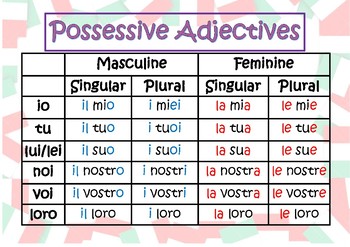
As you can see from the table, most possessives follow a clear pattern:
mio(m. sg.),mia(f. sg.),miei(m. pl.),mie(f. pl.)tuo(m. sg.),tua(f. sg.),tuoi(m. pl.),tue(f. pl.)
There is one important exception:
Loro(their) is invariable—it never changes its form. Only the definite article before it will change (il loro,la loro,i loro,le loro).
3. How to Build a Possessive Phrase
In the previous lessons on nouns and articles, you learned that nouns have gender and number. That knowledge is the foundation for using possessives correctly. The standard structure is simple but strict:
Definite Article + Possessive Adjective + Noun
For example, to say "my car":
- Noun:
macchina(car) is feminine singular. - Article: The definite article for
macchinaisla. - Possessive: The feminine singular form for "my" is
mia. - Result:
la mia macchina.
Let's explore this with some practical examples, which aligns with your preference for learning phrases first.
Italian Possessive Adjectives: how to use mio, tuo, suo…
The article 'Italian Possessive Adjectives' from Joy of Languages is great for seeing these phrases in context. It uses simple, memorable examples.
Read the sections 'How to Use Italian Possessive Adjectives' and 'Italian Possessive Adjectives: A Common Mistake'. Focus on the examples like la mia pizza, il mio passaporto, and the explanation for il suo libro (his/her book).
Test your understanding!
Let's apply this logic. How would you say the following phrases in Italian?
- Your (sg.) key (
la chiave, f.) - Our tickets (
i biglietti, m. pl.) - Her telephone (
il telefono, m.) - Their house (
la casa, f.)
Show answer
la tua chiave(chiaveis fem. sg., so we uselaandtua)i nostri biglietti(bigliettiis masc. pl., so we useiandnostri)il suo telefono(telefonois masc. sg., so we useilandsuo- remember, "her" doesn't change the adjective!)la loro casa(casais fem. sg., so we usela;lorois invariable)
4. Practice and Exceptions
Now, let's get some active practice. The following video includes a short quiz section where you can test your choices.
5. Learn Italian Elementary (A2): Aggettivi possessivi - Possessive adjectives (pt 1)
The video 'Aggettivi possessivi - Possessive adjectives' by Passione Italiana has an excellent practice section.
Watch from 06:19 to 11:35. The presenter will give you a sentence with a blank. Try to say the correct possessive adjective out loud before she reveals the answer. At 11:35, she also gives a very important summary about always using the article.
A Quick Note on Family Members
As you saw mentioned in the resources, there is a specific exception to the article rule when talking about singular, unmodified family members. In these cases, you drop the article.
mia madre(my mother)tuo fratello(your brother)
However, the article comes back for plural or modified family members:
i miei fratelli(my brothers)la mia cara madre(my dear mother)
This is a nuanced topic that we will revisit later. For now, just be aware that this exception exists, but continue to practice the main rule: Article + Possessive + Noun.
Conclusion
Ottimo lavoro! You have now learned how to express ownership, a critical component for describing the world around you.
Key Takeaways:
- The "Golden Rule": Possessive adjectives agree in gender and number with the noun they describe, not the owner.
- The standard structure is Definite Article + Possessive Adjective + Noun (e.g.,
il mio libro). - Most possessives have four forms (
mio, mia, miei, mie), butloro(their) is invariable. - The article is generally required, with a special exception for singular family members that we will explore more later.
This lesson completes our module on "Describing Your World." You can now use essere and avere to describe things, state what exists with c'è and ci sono, express feelings, and now claim ownership.
In our next lesson, we will begin a new module, "Asking Questions & Getting By." You'll learn the essential question words like Chi? (Who?), Dove? (Where?), and Quando? (When?), which will empower you to navigate, ask for information, and take your conversational skills to the next level.
A presto