Ciao! Welcome back to your Italian course.
In our last lesson, you learned how to state your nationality and profession using the verb essere. You saw that words like italiano or svedese are adjectives and that their endings can change. For example, un uomo italiano but una donna italiana.
Today, we will build directly on that idea. Your learning goal is to describe people and things using basic adjectives with correct gender and number agreement. This means you'll learn the system behind why those endings change, so you can describe anything—not just nationality. Being able to say that a coffee is buono (good), a city is bella (beautiful), or a book is interessante (interesting) is a fundamental skill for the casual conversations you want to have.
1. Adjectives in Italian: The Core Concepts
In English, adjectives are simple: "a red car," "red cars." The word "red" never changes. In Italian, as you've seen, adjectives must change to match, or agree with, the gender (masculine/feminine) and number (singular/plural) of the noun they describe. This concept is called accordo (agreement).
There's one other key difference: in Italian, the adjective usually comes after the noun.
- English: The red car
- Italian: La macchina rossa
Let's watch a short video that introduces these two fundamental ideas: agreement and placement.
Italian Adjectives: Grammar and Vocabulary
The 'Professor Dave Explains' channel gives a very clear and concise introduction to how Italian adjectives work, contrasting them with English.
Watch the beginning of the video, from 00:00 to 01:55. Focus on the two main points: 1) adjectives usually go after the noun, and 2) they must agree with the noun's gender and number.
2. The Rules of Agreement: Two Main Groups
So, how do you make an adjective agree? The good news is that there's a logical system. Nearly all Italian adjectives fall into two main groups, based on their endings.
Your background in programming might help you see this as a system with two main "classes" of adjectives, each with its own set of rules for changing its form.
Let's get an overview of these two groups with a video that provides plenty of examples.
Adjectives in Italian - Beginner Italian Course: Lesson 4
Manu from 'Italy Made Easy' provides a great beginner-friendly walkthrough of the two main adjective types, focusing on singular forms first.
Watch from 01:22 to 06:42. Pay attention to the two types of adjectives he discusses: Those that end in -o for masculine and -a for feminine (like buono/buona). Those that end in -e for both masculine and feminine (like interessante).
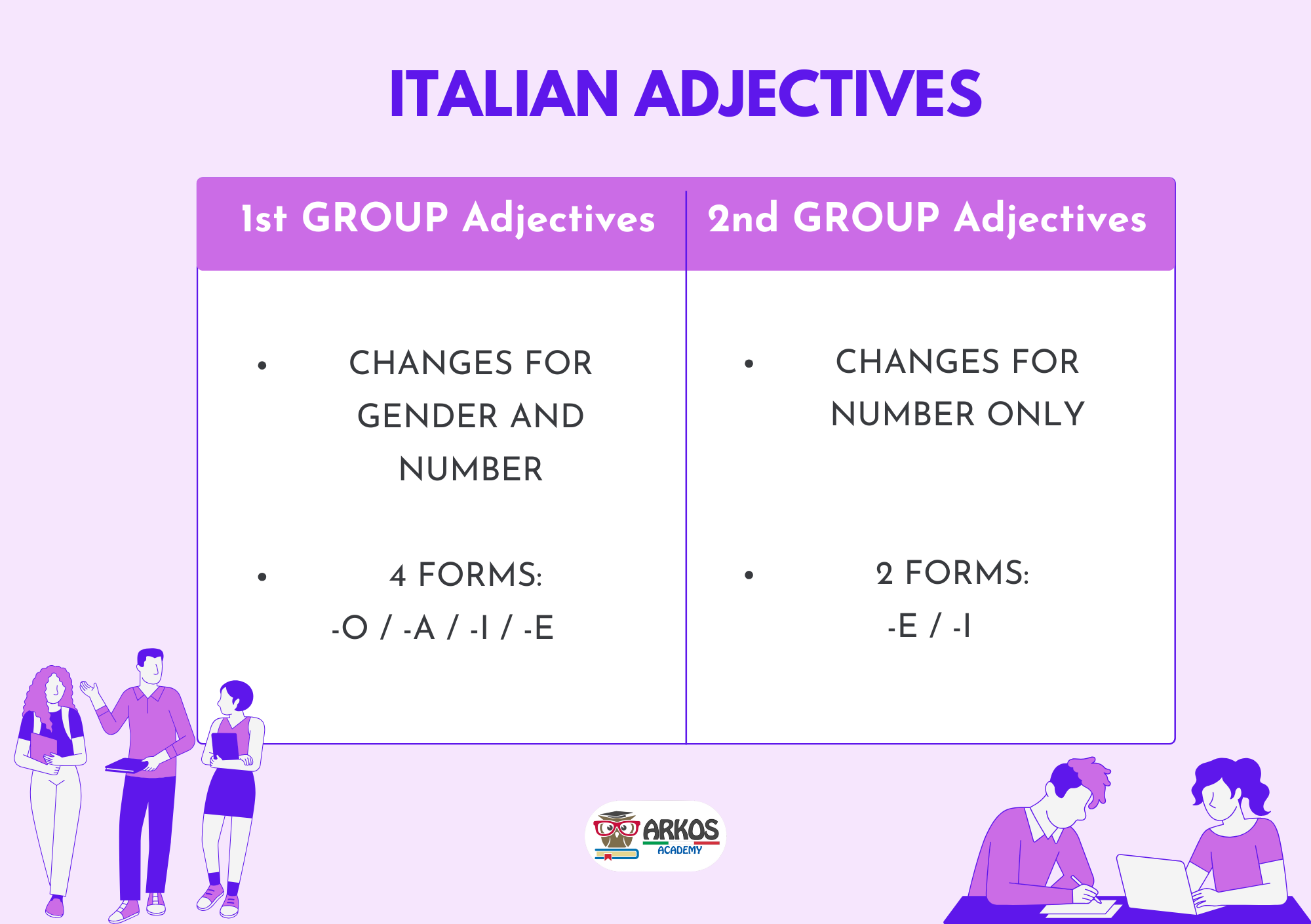
As Manu explained, the two groups function differently:
- Group 1 adjectives have different forms for masculine and feminine.
- Group 2 adjectives use the same form for both genders in the singular.
This visual summary captures the system perfectly:
3. Mastering the Endings: Singular and Plural
Now that you have the conceptual framework, let's lock in the specific rules for both singular and plural forms.
A quick guide to Italian adjectives
This guide from Lingoda provides a clear, detailed breakdown of the agreement rules, complete with an excellent summary table. This is the grammatical reference you can come back to.
Read the section titled 'Gender and number agreement for Italian adjectives'. Focus on the table under 'Plural forms of Italian adjectives'. This table is the key takeaway, as it clearly lays out all the ending changes for both main groups.
Let's summarize that crucial information from the table:
Group 1: Adjectives ending in -o (e.g., rosso - red)
- Masculine singular: -o → il libro rosso (the red book)
- Feminine singular: -a → la macchina rossa (the red car)
- Masculine plural: -i → i libri rossi (the red books)
- Feminine plural: -e → le macchine rosse (the red cars)
Group 2: Adjectives ending in -e (e.g., interessante - interesting)
- Masculine/Feminine singular: -e → il libro interessante, la storia interessante
- Masculine/Feminine plural: -i → i libri interessanti, le storie interessanti
Notice the pattern: for adjectives ending in -e, the singular form is always -e and the plural form is always -i, regardless of gender. This is simpler!
Test your understanding!
Combine the nouns and adjectives below using the correct form of essere. Remember to make the adjective agree with the noun.
- Nouns: la casa (the house, f.), il gatto (the cat, m.), i libri (the books, m.), le ragazze (the girls, f.)
- Adjectives: grande (big), piccolo (small), interessante (interesting), alto (tall)
- La casa / grande -> ___________
- Il gatto / piccolo -> ___________
- I libri / interessante -> ___________
- Le ragazze / alto -> ___________
Show answer
- La casa è grande. (
grandeis a Group 2 adjective, so it ends in -e for the feminine singular.) - Il gatto è piccolo. (
piccolois a Group 1 adjective, ending in -o for masculine singular.) - I libri sono interessanti. (
interessanteis a Group 2 adjective, ending in -i for the plural.) - Le ragazze sono alte. (
altois a Group 1 adjective, ending in -e for the feminine plural.)
4. Building Your Descriptive Vocabulary
Knowing the rules is only half the battle; you also need some adjectives to use! The Lingoda article you just looked at has excellent vocabulary lists.
A quick guide to Italian adjectives
Let's return to the Lingoda guide to pick up some essential vocabulary.
Go to the section 'Lists of essential Italian adjectives by category'. Skim through the lists for 'physical descriptions', 'common situations', and 'personality and mood'. You don't need to memorize them all now, but try to pick out 5-10 that seem most useful to you.
Here are a few high-frequency adjectives to start with:
- Group 1 (-o/-a):
- bello/a - beautiful, handsome
- bravo/a - good, skilled (at something)
- buono/a - good, tasty
- piccolo/a - small
- nuovo/a - new
- vecchio/a - old
- Group 2 (-e):
- grande - big, large
- felice - happy
- triste - sad
- gentile - kind
- facile - easy
- difficile - difficult
Conclusion
Complimenti! You've just learned one of the most fundamental structures in the Italian language. By mastering adjective agreement, you can now add much more detail and precision to your sentences.
Key Takeaways:
- Adjectives in Italian generally go after the noun.
- They must agree in gender and number with the noun they describe.
- There are two main groups: adjectives like bello with four forms (-o, -a, -i, -e), and adjectives like grande with two forms (-e, -i).
- You can now form descriptive sentences like: La pizza è buona (The pizza is good) or I ragazzi sono felici (The boys are happy).
In our next lesson, we'll learn how to talk about what exists in a place using c'è (there is) and ci sono (there are). This will be a perfect opportunity to practice your new adjective skills, by describing the things around you, for example: In piazza c'è una chiesa grande (In the square, there is a big church).
A presto