Introduction
Välkommen tillbaka! In our last lesson, you learned how to start a conversation with the right greeting, paying close attention to the important Italian distinction between formal and informal situations. You can now confidently say hello with Ciao, Salve, or Buongiorno.
Today, we'll take the next logical step in any introduction: saying who you are and where you're from. Our goal is to master the phrases Mi chiamo... (My name is...) and Sono di... (I am from...). Building on last lesson's theme, we'll continue to explore how the choice between formal (Lei) and informal (tu) address affects the questions you'll be asked. By the end of this lesson, you'll be able to handle the first part of a personal introduction in Italian.
Part 1: Stating Your Name
There are two very common ways to state your name in Italian. Let's look at them.
-
Mi chiamo...— This literally translates to "I call myself..." and is the classic phrase you'll find in most textbooks. It means "My name is..."- Example:
Mi chiamo Alex.(My name is Alex.)
- Example:
-
Sono...— This simply means "I am..." and is a very common, slightly more casual alternative.- Example:
Sono Alex.(I am Alex.)
- Example:
Your background in programming might lead you to see these as two functions that produce the same output. In practice, there's a subtle difference in usage that will make you sound more natural. Mi chiamo... can sometimes sound a bit formal or stiff in a face-to-face casual meeting. Sono... is often the preferred choice among native speakers in everyday, informal introductions.
To understand this nuance better, let's watch a short clip.
EASIEST Way to Introduce Yourself in Italian | Step-by-Step Guide + Template
In this video, 'EASIEST Way to Introduce Yourself in Italian', Valentina explains the subtle but important difference between using 'Mi chiamo' and 'Io sono' in real-life situations.
Watch from 01:56 to 04:31. Pay close attention to her explanation of when 'Mi chiamo' is appropriate (e.g., on the phone) versus when 'Io sono' (or just 'Sono') is more common (e.g., in a group).
Asking for a Name
Of course, a conversation is a two-way street. Here is how you ask someone for their name, remembering the formal/informal distinction from our last lesson:
- Informal (to a friend, a peer):
Come ti chiami?(What is your name?) - Formal (to a stranger, an older person):
Come si chiama?(What is your name?)
To see and hear these phrases used in real interactions, the following video shows several brief interviews on the streets of Italy.
Introduce Yourself in Italian (for absolute beginners) | Super Easy Italian 48
This clip from Easy Italian, 'Introduce Yourself in Italian', shows people on the street being asked for their names and responding. It's a great way to hear the natural rhythm of the language.
Watch the first minute of the video (00:00 - 01:02). Listen for the questions 'Come ti chiami?' and 'Come si chiama?' and the responses 'Mi chiamo...' and 'Sono...'. Don't worry about understanding every word; just focus on the key phrases.
Part 2: Stating Your Origin
After names, the next common question is about origin.
Asking "Where are you from?"
Just like with names, the question changes based on formality:
- Informal:
Di dove sei?(Where are you from?) - Formal:
Di dov'è?(Where are you from?)
This article provides a very clear table summarizing how the questions change depending on whether you use the informal tu or the formal Lei.
Introduce yourself in Italian with essential phrases
The article 'Introduce yourself in Italian with essential phrases' has an excellent section that clarifies the formal/informal distinction for key introductory questions.
Please read the section titled 'Choose between tu and Lei with confidence'. Focus on the table that shows the difference between 'Come ti chiami?' / 'Come si chiama?' and 'Di dove sei?' / 'Di dov’è?'. This will reinforce the concept we've been discussing.
Answering "I am from..."
The most direct way to answer is with the phrase Sono di... followed by your hometown or city of origin.
Sono di [city name]— I am from [city name].- Example:
Sono di Stoccolma.(I am from Stockholm.) - Example:
Sono di New York.(I am from New York.)
- Example:
Let's return to the Easy Italian video to see this phrase in action.
Introduce Yourself in Italian (for absolute beginners) | Super Easy Italian 48
This next clip from the same Easy Italian video demonstrates how people respond when asked where they are from.
Watch from 01:02 to 01:33. Listen for the question 'Di dove sei?' and the common answer 'Sono di...'
For a bit more context, you can also use your nationality. We will cover adjectives and nationalities in a later lesson, but for now, it's useful to know the pattern: Sono svedese (I am Swedish).
Putting It All Together: A Sample Conversation
Now let's see how these phrases combine to form the beginning of a conversation. Reading a full dialogue helps put the individual pieces into a logical flow.
How to Introduce Yourself in Italian and Make Small Talk 📚 ...
This article, 'How to Introduce Yourself in Italian and Make Small Talk', contains an excellent sample dialogue that uses the phrases we've just learned.
Read the 'Informal conversation' dialogue between Kristy and Marco. Notice how they greet each other, introduce themselves ('Mi chiamo Kristy', 'Io sono Marco'), and ask about origin ('Di dove sei, Kristy?'). This is a perfect model for what you've learned today.
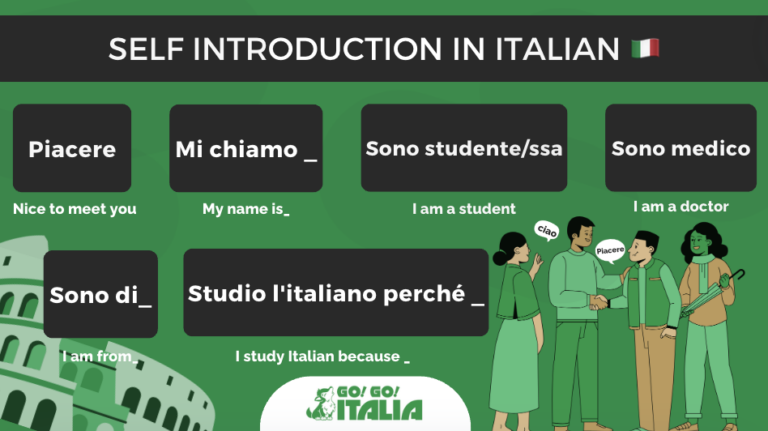
Here is a simple visual summary of the key phrases from today's lesson.
Test your understanding!
Imagine you meet a new person your age named Sofia at a café in Italy. How would you construct a short dialogue? Fill in the blanks.
You: Ciao! Io ______ [your name]. Come ti chiami?
Sofia: Ciao, piacere. Io ______ Sofia. Di dove sei?
You: ______ di [your city]. E tu?
Sofia: Sono di Roma.
Show answer
You: Ciao! Io sono [your name]. Come ti chiami?
Sofia: Ciao, piacere. Io sono Sofia. Di dove sei?
You: Sono di [your city]. E tu?
Sofia: Sono di Roma.
Note: Using Mi chiamo... would also be grammatically correct, but Sono... is very natural in this casual context.
Conclusion
Excellent work! You have now learned the fundamental building blocks for introducing yourself in Italian. You can confidently state your name and origin and ask someone else for the same information, all while being mindful of the social context.
Key Takeaways:
- To say your name, you can use
Mi chiamo...or the often more casualSono.... - To ask for a name, use
Come ti chiami?(informal) orCome si chiama?(formal). - To state your city of origin, use
Sono di.... - To ask where someone is from, use
Di dove sei?(informal) orDi dov'è?(formal).
Now that you can greet someone and introduce yourself, the next natural step is to learn the essential courtesy phrases that smooth any social interaction. In our next lesson, we will cover how to say "please," "thank you," "you're welcome," and "excuse me" with per favore, grazie, prego, and scusi/scusa.
A presto