Hello! Last time, you used wave superposition to predict where overlapping waves reinforce or cancel. Light also shows wave behavior, but one experiment revealed a limit to a wave-only account of it.
This lesson focuses on the photoelectric effect: light striking a metal can eject electrons. By the end, you should be able to explain why the light must exceed a particular frequency, and why making lower-frequency light brighter does not overcome that threshold.
The observation that needs explaining
Imagine shining light onto a clean metal surface and checking whether electrons leave it. For a given metal, sufficiently high-frequency light can eject electrons. Below a certain frequency, the ordinary photoelectric experiment detects no ejected electrons—even when the beam is made much brighter.
That is surprising if you picture light only as a continuous wave delivering energy to the surface. A brighter wave delivers more energy overall, so why would it not eventually free an electron? And why should changing the light’s frequency make the decisive difference?
Watch the selected parts of Wave-Particle Duality and the Photoelectric Effect by Professor Dave Explains. The first segment introduces frequency and the experimental puzzle; the later segment gives the single-photon explanation. Skip the discussion between them, which is not needed for this lesson.
Wave-Particle Duality and the Photoelectric Effect
Watch Professor Dave Explains introduce the photoelectric effect and contrast a light beam’s brightness with its frequency.
Watch waves and threshold for the wave description of light and the surprising result at a metal surface. Then skip to individual photons. Focus on why the energy available in one encounter matters more than the beam’s total energy.
A useful qualification to the video’s “dimmest light” description: a very dim, high-frequency beam can eject an electron when a suitable photon arrives. If photons arrive rarely, you may simply have to wait longer to observe one.
Frequency sets each photon’s energy; brightness sets their number
The explanation treats light as arriving in photons, or individual packets of energy. A photon’s energy depends on the light’s frequency:
Here is frequency—the number of wave cycles passing a point each second—and is a fixed constant called Planck’s constant. You do not need its numerical value. The essential relationship is that higher frequency means more energy per photon.
Brightness, or intensity, answers a different question: how much light energy arrives over a given area in a given time. At a fixed frequency, increasing the intensity means more photons arrive, not that each photon becomes more energetic.
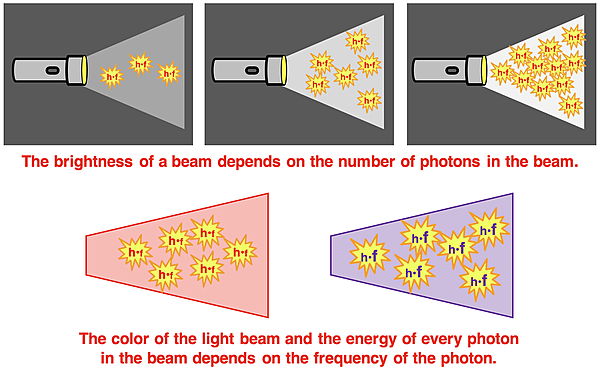
This distinction prevents a common mix-up. “More light” can mean more total energy reaches the metal, while every photon still carries the same amount of energy as before.
The Physics Classroom’s The Photon connects this distinction to the observations and gives a short numerical example. Read its photoelectric-effect discussion rather than the later material on emission spectra.
Chemistry Tutorial - Modern Atomic Model - Physics in the Early 20th Century - The Photon
Read The Physics Classroom’s account of the photoelectric effect to see how the observed roles of frequency and intensity lead to the photon explanation.
In “The Photoelectric Effect,” read the observations, ending after the two numbered flaws in the classical expectation. Continue with the photon explanation, including the subsection “Einstein's Explanation of the Photoelectric Effect.” Stop after its 500-unit and 600-unit example. Notice separately what changing frequency does and what changing intensity does.
Why there is a threshold
An electron needs a minimum amount of energy to escape a particular metal. That minimum is called the metal’s work function, written . In the ordinary photoelectric effect considered here, an electron receives energy from an individual photon.
If that photon has less energy than the work function, it cannot free the electron. Delivering more photons of the same insufficient energy gives the surface more energy overall, but does not give any one of those photon–electron encounters enough energy for ejection. The photons do not simply add their energies together to free a single electron in this experiment.
Because photon energy is , there is a threshold frequency at which one photon has just enough energy to meet the work function:
Below that frequency, , so increasing intensity cannot produce ordinary photoelectric emission. Above it, a photon has enough energy to free an electron. A brighter beam at that same above-threshold frequency can then eject more electrons per unit time, because more suitable photons arrive.
The threshold belongs to the metal as well as the light. A frequency that works for one metal might be too low for another whose electrons require more energy to escape. Thus “red light fails, violet light works” can describe a particular metal; it is not a universal rule about those colors.
What happens to a photon’s energy beyond the amount needed for escape? The remainder can become the ejected electron’s kinetic energy—its energy of motion. For electrons ejected with the greatest kinetic energy,
So increasing frequency raises the maximum kinetic energy. Increasing intensity at a fixed frequency raises the number of emitted electrons, but not their maximum kinetic energy. The distinction is between the energy of each emitted electron and the number emitted.
Reading the evidence on a graph
In the graph, the point where each solid line meets the horizontal axis is its threshold frequency. Metal 2’s threshold lies farther right than metal 1’s: it requires a higher-frequency photon to eject an electron. The two lines have the same slope because the increase in photon energy per increase in frequency is governed by the same constant .
The dotted extensions are a mathematical guide to each metal’s work function, not predictions of electrons with negative kinetic energy. Below the threshold there is no photoelectron to plot. That is the most important boundary to notice when reading this graph.
Key takeaways
The photoelectric effect separates two properties of a light beam. Frequency determines the energy of each photon; at a fixed frequency, intensity determines how many photons arrive. An electron can be ejected in the ordinary photoelectric effect only when an individual photon supplies at least the metal’s work function. More below-threshold photons cannot compensate for each photon’s shortfall. Above the threshold, brighter light can produce more emitted electrons, while higher-frequency light can give them greater maximum kinetic energy.
Light’s photon behavior does not erase the wave behavior you studied earlier. Next, the double-slit experiment will bring both into view: individual detections gradually build up a pattern associated with interference.