Welcome to the course! We're beginning our journey into software architecture by focusing on the foundational design principles that underpin maintainable, scalable systems. Your experience in developing large-scale projects has likely given you a strong intuition for what makes code easy or difficult to work with. Our goal in this first module is to formalize that intuition, providing you with a robust theoretical framework and a precise vocabulary to articulate and evaluate architectural decisions.
We'll start with what is arguably the most critical concept in software design: coupling. This first lesson will equip you to define and evaluate the connections between software components. We'll explore why the common advice to "minimize coupling" is an oversimplification and delve into more nuanced ways to think about it. By the end of this lesson, you will be able to identify different types of coupling and use both qualitative and quantitative methods to assess the dependencies in a codebase, a crucial first step toward planning for future maintainability.
The Multifaceted Nature of Coupling
In software engineering, "coupling" refers to the degree of interdependence between software modules. You've probably heard the mantra "loose coupling is good, tight coupling is bad." While this is a useful starting point, it barely scratches the surface. In reality, some coupling is both necessary and inevitable. The real skill lies in understanding and managing it effectively.
To start, let's explore a more sophisticated model of coupling. The following video by Dave Farley introduces a framework developed by Michael Nygard that classifies coupling into five distinct categories. This will give us a much richer vocabulary for discussing dependencies.
Coupling Is The Biggest Challenge In Software Engineering
This video, "Coupling Is The Biggest Challenge In Software Engineering," challenges the simplistic view of coupling and provides a more detailed taxonomy.
Please watch the introduction from the beginning, and then pay close attention to the section that details Michael Nygard's five types of coupling, from the start up to the detailed explanation beginning at 00:50.
As you saw, coupling isn't just one thing. It manifests in several ways:
- Operational Coupling: A consumer can't function without a provider being available (e.g., your web server can't serve user data if the database is down).
- Developmental Coupling: Changes in a provider and consumer must be coordinated. You've likely encountered this when a change in a server API required a simultaneous update to the desktop client.
- Semantic Coupling: Components must change together because they share an understanding of a concept (e.g., if the way you represent money changes, both the shopping cart and order processing modules need to be updated).
- Functional Coupling: Different components solve the same problem in similar ways, often leading to duplicated effort and concepts.
- Incidental Coupling: Components change together for no good architectural reason, often due to physical co-location or historical accident.
This framework shows that coupling extends beyond just code-level dependencies. However, for structuring a single codebase—our primary focus—we need to zoom in on the dependencies within the code itself.
Acceptable vs. Poor Coupling
Within a codebase, not all dependencies are created equal. The key differentiator is often the stability of the interface that mediates the dependency. Let's formalize this distinction.
This chapter from the Software Engineering textbook provides a clear definition of coupling at the code level and introduces crucial distinctions.
Please read section 5.5, starting with the introduction to coupling. Focus on the definitions of acceptable and poor coupling. Continue reading through the end of the section to understand the related concepts of structural and evolutionary coupling, ending just before "5.5.1 Examples".
The key takeaway is that coupling isn't inherently bad, but poor coupling is. Poor coupling arises when changes in one module can easily and unexpectedly break another, typically because the dependency is not mediated by a stable, explicit contract. Your goal as an architect is not to eliminate all dependencies but to convert poor coupling into acceptable, interface-driven coupling.
- Structural coupling (an explicit code reference) is what we often think of, but evolutionary coupling (when a change in B forces a change in A) is what truly impacts maintainability. The goal is to ensure structural coupling doesn't create unintended evolutionary coupling.
A Qualitative Hierarchy of Coupling
To help identify and reduce poor coupling, software designers have developed a qualitative scale that ranks different forms of coupling from best to worst. Understanding this hierarchy helps you spot problematic patterns in your code.
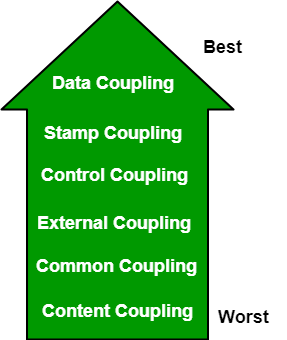
This image shows a widely accepted hierarchy of coupling types. Let's break down what each level means.
- Data Coupling (Best): Modules share data by passing parameters. They are independent of each other and only need primitive data types. For example, a function
calculate_area(width: f64, height: f64) -> f64. - Stamp Coupling: Modules share a composite data structure (like a class or struct) but only use a part of it. For example, passing an entire
Userobject to a function that only needs the user's email address. It's less ideal than data coupling because the consumer is now dependent on the structure of theUserobject, which might contain much more information than it needs. - Control Coupling: One module controls the flow of another by passing it information on what to do (e.g., a boolean flag in a function argument). This is problematic because the two modules are aware of each other's internal logic.
- External Coupling: Two or more modules share a dependency on an external entity, such as a file format, a communication protocol, or a third-party library. This is common and often necessary, but it makes the modules dependent on something outside their own scope.
- Common Coupling: Two or more modules share access to the same global data. A change to the shared data can have wide-ranging and difficult-to-predict effects.
- Content Coupling (Worst): One module directly modifies or relies on the internal workings of another module. In Python, this could be monkey-patching an object's internal state. In less-safe languages, it might involve directly modifying another module's private data. This is a severe violation of encapsulation and creates extremely brittle code.
As you design, aim to use coupling types from the top of this hierarchy (Data, Stamp) and actively refactor away from those at the bottom (Common, Content).
Quantitative Evaluation: Measuring Dependencies
While the qualitative hierarchy is useful for code reviews and design discussions, quantitative metrics can provide an objective measure of coupling. These are especially valuable for tracking the health of a codebase over time. The most fundamental metrics were introduced by Robert C. Martin.
Let's define them using this article from Çomak's Notes on Software.
Coupling Metrics – Afferent and Efferent Coupling
This article provides concise definitions for two key coupling metrics.
Please read the sections defining Afferent Coupling (fan-in) and Efferent Coupling (fan-out).
To summarize:
- Afferent Coupling (Ca) or Fan-in: The number of other modules that depend on a specific module. A high fan-in means the module is heavily relied upon and should be very stable.
- Efferent Coupling (Ce) or Fan-out: The number of other modules that a specific module depends on. A high fan-out means the module is sensitive to changes in many other places, making it inherently "unstable."
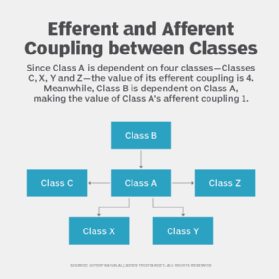
This diagram illustrates the concepts clearly. Class A is depended upon by one class (Class B), so its Afferent Coupling is 1. Class A depends on four other classes (C, X, Y, Z), so its Efferent Coupling is 4.
A high fan-out isn't necessarily bad—an application's main entry point or an orchestrator component in your computer vision pipeline will naturally have high efferent coupling. The problems arise when the dependencies are not managed correctly.
This leads to two powerful derived metrics: Instability and the Distance from the Main Sequence. The following video explains these concepts visually.
Every Dev Should Know This! (Software Architecture Ep. 4: Coupling Metrics)
This video, from Dr. Miles Aron, gives a quick and clear explanation of these quantitative metrics and how to interpret them.
Watch the short segments that define afferent and efferent coupling, instability, and the combined metric called distance from the main sequence.
The Instability (I) metric combines afferent and efferent coupling into a single number between 0 and 1:
- : Maximally stable. Many modules depend on it, and it depends on few or none. (e.g., a core library).
- : Maximally unstable. It depends on many modules and is depended on by few or none. (e.g., a high-level UI component).
The Main Sequence plot is a powerful visualization that plots a module's Instability against its Abstractness (a concept we will explore more later). The key insight is that there is a "Goldilocks zone."
- Modules that are highly concrete and highly stable are in the "Zone of Pain"—they are rigid and difficult to change.
- Modules that are highly abstract and highly unstable are in the "Zone of Uselessness"—they are abstract but have no dependents to make use of that abstraction.
Your goal as an architect is to guide your components toward the main sequence, balancing stability with abstractness. A fundamental principle, the Stable Dependencies Principle, states that dependencies should always flow in the direction of stability. An unstable module should depend on stable ones, not the other way around.
Conclusion
In this lesson, we have moved from a simple notion of coupling to a much richer and more actionable understanding. You now have a framework for both defining and evaluating the dependencies that form the skeleton of your software architecture.
Key Takeaways:
- Coupling is the measure of interdependence between modules, and it exists in many forms beyond simple code calls (e.g., operational, developmental, semantic).
- The goal is not to eliminate coupling but to manage it, favoring acceptable coupling (mediated by stable interfaces) over poor coupling.
- Coupling can be evaluated qualitatively using a hierarchy, where
Data Couplingis ideal andContent Couplingis to be avoided at all costs. - Coupling can also be evaluated quantitatively using metrics like Afferent Coupling (fan-in), Efferent Coupling (fan-out), and the derived Instability index.
- A healthy architecture directs dependencies toward stable components, keeping modules in a balanced zone between useless abstraction and painful rigidity.
In our next lesson, we will explore cohesion, the logical counterpart to coupling. While coupling describes the relationships between modules, cohesion describes how well the elements within a single module belong together. You will see that striving for high cohesion is one of the most effective ways to achieve healthy, low coupling.