In our previous lessons, we've focused on creating well-defined and focused abstractions using principles like Liskov Substitution and Interface Segregation. We've established what good interfaces look like, and now we will address the final and perhaps most crucial piece of the SOLID puzzle: how our code modules should depend on these abstractions.
This lesson covers the Dependency Inversion Principle (DIP), the "D" in SOLID. Your goal is to be able to clearly explain DIP and its crucial relationship with a practical technique you've likely used in frameworks like Node.js or Django: Dependency Injection (DI). Mastering this distinction is vital for senior-level design discussions and is a key indicator of architectural maturity in an interview. This concept forms the foundation of modern application frameworks, including ASP.NET Core, which we will begin building with in our very next session.
1. The Dependency Inversion Principle (DIP)
At its core, the Dependency Inversion Principle is about reversing the traditional, top-down flow of dependencies in your code. The formal definition has two parts:
- High-level modules should not depend on low-level modules. Both should depend on abstractions (e.g., interfaces).
- Abstractions should not depend on details. Details (concrete implementations) should depend on abstractions.
Let's break this down.
Understanding the dependency inversion principle (DIP)
This article from the LogRocket Blog provides a solid conceptual foundation for DIP.
Start by reading the sections What is DIP? and High-level vs. low-level modules. Focus on understanding the distinction between a high-level module (containing business logic) and a low-level module (handling implementation details like writing to a file or a database).
Imagine a high-level ReportGenerator class. Its job is to create a business report. To do this, it needs to save the report somewhere. A traditional, tightly-coupled approach would be for ReportGenerator to directly create an instance of a low-level PdfWriter class.
Tightly-Coupled Code (Violates DIP):
public class PdfWriter
{
    public void Write(string reportData)
    {
        // Logic to write a PDF file
        Console.WriteLine("Writing report to PDF...");
    }
}

public class ReportGenerator
{
    private PdfWriter _writer;

    public ReportGenerator()
    {
        _writer = new PdfWriter(); // Direct dependency on a concrete, low-level module
    }

    public void GenerateReport()
    {
        // ... generate report data
        _writer.Write("some report data");
    }
}
The problem here is that ReportGenerator is permanently tied to PdfWriter. What if you need to save the report as a CSV file or send it to a cloud storage service? You would have to modify the ReportGenerator class itself. This violates the Open/Closed Principle and makes the system rigid and difficult to test.
DIP solves this by introducing an abstraction (an interface) that both the high-level and low-level modules depend on.
Loosely-Coupled Code (Adheres to DIP):
// 1. Define the Abstraction
public interface IReportWriter
{
    void Write(string reportData);
}

// 2. Low-level details depend on the abstraction
public class PdfWriter : IReportWriter
{
    public void Write(string reportData) { /* PDF writing logic */ }
}

public class CsvWriter : IReportWriter
{
    public void Write(string reportData) { /* CSV writing logic */ }
}

// 3. High-level module depends on the abstraction
public class ReportGenerator
{
    private readonly IReportWriter _writer;

    // The dependency is "injected" from the outside
    public ReportGenerator(IReportWriter writer)
    {
        _writer = writer;
    }

    public void GenerateReport()
    {
        // ... generate report data
        _writer.Write("some report data");
    }
}
Notice the "inversion": instead of the high-level ReportGenerator depending on the low-level PdfWriter, both now depend on the IReportWriter abstraction. The direction of dependency has been inverted.
2. DIP, DI, and IoC: A Critical Distinction
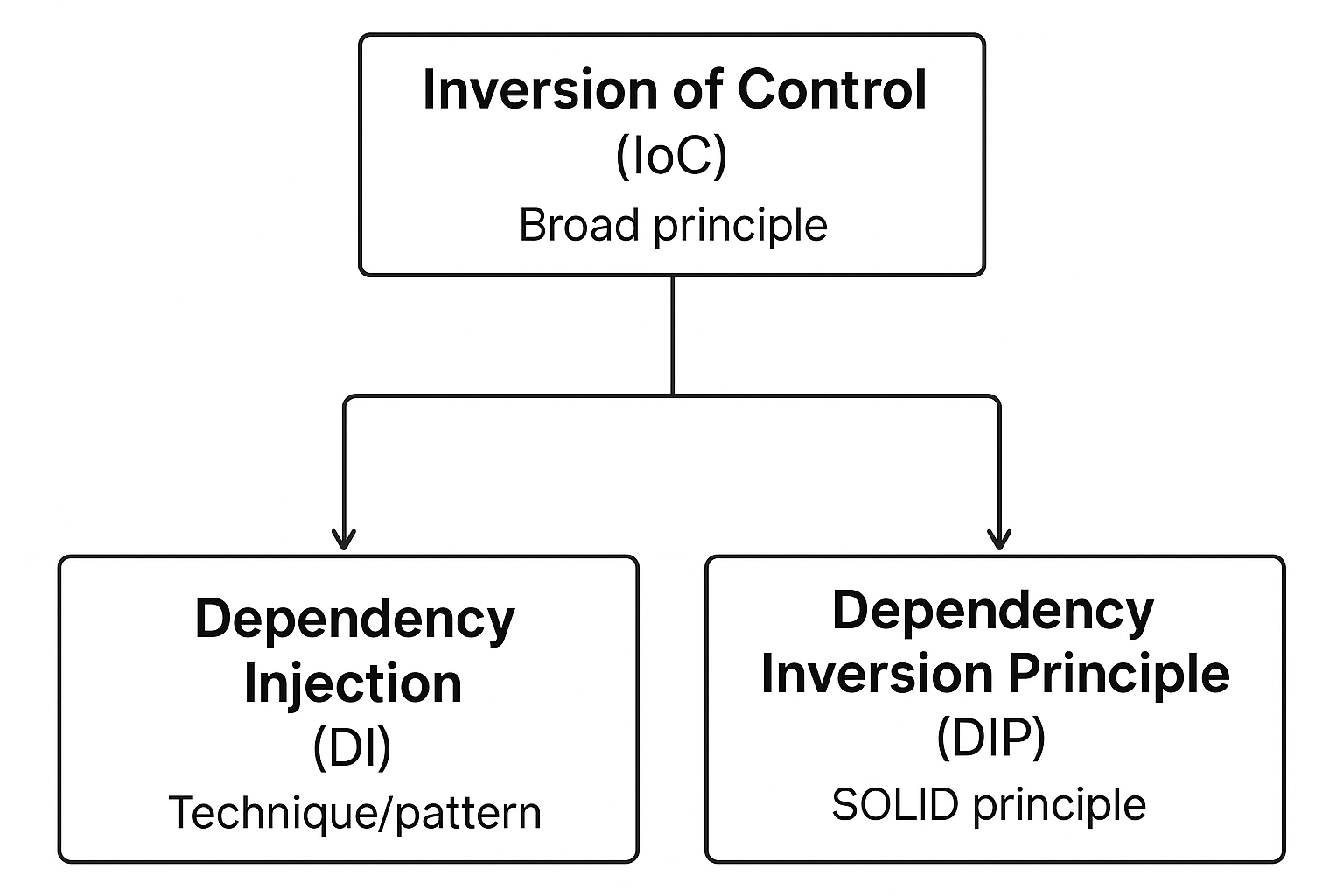
These three terms are often used together and are a common source of confusion—making them a perfect interview topic. Let's clarify their relationship.
-
Inversion of Control (IoC): This is a broad design principle. In traditional programming, your code is in control; it calls libraries and methods to get work done. In IoC, this control is inverted: a framework or container is in control, and it calls your code when needed. For instance, in ASP.NET Core, you don't write the code that listens for HTTP requests and starts your application; the framework does, and it calls your controller action when a request arrives. Your code plugs into the framework's lifecycle.
-
Dependency Inversion Principle (DIP): This is the SOLID principle we just discussed. It's an architectural guideline: depend on abstractions, not concretions.
-
Dependency Injection (DI): This is a specific design pattern or technique used to implement both IoC and DIP. DI is the action of providing a component with its dependencies. In our
ReportGeneratorexample, passing anIReportWriterinstance into its constructor is an example of Constructor Injection.
The following video does an excellent job of walking through these concepts and their practical application in C#.
Dependency injection fundamentals in C# - DI vs IoC vs DIP
This video from Amichai Mantinband provides a fantastic breakdown of the differences between DIP, IoC, and DI using a practical C# example.
First, watch the segment that defines the Dependency Inversion Principle. The author uses a GitHubService that depends on a GitHubClient to illustrate the problem of tight coupling and introduces the IGitHubClient interface as the solution. Next, watch the explanation of IoC vs. DI. This part clearly separates IoC as giving control to a framework and DI as the specific pattern for supplying dependencies. This is the core distinction you need to grasp.
To summarize the relationship: You follow the DIP principle by designing your classes to depend on abstractions. You use the DI pattern to supply the concrete implementations of those abstractions to your classes. This is often managed by a framework that implements the IoC principle.
3. Implementing Dependency Injection in C#
While there are a few ways to perform DI, one is overwhelmingly common in the .NET ecosystem.
Dependency injection fundamentals in C# - DI vs IoC vs DIP
Continue with the same video from Amichai Mantinband.
Watch the section that explains the three types of dependency injection: Constructor, Setter, and Interface Injection. Pay close attention to Constructor Injection, as it is the standard and most robust method used in ASP.NET Core and modern C# development.
Constructor Injection is preferred because it makes dependencies explicit and ensures that an object is in a valid, usable state immediately upon creation. A class cannot be instantiated without its required dependencies.
Now, let's look at a complete C# example that ties DIP and DI together.
Dependency Inversion Principle VS Dependency Injection ...
This article from C-Sharp Corner provides a concise, code-focused walkthrough.
Read from the section DIP Implementation down to the end of the Main method. This shows: DIP: BookService depends on the IBookRepository interface. DI: In the Main method, a concrete DatabaseBookRepository is created and injected into the BookService constructor. Then, read the section DIP vs. DI. This text explicitly summarizes the distinction using the code you just saw.
In a real-world application, you wouldn't manually create and inject dependencies in your Main method as shown in that simple example. You would use a DI Container. A DI container is a framework component responsible for automatically creating and injecting dependencies where they are needed.
The video segment below gives a preview of how this works with the built-in DI container in .NET, which is exactly what we'll be using in our next module on ASP.NET Core.
Dependency injection fundamentals in C# - DI vs IoC vs DIP
One last look at the video from Amichai Mantinband.
Watch the segment from managing dependencies with a container. Here, you'll see how you "register" your services (e.g., telling the container "whenever something asks for an IGitHubClient, give it a GitHubClient"). The container then handles all the new-ing up and constructor injection for you.
4. How to Explain DIP and DI in an Interview
Given your background, you can frame this in the context of building scalable, maintainable systems. Here is a strong way to structure your answer:
-
Define the Principle (DIP): "The Dependency Inversion Principle is the 'D' in SOLID. It states that high-level modules, like business logic services, should not depend on low-level modules, like specific database or logging implementations. Instead, both should depend on abstractions, like interfaces."
-
Explain the Problem it Solves: "The goal is to achieve loose coupling. Without DIP, our high-level business logic becomes tightly coupled to implementation details. This makes the system rigid. For example, if my
OrderServicedirectly uses aPostgreSqlRepository, switching to a different database becomes a major refactoring task, and unit testing theOrderServicein isolation is nearly impossible without a real database." -
Introduce the Solution (DI): "Dependency Injection is the design pattern we use to achieve this. Instead of a class creating its own dependencies, its dependencies are 'injected' from an external source. The most common form is Constructor Injection, where dependencies are provided as parameters to the constructor."
-
Connect DIP and DI: "So, DIP is the principle—depend on abstractions. DI is the technique—pass in the concrete implementation of that abstraction from the outside. By having my
OrderServicedepend on anIRepositoryinterface (DIP), I can then inject aPostgreSqlRepositoryor aMockRepositoryfor testing (DI)." -
Mention Frameworks: "Modern frameworks like ASP.NET Core have built-in Inversion of Control containers that manage this process. We register our services and their corresponding interfaces, and the framework automatically handles the dependency injection for us throughout the application."
This answer demonstrates a deep, practical understanding of the theory and its real-world application, which is precisely what interviewers are looking for.
Conclusion
You have now completed the SOLID principles. The Dependency Inversion Principle is the capstone that enables true modularity and testability. It forces a clean separation of concerns by ensuring that high-level policy is not entangled with low-level implementation details.
Key Takeaways:
- DIP is a Principle: High-level modules should depend on abstractions, not low-level concrete classes.
- DI is a Pattern: Dependencies are supplied to an object from an external source, rather than the object creating them itself. Constructor Injection is the preferred method.
- IoC is a broader concept where a framework manages the application's flow and lifecycle.
- Together, these concepts create loosely coupled, flexible, and highly testable software systems.
This lesson serves as the perfect bridge to our next module. Now that you understand how dependencies are managed in a modern C# application, you are ready to see it in action. In the next lesson, we will begin building a REST API with ASP.NET Core and immediately use its built-in DI container to inject services into our API controllers.