Welcome to your seventh lesson. In our previous session, we concluded our tour of foundational function concepts by exploring composition and inverses. As we discussed, this marked the end of our first module and prepared us for a major transition into the world of calculus. Today, we take that first step by formally introducing the concept of a limit.
While we can think of a limit intuitively as "what value a function gets close to," today's goal is to move beyond intuition. We will establish a set of formal rules—the limit laws—that allow us to compute limits algebraically. This is a crucial skill, as the limit is the fundamental building block for all of calculus. The definitions of the derivative and the integral, which we will study soon, are both based on limits. For your long-term goal of machine learning research, understanding how to work with limits is foundational for topics like the convergence of optimization algorithms and the analysis of function behavior.
By the end of this lesson, you will be able to compute limits of various functions using these powerful and systematic limit laws.
What is a Limit, Formally?
In calculus, we need precise tools. Instead of just guessing a limit from a graph or a table of values, we can use a set of properties called limit laws. These laws allow us to break down complicated limit problems into simpler ones.
The video below gives an excellent overview of the main limit laws. As you watch, focus on understanding the role of each law: how it allows you to manipulate a limit expression.
Calculus 1: Calculating Limits Using the Limit Laws (Video #3) | Math with Professor V
Watch the first part of this video from Math with Professor V for a clear introduction to the limit laws.
Watch from the beginning to the overview of the laws. The list includes rules for sums, differences, constant multiples, products, quotients, powers, and roots.
For a formal written statement of these rules, you can refer to the following resource.
2.3: Limit Laws & Techniques for Computing Limits
This section provides the formal definitions of the limit laws we will be using.
Please read the section under the heading "Limit Laws". Pay attention to the conditions under which each law applies, especially the quotient law's requirement that the limit of the denominator is not zero.
The Easiest Case: Direct Substitution
As you may have noticed from the limit laws, for many functions, calculating the limit is surprisingly straightforward. If a function is "well-behaved" at a point—meaning it's a polynomial or a rational function where the point is in its domain—the limit laws collectively imply that you can find the limit by simply plugging the value into the function. This is known as the Direct Substitution Property.
This should always be your first attempt when faced with a limit.
2.3: Limit Laws & Techniques for Computing Limits
This part of the resource explains how the limit laws lead to the direct substitution property for polynomials and rational functions.
Read the section "Limits of Polynomial and Rational Functions" to see how this property is a direct consequence of the laws you just learned. Then, look at Example 3 to see it in action.
The following video clip also demonstrates this "first-resort" strategy very clearly.
Calculus 1: Calculating Limits Using the Limit Laws (Video #3) | Math with Professor V
Watch this segment for a worked example of applying the direct substitution property.
Watch the explanation and example from direct substitution. Notice how the first step is always to check if the point is in the domain of the function.
When Direct Substitution Fails: Indeterminate Forms
Things get more interesting when direct substitution results in an indeterminate form, most commonly 0/0. This result does not mean the limit is zero, nor does it mean the limit doesn't exist. It simply means there is more work to be done. The value 0/0 is a mathematical smoke signal telling you to investigate further.
The most common strategy is to algebraically manipulate the function into an equivalent form (one that is identical everywhere except at the point in question) where direct substitution does work. The flowchart below provides an excellent roadmap for the techniques we will use.
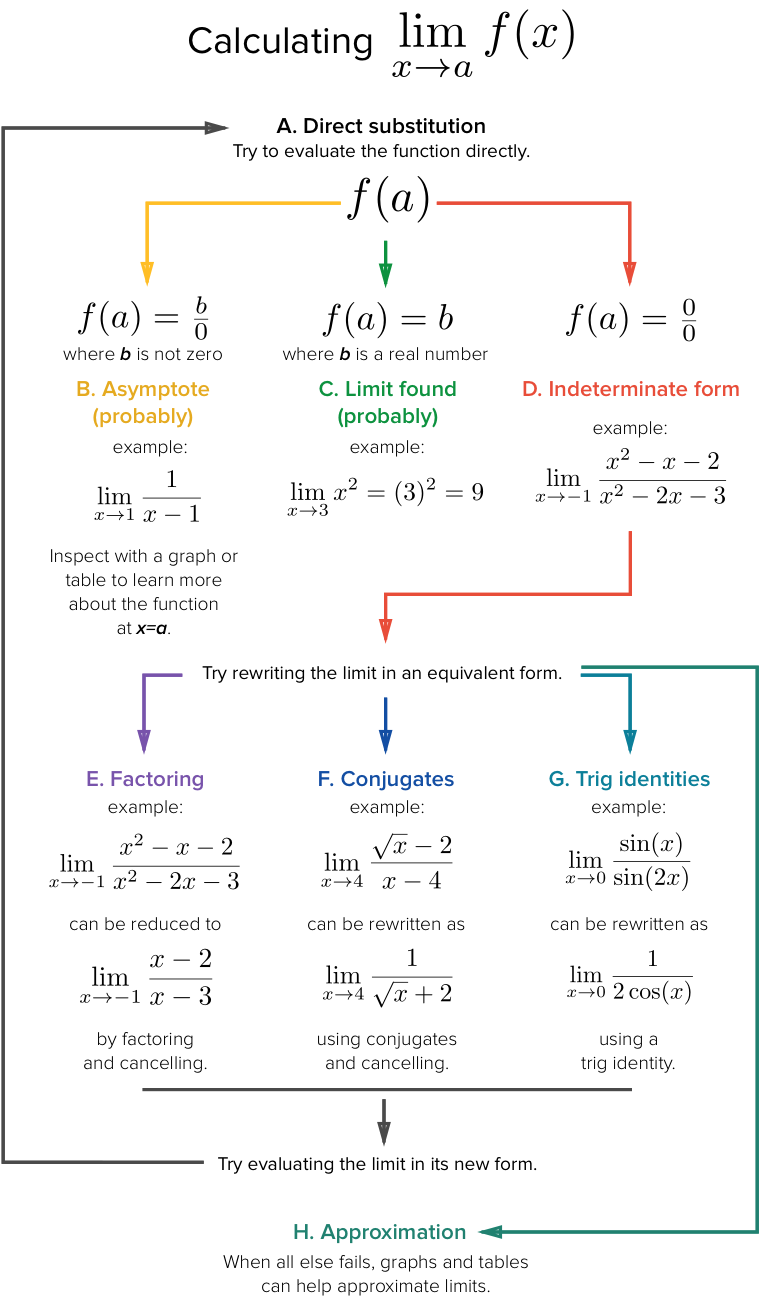
Today, we'll focus on the algebraic paths: factoring and using conjugates.
Technique 1: Factoring and Canceling
This is the go-to method for rational functions. The goal is to factor the numerator and denominator to find and cancel the term that is causing the 0/0 issue.
Calculus 1: Calculating Limits Using the Limit Laws (Video #3) | Math with Professor V
This video segment provides a clear, step-by-step example of the factoring-and-canceling technique.
Watch the example from factoring. The key insight is that by canceling the (x-1) term, we create a new function that is identical to the original everywhere except at x=1, but whose limit at x=1 we can evaluate.
Technique 2: Multiplying by the Conjugate
When you see a radical (a square root) in a limit that results in 0/0, your first thought should be to use the conjugate. Multiplying the numerator and denominator by the conjugate of the expression containing the radical often magically simplifies the expression, allowing the problematic term to be canceled.
Calculus 1: Calculating Limits Using the Limit Laws (Video #3) | Math with Professor V
This segment demonstrates how to use the conjugate to solve a limit problem involving a radical.
Watch from this example. Notice that the goal is the same as with factoring: manipulate the expression so you can cancel the term causing the zero in the denominator (in this case, h).
For more examples of these techniques, including simplifying complex fractions, you can review the resource we looked at earlier.
2.3: Limit Laws & Techniques for Computing Limits
This section provides several worked examples for handling the indeterminate form 0/0.
Skim through the "Additional Limit Evaluation Techniques" section. Focus on Example 4 (factoring), Example 5 (conjugate), and Example 6 (simplifying a complex fraction) to solidify your understanding of these strategies.
A Glimpse at the Foundations
Since your goal is a rigorous understanding of mathematics, it's important to know that these limit laws are not arbitrary rules. They are theorems that can be proven from the formal epsilon-delta definition of a limit.
This definition, first formulated by mathematicians like Bolzano and Weierstrass, provides the rigorous bedrock for all of calculus. In essence, it formalizes the intuitive idea of "getting arbitrarily close".
The statement means:
For every target closeness (epsilon) around the limit ,
there exists a range (delta) around the point ,
such that if is within of (but not equal to ),
then is guaranteed to be within of .
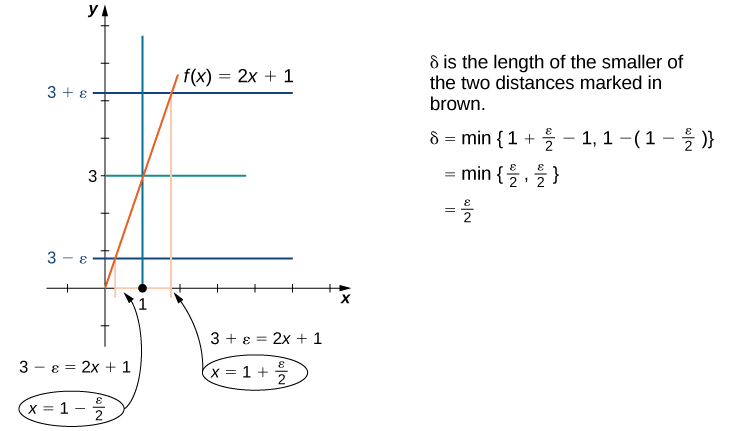
You are not expected to produce epsilon-delta proofs at this stage, but it is valuable to see how the rules we use are built on this solid foundation. The following resource provides the proofs for the limit laws.
Calculus I - Proof of Various Limit Properties
This resource from Paul's Online Math Notes provides rigorous proofs of the limit laws using the epsilon-delta definition.
You don't need to read the entire page in detail. I suggest you read the introduction to understand the context, and then read through the proofs for the constant multiple and sum rules. The goal is not to memorize these proofs, but to appreciate the underlying logic and see how the epsilon (\varepsilon) and delta (\delta) concepts are used to establish the rules you are now applying.
An Advanced Tool: The Squeeze Theorem
Sometimes we encounter functions that resist our standard algebraic techniques, especially those involving trigonometric functions. For these, we have an elegant tool called the Squeeze Theorem (or Sandwich Theorem).
It states that if a function is "squeezed" between two other functions, and , and if and approach the same limit at a certain point, then must also approach that same limit .
This theorem is particularly useful for evaluating famous limits like , which is crucial in deriving the derivatives of trigonometric functions.
2.3: Limit Laws & Techniques for Computing Limits
This final section of the text introduces the Squeeze Theorem and shows its power.
Read the section "The Squeeze Theorem" and look at the example of evaluating \lim_{x→0}x \cos x. Then, briefly review the geometric argument used to prove that \lim_{θ→0}\frac{\sin θ}{θ}=1.
Conclusion
Today we have built a practical and powerful toolkit for evaluating limits. You've moved from an intuitive understanding to a systematic, algebraic approach grounded in the limit laws.
Key Takeaways:
- The Limit Laws provide a formal system for breaking down and evaluating limits.
- Direct Substitution is your first strategy. It works for polynomials and rational functions as long as the point is in the function's domain.
- The indeterminate form
0/0is a signal to do more work. Algebraic techniques like factoring and multiplying by the conjugate are used to find an equivalent function whose limit can be evaluated. - These laws are not magic; they are provable theorems derived from the rigorous epsilon-delta definition of a limit.
- The Squeeze Theorem is a powerful tool for finding limits of functions that can be bounded by simpler ones.
This lesson has been foundational. In our next session, we will officially begin differential calculus by defining the derivative. You will see immediately that the definition of the derivative is a limit of a function that results in the 0/0 indeterminate form. The skills you've built today will be put to use right away.