Welcome to your first lesson in the Mathematics for Machine Learning course! Your goal of pursuing research in machine learning requires a deep and rigorous mathematical foundation, and this course is designed to build exactly that, starting from the ground up as you requested.
Today, we will begin with a topic that forms the bedrock of many advanced mathematical concepts: manipulating algebraic expressions, specifically polynomials and rational functions. These are not just abstract exercises; they appear everywhere in machine learning, from defining complex model architectures and cost functions to enabling advanced calculus techniques used in optimization.
In this lesson, you will learn to:
- Define polynomials and understand their key properties like degree and leading term.
- Perform arithmetic operations on polynomials: addition, subtraction, multiplication, and division.
- Understand the theory connecting polynomial division to its factors and zeros.
- Break down complex rational functions into simpler components through partial fraction decomposition.
Let's begin by establishing what exactly a polynomial is.
What is a Polynomial?
A polynomial is an expression consisting of variables and coefficients, involving only the operations of addition, subtraction, multiplication, and non-negative integer exponents of variables. This simple definition hides a great deal of power and structure.
To get a formal introduction to polynomials and their associated terminology, please watch the following video from Professor Leonard. It provides a clear, conceptual overview.
Introduction to Polynomial Functions (Precalculus - College Algebra 27)
This video defines what polynomials are, what they are not, and introduces the vocabulary we will use throughout this course.
Please watch the following segments: Introduction to terms: Understand how polynomials are constructed from terms. Key terminology: Pay close attention to the definitions of leading term, leading coefficient, degree, and constant term. Note the importance of writing polynomials in descending order of exponents. Rules and domain: This part explains the crucial rules for exponents in polynomials (non-negative integers) and why their domain is always all real numbers. Examples: Watch the breakdown of several examples. This will solidify your understanding of how to identify a polynomial and its properties.
To summarize the key points from the video:
- Standard Form: A polynomial is written in standard form when its terms are ordered by descending exponents. For example, .
- Degree: The degree of a polynomial is the highest exponent of its variable. The degree tells us a lot about the shape and complexity of the polynomial's graph.
- Leading Term: In standard form, the first term is the leading term. Its behavior dominates the polynomial's behavior for very large values of .
- Constraints: The exponents must be non-negative integers. This means expressions with fractional exponents (like ) or negative exponents (like ) are not polynomials.
Operations on Polynomials
Now that we have a solid definition, let's explore how to manipulate these expressions. Like numbers, we can add, subtract, multiply, and divide them.
The following video provides a practical guide with worked examples for these operations.
Polynomials - Adding, Subtracting, Multiplying and Dividing Algebraic Expressions
This video from The Organic Chemistry Tutor demonstrates the mechanics of polynomial arithmetic.
Please watch these segments: Addition, Subtraction, and Multiplication: Observe how adding and subtracting involves combining like terms, and multiplication is a repeated application of the distributive property. Division: This segment introduces long division for polynomials, which works in all cases, and synthetic division, a powerful shortcut when dividing by a linear term of the form x-c.
Addition and subtraction are straightforward applications of combining like terms. Multiplication, while more involved, is a systematic process of distribution. Division, however, is where things get more interesting and lead to deeper theoretical insights.
The Theory Behind Division: The Factor and Remainder Theorems
The videos showed you the "how" of polynomial division. As you're aiming for a research-level understanding, the "why" is equally critical. The relationship between division, factors, and the zeros of a polynomial is formalized by two important theorems.
The following document provides a rigorous look at these concepts, including their proofs, which you should find insightful.
[PDF] 3.2 The Factor Theorem and The Remainder Theorem - WebAssign
This resource formalizes the connection between division and finding the roots of a polynomial.
Please read the sections defining Theorem 3.5 (The Remainder Theorem) and Theorem 3.6 (The Factor Theorem), along with their proofs. You can find this material on page 258. Focus on understanding these two theorems and how they follow from the process of polynomial division.
Let's distill the essence of these theorems:
-
The Remainder Theorem: If you divide a polynomial by , the remainder is simply . This gives you a quick way to evaluate a polynomial at a certain point. For example, the remainder of is .
-
The Factor Theorem: This is a direct consequence of the Remainder Theorem. It states that is a factor of if and only if . This creates a fundamental link: finding the zeros (or roots) of a polynomial is the same as finding its linear factors.
For instance, if we use synthetic division to divide by and find the remainder is 0, the Factor Theorem tells us that is a zero of and is a factor.
Rational Functions and Partial Fraction Decomposition
We've seen that not every algebraic expression is a polynomial. A rational function is a function formed by the ratio of two polynomials, .
Sometimes, a complex rational function is easier to work with if we break it down into a sum of simpler fractions. This process is called partial fraction decomposition. This technique is indispensable in integral calculus, and its principles of decomposition are echoed in more advanced fields relevant to machine learning, such as signal processing.
First, a crucial distinction:
- If the degree of the numerator is less than the degree of the denominator, the fraction is proper.
- If the degree of the numerator is greater than or equal to the degree of the denominator, the fraction is improper. In this case, you must first perform polynomial division to get a polynomial plus a proper fraction.
The following resource explains the method for decomposing proper rational functions.
This guide explains the process of breaking a rational function into its component partial fractions.
Start by reviewing section 2, "Revision of adding and subtracting fractions", to see how simpler fractions combine into a more complex one. Our goal is to reverse this process. Then, read section 3, "Expressing a fraction as the sum of its partial fractions". This section details the fundamental technique for a denominator with distinct linear factors. Pay close attention to the method of substituting "special values" of x to solve for the unknown coefficients A and B. After mastering this case, skim sections 4 and 5 to see how the setup changes for repeated linear factors and irreducible quadratic factors. Don't worry about mastering every detail now; the goal is to recognize the different forms.
The key is to know what form the decomposition will take based on the factors of the denominator. The following table provides a convenient summary of the rules.
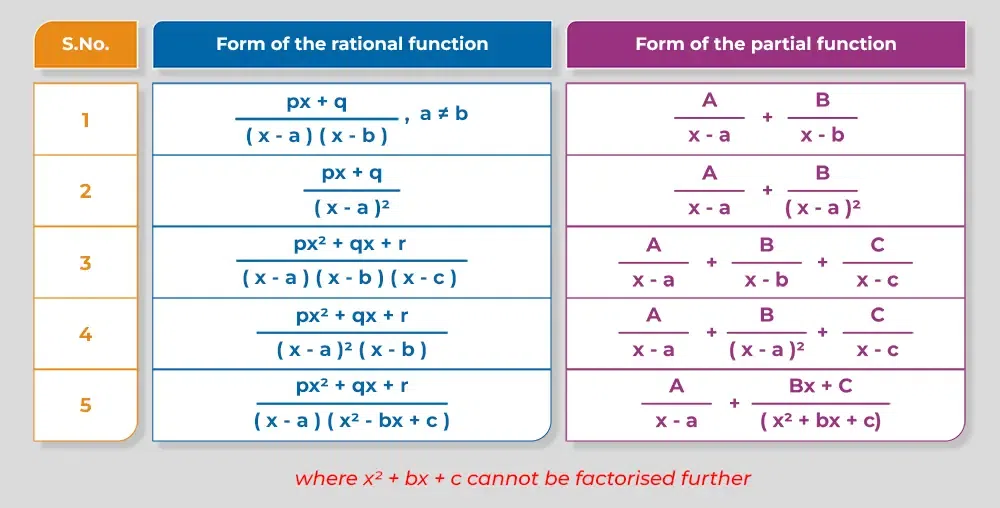
Let's walk through an example for the first case: distinct linear factors.
Suppose we want to decompose .
The denominator has distinct linear factors and . According to the rules (row 1 in the table), the decomposition will have the form:
To find and , we multiply both sides by the common denominator :
This equation must hold for all values of . We can find and by substituting convenient values for :
- To find , let . This makes the term zero:
- To find , let . This makes the term zero:
So, the decomposition is:
Conclusion
In this foundational lesson, we have covered a significant amount of ground. You've learned to define, identify, and manipulate polynomials, which are central to describing functions and models in science and engineering. We went beyond simple mechanics to understand the formal theorems that govern polynomial division and factoring, providing the rigorous understanding necessary for advanced study. Finally, we introduced rational functions and the powerful technique of partial fraction decomposition.
Key Takeaways:
- Polynomials are expressions with non-negative integer exponents, and their properties (like degree) determine their behavior.
- Polynomial arithmetic (addition, subtraction, multiplication, division) follows a clear set of rules.
- The Factor Theorem provides a crucial bridge between the algebraic factors of a polynomial and its geometric zeros.
- Rational functions can be broken into simpler partial fractions, a technique that simplifies complex expressions.
In our next lesson, we will shift gears slightly to another cornerstone of mathematics for machine learning: solving systems of linear equations. This will be our first formal step into the world of linear algebra, where we move from dealing with single equations to managing sets of them simultaneously—a skill that is absolutely essential for nearly every area of machine learning.