¡Hola! Welcome to our final lesson in this course.
Over the past few months, we have built a solid foundation, moving from learning how to learn Spanish, through the essential grammar of present and past tenses, and finally to the specific cultural nuances of Colombian conversations. In our last session, you learned the critical social phrases for gracefully starting and ending conversations.
Today, we will put it all together. This lesson is the capstone of your preparation, designed to help you combine learned structures to navigate multi-turn conversations about introductions, travel, and personal experiences. We'll focus on strategies to weave together everything you've learned into fluid, natural dialogues, so you can feel confident making small talk at the wedding.
1. The Anatomy of a Conversation: Building Your "Train"
Think of a conversation not as a list of memorized lines, but as a train you build in real-time. You start with an engine (the "locomotive") and then add cars one by one. This approach prevents the mental overload of trying to translate a full, perfect sentence in your head before you speak.
Tips to Improve Your Conversational Skills in Spanish
The video 'Tips to Improve Your Conversational Skills in Spanish' by Spanish With Qroo Paul provides an excellent analogy for this process. It explains why translating full sentences is counterproductive and introduces the 'train' model for building conversations on the fly.
Please watch from 01:29 to 06:43. Pay close attention to: The demonstration of why translating in your head creates awkward pauses (01:29 - 02:43). The concept of using 'chunks' or 'phrases' as your 'train cars' (02:43 - 03:47). How to use a starting phrase (the 'locomotive') and add more phrases, using filler words to buy time (03:47 - 06:43).
The key takeaways from this model are:
- The Locomotive: Start your sentence with a phrase you know well. This gets the conversation moving.
- The Train Cars: These are the "chunks" of language—phrases, not individual words—that you add to your initial phrase.
- Connecting the Cars: Use the filler words we practiced (
pues,bueno,entonces) to bridge the gap between your 'train cars' while you think of the next one.

2. Strategy 1: Power Up Your "Train Cars" with Compound Phrases
One of the most efficient ways to build your conversational "train cars" is by using compound phrases. This is a structure where you combine one conjugated verb with another verb in its infinitive form.
This technique is a powerful shortcut. It allows you to express a wide range of ideas by only needing to know the conjugation for a few key verbs (querer, poder, necesitar, tener que), which you can then pair with any infinitive. This drastically reduces your cognitive load in a live conversation.
Compound Phrases - Hacking Conversational Spanish
The video 'Compound Phrases - Hacking Conversational Spanish' by Real Fast Spanish explains this concept in detail. It's a high-leverage strategy that aligns perfectly with your goal of efficient learning.
Watch from 02:27 to 12:03. Focus on: How to form compound phrases like quiero hablar (I want to speak) and necesito comer (I need to eat) (02:27 - 05:37). How this strategy helps you avoid difficult conjugations by saying, for example, no puedo dormir bien (I can't sleep well) instead of struggling to remember no duermo bien (I don't sleep well) (05:37 - 12:03).
At the wedding, you might use this to talk about your plans or ask for recommendations:
Quiero **visitar** el Museo del Oro después de la boda.(I want to visit the Gold Museum after the wedding.)Tengo que **encontrar** un taxi para ir al hotel.(I have to find a taxi to go to the hotel.)¿Podemos **hablar** un momento?(Can we talk for a moment?)
3. Strategy 2: Steer the Conversation by Asking Questions
A conversation is a dance, not a monologue. Asking questions is the best way to show interest, keep the dialogue moving, and steer it toward topics you're comfortable with. You've already learned the basic question words, but having a set of ready-to-go questions for common small-talk situations is invaluable.
50 Simple Spanish Questions To Ask in a Conversation ...
The article '50 Simple Spanish Questions To Ask in a Conversation' from Spanish Academy provides an excellent bank of questions you can adapt for the wedding.
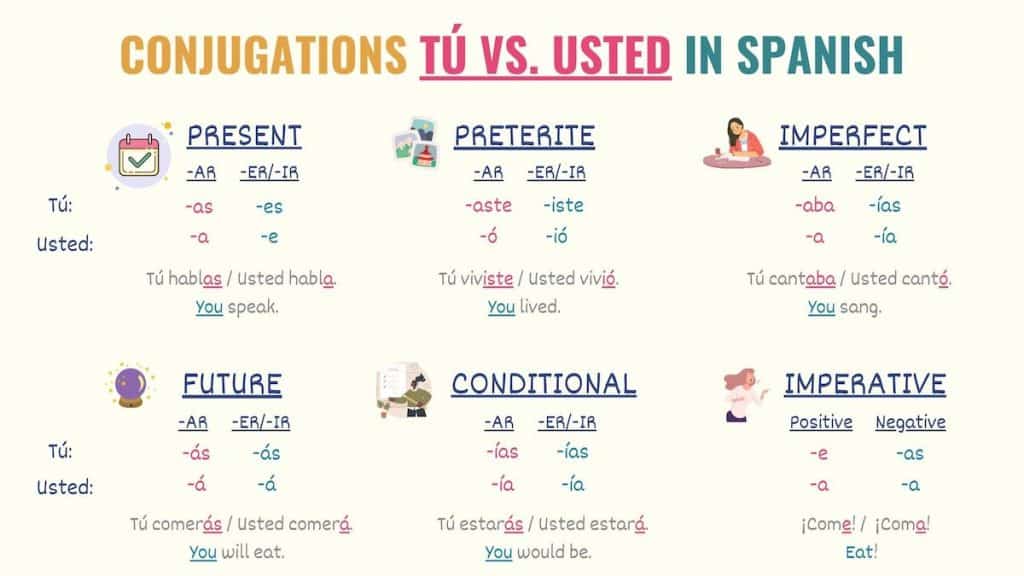
First, review the section '50 Spanish Questions To Use in Conversation'. Focus specifically on the subsections: 'Conversation Starters in Spanish' 'Get To Know You Questions' 'Talking About Travel' Next, quickly review the 'Tú vs Usted' section to refresh your memory on this crucial distinction. Remember, in your Colombian wedding context, usted is the default polite form for new acquaintances.
Here are some key questions from that list, adapted for the formal usted form you'll be using:
- Introductions:
¿Cómo se llama usted?(What is your name?)¿De dónde es usted?(Where are you from?)¿A qué se dedica?(What do you do for work?)
- Travel & Experiences:
¿Ha estado aquí antes?(Have you been here before?)¿Qué países ha visitado?(What countries have you visited?)¿Habla otros idiomas?(Do you speak other languages?)
- Getting to know them:
¿Qué le gusta hacer para divertirse?(What do you like to do for fun?)¿Conoce a los novios desde hace mucho tiempo?(Have you known the bride and groom for a long time?)
4. Putting It All Together: A Simulated Wedding Conversation
Let's walk through a complete, multi-turn conversation. Notice how it combines greetings, compound phrases, past tenses to share experiences, questions, and polite farewells.
Scenario: You approach a guest you don't know who is standing near the bar.
You (The Locomotive):Hola, buenas noches.
(Hello, good evening.)
You start with a simple, polite greeting from our last lesson.
Guest:¡Hola! Buenas noches.
(Hi! Good evening.)
You (Introduce & Ask):Soy [Your Name], un amigo/a de los novios. ¿Usted es familia o amigo/a?
(I'm [Your Name], a friend of the bride and groom. Are you family or a friend?)
You state your connection and immediately ask a question to engage them.
Guest:Mucho gusto. Soy Carlos, un primo de la novia. ¿Y usted, de dónde es?
(A pleasure. I'm Carlos, a cousin of the bride. And you, where are you from?)
You (Answer with past/present perfect & ask back):Soy de Australia, pero he vivido en Londres. Vine a Colombia solo para la boda.
(I'm from Australia, but I've lived in London. I came to Colombia just for the wedding.)
You use the present perfect (
he vivido) and preterite (vine) to share your experience.
Guest:¡Ah, qué bien! ¿Y le gusta Colombia?
(Ah, that's great! And do you like Colombia?)
You (Express opinion & use a compound phrase):Sí, me encanta. Es mi primera vez aquí. Después de la boda, **quiero viajar** un poco por el país. **Pues...** no sé exactamente a dónde ir. ¿Usted **puede recomendarme** algún lugar?
(Yes, I love it. It's my first time here. After the wedding, I want to travel a bit around the country. Well... I don't know exactly where to go. Can you recommend a place to me?)
You use
gustarto express an opinion, connect thoughts with the fillerpues, and use two compound phrases (quiero viajar,puede recomendarme) to state your plan and ask for advice. This is the core of the "building a train" method.
Guest:¡Claro! **Tiene que ir** a Cartagena. Es una ciudad hermosa en la costa.
(Of course! You have to go to Cartagena. It's a beautiful city on the coast.)
You (Thank & wrap up):Ah, perfecto. Muchas gracias por la recomendación. Bueno, fue un placer conocerle, Carlos.
(Ah, perfect. Thanks very much for the recommendation. Well, it was a pleasure meeting you, Carlos.)
You use a polite closing phrase.
Guest:Igualmente. Que disfrute la fiesta. ¡Chao, pues!
(Likewise. Enjoy the party. Bye, then!)
The guest responds with a classic Colombian farewell.
Test your understanding!
Using the "train" model, how would you construct a response to this question from a new acquaintance: ¿Y usted, viaja mucho por su trabajo? (And you, do you travel a lot for your work?)
Try to build a 2-3 sentence answer that:
- Starts with a simple "yes" or "no."
- Uses a past tense (preterite or imperfect) to give a specific example.
- Uses a compound phrase (
poder,querer,tener que, etc.) to talk about a future desire related to travel.
Show answer
There are many possible answers, but here is a good example following the structure:
No, no mucho ahora. Pero el año pasado **fui** a una conferencia en Alemania. (No, not much now. But last year I went to a conference in Germany.)Me gustó mucho. **Quiero conocer** más de Europa en el futuro. (I liked it a lot. I want to get to know more of Europe in the future.)
This response effectively combines a simple answer, a past tense example (fui), and a compound phrase for a future plan (quiero conocer).
Your Final Practice
The key now is practice. The goal is not to memorize scripts, but to internalize the strategy of combining these building blocks.
The 'Spanish Dialogues with Audio' resource is an excellent tool for your final preparation. You can use it to simulate real conversations.
Go to the 'Spanish Conversations - Beginners Level' and select either 'Mid' or 'High' dialogues. Look for topics like introductions, travel, or hobbies. Instead of just listening, engage with them actively: Listen to one person's line. Pause the audio. Formulate a logical question or response out loud, as if you were the other person in the dialogue. Press play and see how your response compares to what the speaker actually said. This 'listen-pause-respond' method is a powerful way to practice building conversational 'trains' in a low-pressure environment.
Conclusion
This lesson marks the end of our course, but the beginning of your real-world practice. You have systematically built up your skills from the ground up, and you now possess a comprehensive toolkit for navigating conversations at the wedding.
Key Takeaways:
- Think in Chunks, Not Words: Build your conversations using phrases and pre-made "chunks" of language.
- Use the "Train" Model: Start with a simple phrase (the locomotive) and add more phrases (the train cars) as you go, using fillers to connect them.
- Lean on Compound Phrases: Structures like
quiero + infinitiveare your best friend. They allow you to communicate complex ideas with simple grammar. - Be the Questioner: Asking questions keeps the conversation flowing and puts you in control.
You have all the components: the grammar, the vocabulary, the cultural etiquette, and now, the strategies to combine them. The goal is not perfection; it's connection. Be curious, be brave, and don't be afraid to make mistakes.
¡Te deseo mucho éxito en la boda y en tu viaje por Colombia! ¡Fue un placer ser tu tutor