Hello! Welcome to your fifth lesson.
In our last session, we designed a practice routine to balance your learning across listening, reading, speaking, and writing. This gives you the "how" and "when" of your study plan. Now, we'll start filling that plan with the "what," beginning with the most fundamental component of spoken language: pronunciation.
Today's learning outcome is to produce all Spanish vowel sounds and key consonants (r, rr, j, ñ) correctly. Mastering these sounds from the outset is crucial. It not only makes you easier to understand but also sharpens your listening skills, as you'll be able to distinguish sounds you couldn't before. Think of this as tuning the foundational layers of a neural network; getting them right makes all subsequent learning more effective.
1. The Spanish Vowels: A Simple, Consistent System
The best news about Spanish pronunciation is its simplicity, especially with vowels. Unlike English, where a single vowel letter can represent many different sounds (e.g., 'a' in cat, father, able), Spanish is beautifully consistent.
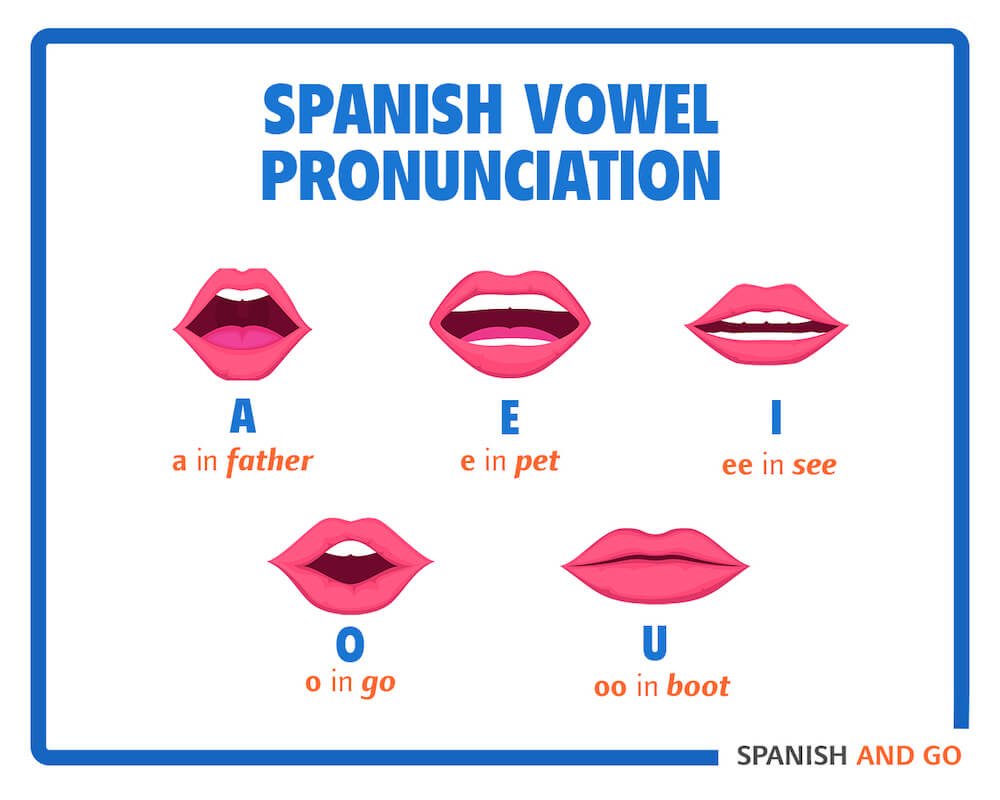
There are five vowels, and they each have one, and only one, pure sound.
- A is always "ah" (like the 'a' in "father")
- E is always "eh" (like the 'e' in "get" or "bet")
- I is always "ee" (like the 'ee' in "see")
- O is always "oh" (like the 'o' in "go," but shorter)
- U is always "oo" (like the 'oo' in "boot")
This image provides a helpful visual for the mouth shape of each vowel.
To hear these sounds and get practical advice on producing them, let's watch a video.
How To Pronounce Letters In Spanish
The video 'How To Pronounce Letters In Spanish' by The Language Tutor provides a very clear and systematic breakdown of the Spanish vowel sounds. The presenter gives excellent tips for avoiding common English-speaker mistakes.
Watch the section from 00:10 to 03:03. Pay close attention to the instruction for pronouncing 'o' and 'u' without rounding your lips as you would in English. Practice saying each sound aloud along with the video.
A Common Pitfall: The Unstressed Vowel
One of the most revealing signs of an English speaker's accent is how they pronounce vowels in unstressed syllables. In English, we tend to reduce these vowels to a neutral "uh" sound (called a schwa). For example, in "president," the 'e' and 'i' are not fully pronounced.
In Spanish, this never happens. Every vowel retains its pure, full sound, regardless of whether it is stressed or not. This is a critical rule.
To dive deeper into this concept, the following text provides excellent examples.
Spanish Pronunciation: The Complete Guide
The article 'Spanish Pronunciation: The Complete Guide' from One Month Spanish has a great section that contrasts Spanish and English vowels, particularly under weak stress. This will help you train your ear and mouth to avoid that common reduction.
Please read the section titled 'Pronunciation of Spanish vowels'. Focus on two parts: 'English vowels vs. Spanish vowels' and 'Contrasting Spanish vowel sounds under weak stress'. You don't need to memorize the word lists, but try saying a few pairs aloud (e.g., 'canta' vs. 'canto', 'mesa' vs 'meso') to feel the difference.
Test your understanding!
Say the Spanish word banana out loud. How should each of the three 'a' sounds be pronounced?
Show answer
All three 'a's should be pronounced with the same pure "ah" sound. In English, we might be tempted to reduce the first or last 'a', but in Spanish, the pronunciation is consistent: bah-NAH-nah.
2. Key Consonants: J, Ñ
Now let's move on to some consonants that have distinct sounds in Spanish.
The 'J' (la jota)
The Spanish j is never pronounced like the 'j' in "judge." Instead, it sounds like the English 'h' in "hat" or "hello." In some dialects, it's a bit more guttural, like the "ch" in the Scottish "loch," but starting with the English 'h' sound is perfect.
Examples:
jefe(boss) sounds like HEH-fehojo(eye) sounds like OH-hohviajar(to travel) sounds like byah-HAR
The 'Ñ' (la eñe)
This letter, with its distinctive squiggle on top (called a tilde), is unique to Spanish. It represents a "ny" sound, similar to the 'ni' in "onion" or the 'ny' in "canyon."
Examples:
señor(Mr., sir) sounds like seh-NYORmañana(morning, tomorrow) sounds like mah-NYAH-nahaño(year) sounds like AH-nyoh
Let's watch a short segment that covers these two sounds.
How To Pronounce Letters In Spanish
We'll return to the same video from The Language Tutor to hear these consonants pronounced.
Watch from 05:32 to 07:29. The presenter explains the 'jota' and the 'eñe' with clear examples.
3. The 'R': A Physical Skill
The Spanish 'r' is probably the most challenging sound for native English speakers, but it is a physical skill that can be learned with deliberate practice. There are two 'r' sounds: the single r and the double rr.
The Single 'r' (the "flap")
The single r sound is a quick "flap" of the tongue against the roof of the mouth. You actually already make this sound in English without realizing it. It's the sound in the middle of words like "butter," "water," or "ladder," where the 'tt' or 'dd' isn't a hard stop.
To make this sound:
- Place the tip of your tongue on the ridge just behind your upper front teeth (the alveolar ridge).
- As you exhale, let your tongue briefly "flap" against that ridge.
Examples:
pero(but)caro(expensive)ahora(now)
The Double 'rr' (the "trill")
The double rr is the famous "rolled R." It's a continuous vibration or trill of the tongue against the alveolar ridge. The single letter r also gets this trilled sound when it's at the beginning of a word (rojo, rápido) or after an n, l, or s.
Mastering the trill takes time and muscle training. Don't worry if you can't do it perfectly today. The first step is to understand the mechanism and begin practicing.
The following video provides an excellent mechanical analogy for producing both the flap and the trill.
How To Pronounce Letters In Spanish
This final segment from The Language Tutor is one of the best explanations available for the Spanish 'r' sounds. The 'butter' analogy is particularly effective for learning the single 'r' flap.
Watch from 08:18 to 10:33. Focus on the physical instructions for tongue placement. Try to imitate the sounds for 'pero' (but) and 'perro' (dog) to feel the difference.
4. Putting It All Together: Practice
Let's practice combining these sounds. Say the following words out loud. Focus on keeping your vowels pure and producing the correct consonant sounds. Don't worry about speed; focus on accuracy.
rojo(red) - Rolledrrat the start, pure 'oh' sounds.tarjeta(card) - Flapr, 'h' sound for thej, pure vowels.señora(Mrs., lady) - 'ny' sound forñ, flapr.cerveza(beer) - Note: In Latin America, thecbeforeeand thezboth sound like 's'. ser-VEH-sah.naranja(orange) - Flapr, 'h' sound for thej.trabajar(to work) - Flaprafter a consonant, 'h' sound for thej.arroz(rice) - Flapr, then a trilledrrsound (since 'z' at the end of a syllable can trigger it).genial(great) - Note: agbeforeeorimakes the same 'h' sound as thej. heh-nee-AHL.
Conclusion
Congratulations on completing this crucial foundational lesson! You now have the technical knowledge to produce the core sounds of Spanish accurately.
Key Takeaways:
- Spanish has five pure vowel sounds (a, e, i, o, u) that never change, even when unstressed.
- The letter
j(andgbeforee/i) is pronounced like the English 'h'. - The letter
ñis pronounced like the "ny" in "canyon." - The single
rbetween vowels is a quick flap of the tongue, like the 'tt' in "butter." - The double
rr(and singlerat the start of a word) is a trilled or "rolled" sound that requires practice.
In your personal practice this week, focus on applying these rules. When you review vocabulary, say the words out loud. When you listen to a podcast, try to notice these specific sounds. This active listening and conscious production will build the muscle memory you need.
Preview of the Next Lesson:
Now that we've covered the individual sounds (phonemes), we'll zoom out to look at how they work within a word. In the next lesson, we will apply Spanish stress and intonation rules for clear pronunciation. You'll learn which syllable to emphasize in any given word, which is the next key to sounding clear and natural.