Hello! Welcome back to your second lesson in this module.
In our last lesson, you learned one of the most systematic and powerful rules in Spanish: how to conjugate regular -ar, -er, and -ir verbs. This gave you a foundational algorithm for creating a huge number of sentences.
Today, we're going to tackle what is arguably the most common challenge for English speakers: the two verbs for "to be." Our learning outcome is to differentiate between 'ser' and 'estar' to describe identity, location, and states of being. Mastering these two verbs is absolutely essential for small talk and will dramatically increase your expressive power. We'll move beyond simple rules-of-thumb to a more robust, logical understanding that should resonate with your systematic approach to learning.
1. The Building Blocks: Conjugating Ser and Estar
Before we explore when to use them, we need to know how to form them. Unlike the regular verbs you just learned, ser and estar are irregular. Their conjugations don't follow a predictable pattern and must be memorized.
Here are their present tense forms.
Ser (to be - for essence/identity)
| Pronoun | Conjugation |
|---|---|
| yo | soy |
| tú | eres |
| él/ella/usted | es |
| nosotros/as | somos |
| vosotros/as | sois |
| ellos/ellas/ustedes | son |
Estar (to be - for state/location)
| Pronoun | Conjugation |
|---|---|
| yo | estoy |
| tú | estás |
| él/ella/usted | está |
| nosotros/as | estamos |
| vosotros/as | estáis |
| ellos/ellas/ustedes | están |
Note the accent marks on estás, está, estáis, and están. These are important as they affect pronunciation and meaning.
Ser vs. estar: understanding Spanish “to be” verbs
For a more detailed look at these conjugations with example sentences, please review the relevant sections of the article 'Ser vs. estar: understanding Spanish “to be” verbs' from Preply.
First, read the section 'Decoding ser: Variations in conjugation' to see the forms of 'ser' used in sentences. Then, find the section 'Decoding estar: Variations in conjugation' and review the table and examples for 'estar'. Focus on how each form matches its subject.
2. The Core Concept: "What" vs. "How"
The most common shortcut you'll hear is that ser is for "permanent" things and estar is for "temporary" things. While this is a helpful starting point, it's an oversimplification that quickly breaks down.
A more robust mental model is to think of it this way:
Sertalks about WHAT something is (its essence, its defining characteristics).Estartalks about HOW something is (its state, condition, or location at a given moment).
For example:
Ella **es** una persona feliz.(She is a happy person.) - This describes her core personality, what she is.Ella **está** feliz hoy.(She is happy today.) - This describes her current emotional state, how she is right now.
3. A Systematic Framework: The DOCTOR & PLACE Acronyms
To make this distinction more concrete, we can use a pair of acronyms. This provides a rule-based system for deciding which verb to use.

When to use Ser → DOCTOR
- Description:
Mi casa **es** grande.(My house is big.) - Occupation:
Yo **soy** ingeniero.(I am an engineer.) - Characteristic:
Él **es** inteligente.(He is intelligent.) - Time/Date:
**Son** las dos de la tarde.(It's 2 PM.) - Origin:
Ellos **son** de Colombia.(They are from Colombia.) - Relation:
Ella **es** mi hermana.(She is my sister.)
When to use Estar → PLACE
- Position:
El libro **está** sobre la mesa.(The book is on the table.) - Location:
Yo **estoy** en la oficina.(I am in the office.) - Action (Present Progressive):
Nosotros **estamos** hablando.(We are talking.) - Condition:
Tú **estás** cansado.(You are tired.) - Emotion:
Ella **está** contenta.(She is happy.)
Ser vs Estar - Spanish Grammar - Superprof
The article 'Ser vs Estar' from Superprof provides a great breakdown of these acronyms with clear tables and examples.
Please read the sections 'How to Remember: DOCTOR vs PLACE', 'When to Use Ser: Permanent States and Characteristics', and 'When to Use Estar: Temporary Conditions and Location'. This will reinforce the categories and provide more examples.
Test your understanding!
For the upcoming wedding in Colombia, you might want to say "The bride is very nice." Which verb would you use, ser or estar, and why?
Show answer
You would use ser. Saying "La novia es muy simpática" fits under 'C' for Characteristic in the DOCTOR acronym. You are describing an inherent personality trait. Using estar would imply she is only being nice at this particular moment, which could sound a bit strange.
4. Beyond the Acronyms: Important Nuances
The DOCTOR/PLACE system covers about 80% of cases. Now, let's explore some crucial exceptions and nuances that move you toward true accuracy. The following video offers an excellent, in-depth explanation that challenges the simple "permanent vs. temporary" rule.
Ser vs Estar: Rules, Examples & My Method for 100% Accuracy
The video 'Ser vs Estar: Rules, Examples & My Method' from the 'Tell Me In Spanish' channel provides a fantastic deep dive into the tricky situations where the basic rules might fail.
We will watch this video in parts. First, watch from 05:17 to 09:24. This part covers the most important exception for location: ser is used for the location of events. Next, watch from 10:18 to 15:25. This explains the nuance between using ser for inherent traits vs. estar for temporary conditions or to highlight a temporary state. Finally, watch from 15:25 to 17:55. This reveals how some adjectives completely change their meaning depending on whether they are used with ser or estar.
Key Nuance 1: The Location of Events
This is a critical rule to remember. While estar is used for the location of people, places, and things, ser is always used for the location of an event.
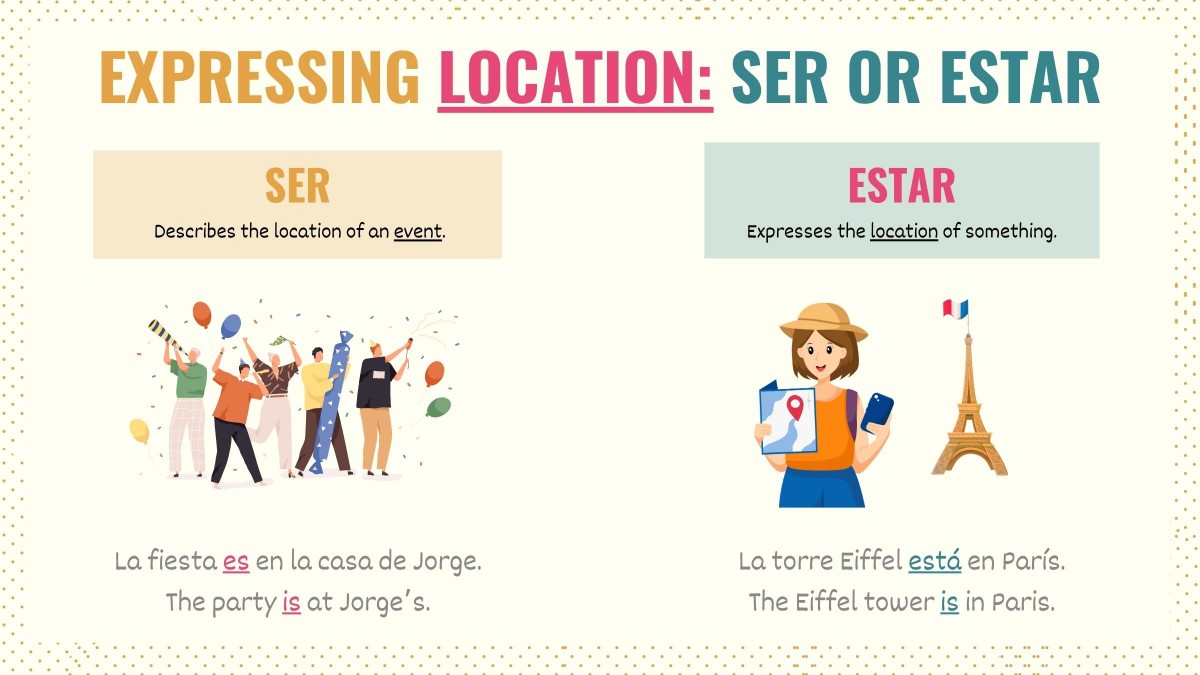
- Wedding context:
La boda **es** en Cartagena.(The wedding is in Cartagena.) - Event location.Cartagena **está** en Colombia.(Cartagena is in Colombia.) - City location.
Key Nuance 2: Adjectives That Change Meaning
As the video explained, some adjectives have a different meaning depending on the verb. This is a powerful tool for adding nuance to your speech. Here are two very useful examples:
| Adjective | With ser (Essence) |
With estar (State) |
|---|---|---|
| listo/a | ser listo = to be smart, clever |
estar listo = to be ready |
| aburrido/a | ser aburrido = to be boring |
estar aburrido = to be bored |
Él **es** listo.(He is smart.)Él **está** listo.(He is ready.)
5. Final Practice
Let's apply everything you've learned. Fill in the blank with the correct form of ser or estar. Think about the logic (DOCTOR/PLACE and the exceptions) for each choice.
- Yo _______ de Australia, pero ahora _______ en Colombia para una boda.
(I am from Australia, but now I am in Colombia for a wedding.) - La ceremonia _______ a las cuatro de la tarde.
(The ceremony is at 4 PM.) - Nosotros _______ muy emocionados por la fiesta.
(We are very excited for the party.) - El novio _______ un hombre muy simpático.
(The groom is a very nice man.) - ¿Tú _______ listo para irnos? La fiesta _______ en un hotel cerca de aquí.
(Are you ready to go? The party is in a hotel near here.)
Show answers
- soy, estoy.
soyfor Origin (O in DOCTOR),estoyfor Location (L in PLACE). - es.
esfor Time (T in DOCTOR). - estamos.
estamosfor Emotion (E in PLACE). - es.
esfor Characteristic (C in DOCTOR). - estás, es.
estásfor Condition/state of being ready.esfor the location of an event (the party).
Conclusion
Excellent work. Today you've tackled a complex but essential part of Spanish grammar. You've moved beyond simple rules to a more nuanced and logical framework for choosing between ser and estar.
Key Takeaways:
- Conjugations:
Serandestarare irregular verbs whose present tense forms must be memorized. - Core Logic:
Serdescribes the essence of something (what it is), whileestardescribes its state or location (how or where it is). - Systematic Approach: The DOCTOR (
ser) and PLACE (estar) acronyms provide a reliable framework for making the right choice. - Crucial Exceptions: Remember to use
serfor the location of events and be aware that some adjectives change meaning depending on the verb used.
Preview of the Next Lesson:
Now that you can form sentences describing who people are and how they feel, we'll add another layer of detail. In the next lesson, we will focus on using articles (un, una, el, la) and making adjectives agree in gender and number. This will allow you to build richer, more descriptive sentences like "Él es **un** hombre **alto**" (He is a tall man) or "La casa **es** **blanca**" (The house is white).