Hello! Welcome back to our Spanish course.
In our last lesson, you mastered the rules for articles and adjective agreement, allowing you to build descriptive sentences like La boda es elegante (The wedding is elegant) and Los invitados están contentos (The guests are happy). These positive statements are a fantastic start. But what if you want to say something is not the case?
Today, we'll address exactly that. Our learning outcome is to form basic negative sentences by placing 'no' before the verb. This is one of the most straightforward and satisfying rules in Spanish. For someone with your background in machine learning who appreciates efficient, systematic rules, you'll find the logic of Spanish negation refreshingly simple compared to English. Let's dive in.
The Core Rule of Spanish Negation
In English, to make a sentence negative, we often have to insert auxiliary verbs like "do not" or "is not." For example, "I speak" becomes "I do not speak."
Spanish simplifies this entire process down to one word: no.
The fundamental rule is: Place no directly before the conjugated verb.
That's it. There's no "do not" or "does not." The verb form itself doesn't change.
Let's look at some examples building on what you already know:
-
Affirmative:
Hablo español.(I speak Spanish.) -
Negative:
**No** hablo español.(I do not speak Spanish.) -
Affirmative:
La novia es simpática.(The bride is nice.) -
Negative:
La novia **no** es simpática.(The bride is not nice.) -
Affirmative:
Vivimos en Colombia.(We live in Colombia.) -
Negative:
**No** vivimos en Colombia.(We do not live in Colombia.)
To get a clear explanation of this core principle, let's start with a brief reading.
Making Simple Negative Sentences in Spanish: The Easy Rule
This article, 'Making Simple Negative Sentences in Spanish', clearly lays out the foundational rule and contrasts it with English. It's a perfect summary of the concept.
Please read the first section, 'The Simple Rule: Just Add "No"'. Focus on the examples provided and the direct comparison to the English structure.
Now, let's hear this rule explained. Watching a short video will help reinforce the pronunciation and rhythm of negative sentences.
This video, 'Grammar: Negation in Spanish' from the Learn Spanish with SpanishPod101.com channel, provides a concise explanation of the main rule.
Watch from 01:06 to 02:28. The presenter clearly states the rule—'always before the conjugated verb'—and gives a simple example with the verb 'ser'.
Test your understanding!
Make the following affirmative sentences negative.
Como carne.(I eat meat.)El hotel es caro.(The hotel is expensive.)Bailamos bien.(We dance well.)Los invitados están aquí.(The guests are here.)
Show answer
**No** como carne.El hotel **no** es caro.**No** bailamos bien.Los invitados **no** están aquí.
Negation with Pronouns
What happens when a sentence includes pronouns, like the indirect object pronouns used with verbs like gustar? The rule remains consistent: no comes before the entire verb-pronoun cluster.
The structure is: no + pronoun + verb.
You've already seen this structure in your Duolingo experience, and it's essential for expressing likes and dislikes, a cornerstone of small talk.
- Affirmative:
Me gusta la música.(I like the music.) - Negative:
**No** me gusta la música.(I don't like the music.)
Let's turn to a resource that explains this placement clearly.
No for negative sentences | Spanish Grammar
The article 'No for negative sentences' from Kwiziq provides excellent examples showing where to place 'no' when sentences include reflexive pronouns. This pattern also applies to other object pronouns.
Read the section titled 'If the sentence has reflexive pronouns...'. Notice the word order: 'no' comes before the pronoun (me, te, se, etc.). This structure is the key takeaway.
To see this applied specifically to gustar, which is a very common scenario, let's watch a segment from another video. The presenter's style is very dynamic and memorable.
Learn Spanish Grammar: Double Negatives in Spanish – No, Nada, Niguno, Ninguna, Nadie & more
In this clip from Butterfly Spanish, the host demonstrates how to negate sentences with 'gustar'. While the full video discusses double negatives (a future topic), we will focus only on this specific part about saying you don't like something.
Watch from 09:19 to 11:44. Pay close attention to the phrase No me gustan and how the word no is placed before me.
This structure is a fixed pattern, which makes it reliable and easy to apply once you get used to it.
No te veo. (I don't see you.)Ella no se levanta temprano. (She doesn't get up early.)
Visualizing Affirmative vs. Negative
This image provides a helpful visual contrast between affirmative and negative ideas. It also gives a small peek at other negative words like nada (nothing) and nunca (never).
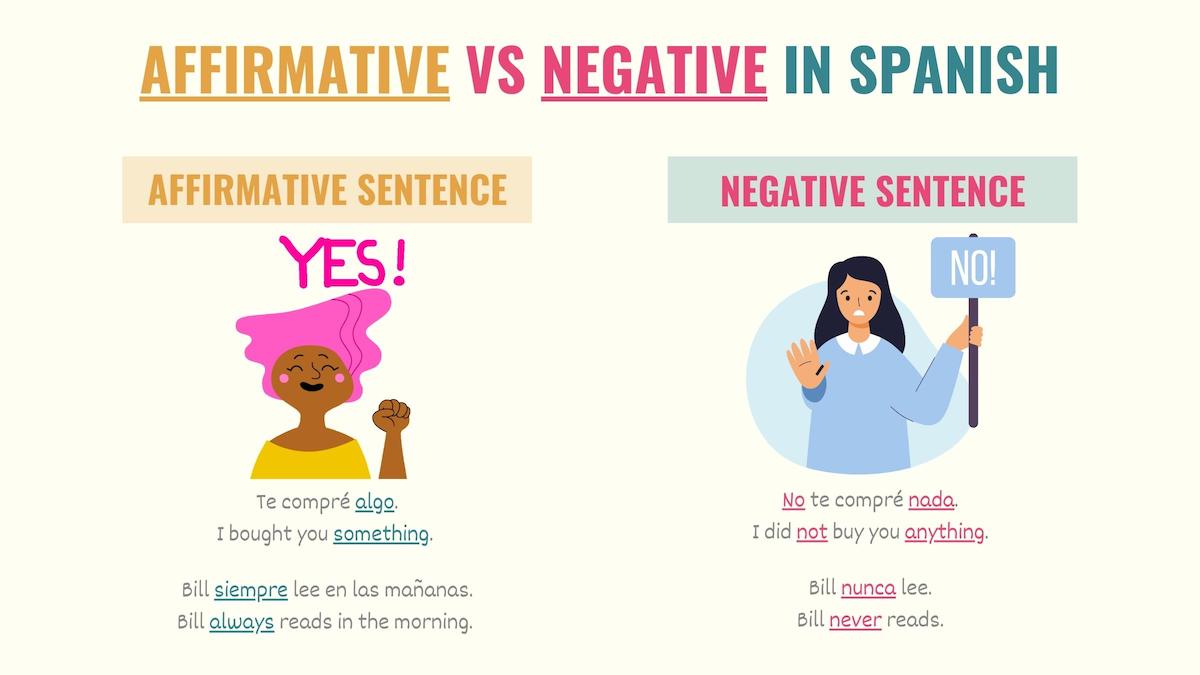
For now, our focus remains on the simple negation with no. The concept of double negatives (e.g., No ... nada) is a standard feature in Spanish and something we'll explore in a later module. The key insight for today is that even in these more complex sentences, the initial no still comes right before the verb.
Final Practice!
You're at the wedding reception. How would you say the following in Spanish?
- I don't drink wine. (
beber- to drink;vino- wine) - I don't like this song. (
esta canción- this song) - We are not tired. (
cansados- tired) - He doesn't speak English. (
hablar- to speak;inglés- English)
Show answers
No bebo vino.No me gusta esta canción.No estamos cansados.Él no habla inglés.(TheÉlis optional if the context is clear).
Conclusion
Excellent work. You've now unlocked the other half of basic expression: negation. The beauty of this rule lies in its simplicity and consistency, a principle that resonates well with building a complex system from reliable components.
Key Takeaways:
- To make a simple sentence negative in Spanish, you place the word
nodirectly before the conjugated verb. - Unlike English, Spanish does not use auxiliary verbs like "do" or "does" for negation.
- If the sentence has an object or reflexive pronoun before the verb,
nois placed before the pronoun (e.g.,No me gusta).
Preview of the Next Lesson:
So far, we've focused on regular verbs and the essential verbs ser and estar. To significantly expand your conversational ability, you need to master a few high-frequency irregular verbs. In the next lesson, we will learn to conjugate and use the key irregular verbs tener (to have), hacer (to do/make), and ir (to go) in the present tense. These three verbs are conversational power tools, and learning their patterns will be a major step forward.