In our last lesson, we explored the geographical stage of 15th-century India, understanding how its mountains, plains, and rivers shaped the course of its history. Now, we will populate that stage with the key actors. Our goal is to identify the major kingdoms and sultanates that held power across the subcontinent around the year 1400.
You will discover that, unlike in some earlier periods, India was not dominated by a single, central empire. Instead, the political landscape was a complex and fragmented mosaic of competing states. This lesson will provide a crucial political map, introducing the main players whose rivalries and ambitions defined the century.
A Fragmented Subcontinent
By the late 14th century, the authority of the once-mighty Delhi Sultanate, which had dominated northern India for nearly two centuries, was in a state of rapid decline. A combination of internal rebellions, mismanagement, and a devastating external invasion (which we will cover in the next lesson) had shattered its power. This created a power vacuum, allowing provincial governors and ambitious local leaders to assert their independence, leading to the rise of numerous regional kingdoms.
Let's begin by looking at a map that illustrates this political reality.

The Diminished Center: The Delhi Sultanate
For over 150 years, the Delhi Sultanate was the preeminent power in North India. From its capital in the strategic heart of the Indo-Gangetic Plain, it had expanded its influence across vast territories. However, by 1400, its golden age was long past.
The following video provides a concise history of the Delhi Sultanate. While you don't need to memorize every ruler, it will give you a sense of the Sultanate's rise and the reasons for its decline leading into our period of focus.
Who were the Sultans of Delhi?(Conquest of India, Mongol invasions!)Delhi Sultanate History
Watch this segment from the video "Who were the Sultans of Delhi?" by the channel Epimetheus.
Focus on the discussion of the Tughlaq dynasty's decline, noting the "rampant mismanagement" that led to widespread revolt. Then, pay close attention to the brief but crucial segment on Timur's invasion and the collapse of the Tughlaq dynasty. This sets the scene for the political fragmentation we are exploring.
As the video explains, the reign of Muhammad bin Tughlaq in the mid-14th century, followed by internal strife and the catastrophic sack of Delhi by the Turco-Mongol conqueror Timur in 1398, left the Sultanate shattered. By 1400, the Tughlaq dynasty's direct rule was effectively confined to a small territory surrounding Delhi. The great empire had become just one regional power among many.
The Southern Giants: Vijayanagara and the Bahmani Sultanate
While the Delhi Sultanate was weakening in the north, two powerful and wealthy empires had risen to dominate the southern part of the subcontinent, the Deccan plateau.
- The Vijayanagara Empire: A vast Hindu empire that controlled the territory south of the Krishna and Tungabhadra rivers. Its capital, Vijayanagara (near modern Hampi), was one of the largest and most prosperous cities in the world at the time.
- The Bahmani Sultanate: A Muslim sultanate located to the north of Vijayanagara, controlling the northern Deccan from the Arabian Sea to the Bay of Bengal.
These two empires were born from the rebellion against the Delhi Sultanate's overreach into the south a few decades earlier. They became the primary powers of the Deccan and were locked in a near-constant state of rivalry. As we discussed in the last lesson, their conflict often centered on the control of the fertile and strategic Raichur Doab.
The video below gives a clear narrative of how these two rival states emerged.
India's Medieval Golden Age: Rise and Fall of the Vijayanagar Empire
Watch the introduction to "India's Medieval Golden Age: Rise and Fall of the Vijayanagar Empire" from the Odd Compass channel.
Watch from the beginning, covering the emergence of the two rival states from the chaos of the Delhi Sultanate's decline in the south. The video clearly establishes their respective identities and the beginning of their long-standing conflict.
To understand their origins more formally, the following text provides specific details about their founding.
This text from BYJU'S outlines the emergence of the major southern kingdoms.
First, read the introductory paragraph which sets the context of the Delhi Sultanate's disintegration. Then, jump to the "Sangama Dynasty" section and read about the founders, Harihara and Bukka. Finally, navigate to the "Bahmani Kingdom" section and read the introductory paragraph and the section on its founder, Alauddin Hasan Bahman Shah.
A Mosaic of Regional Kingdoms
With the center in Delhi unable to enforce its authority, provincial governors across the subcontinent declared their independence. This led to the formation of several powerful and culturally distinct regional sultanates.
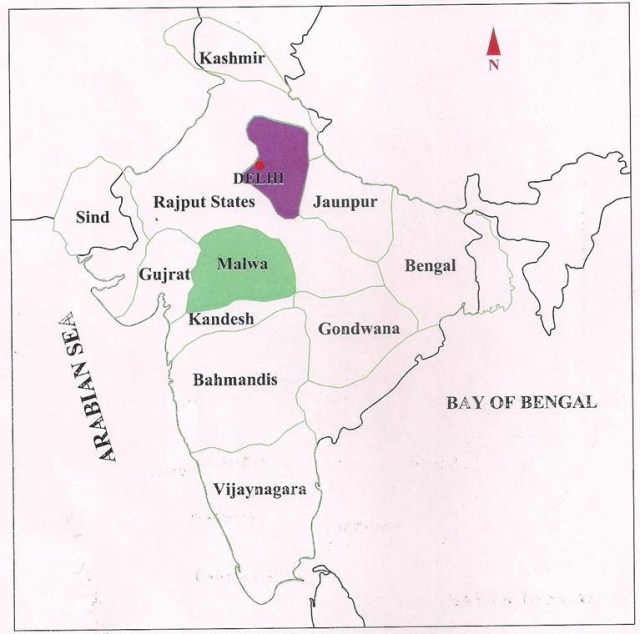
Let's survey the most important of these new regional powers. The following readings are from a single, comprehensive article.
Western and Central India: Gujarat, Malwa, and Mewar
The regions of western and central India were strategically vital, controlling rich agricultural lands, crucial trade routes, and access to prosperous sea ports.
Provincial Kingdoms of Western India - BYJU'S
This article from BYJU'S details the rise of the independent kingdoms of western India.
Read the section on Gujarat, noting its wealth and how its governor broke away from Delhi after Timur's invasion. Then, read about Malwa, understanding its strategic location controlling the routes between north and south. Finally, read the introductory paragraphs on Mewar, which emerged as the most powerful of the Hindu Rajput states in this period.
- Gujarat Sultanate: Blessed with fertile land and a long coastline, Gujarat was one of the richest provinces. Its ports were bustling centers of Indian Ocean trade. Its rulers became major players in the politics of western India.
- Malwa Sultanate: Located on a plateau in central India, Malwa commanded the trunk routes connecting Gujarat to the northern heartland and the north to the south. Control of Malwa was essential for any power with pan-Indian ambitions.
- The Rajput States: In the arid region of Rajputana (modern Rajasthan), a collection of clan-based Hindu kingdoms maintained their independence through martial prowess. The most prominent among them in the 15th century was Mewar, which under rulers like Rana Kumbha became a formidable military power.
Eastern India: Jaunpur and Bengal
In the east, two major sultanates emerged in the fertile Ganges basin and its delta.
Provincial Kingdoms of Western India - BYJU'S
Continuing with the same article, let's look at the eastern powers.
Read the section on Jaunpur, which controlled a large part of the central Gangetic plain. Then move to the section on Bengal, which due to its distance and wealth, frequently asserted its independence from Delhi.
- Jaunpur Sultanate: Based in the middle of the Gangetic plain, the Sharqi dynasty of Jaunpur controlled a wealthy territory and became a major rival to the Delhi Sultanate for control of North India.
- Bengal Sultanate: Rich from agriculture and its access to sea trade, Bengal was a powerful and consistently independent entity. Its distance and difficult terrain made it notoriously hard for Delhi-based powers to control.
Other Significant Powers
To complete our survey, we must mention two other important states in the north and on the eastern coast.
Provincial Kingdoms of Western India - BYJU'S
Finally, let's look at Kashmir and Orissa.
Find and read the introduction to Kashmir, which became a distinct sultanate in the 14th century. Then, read the opening paragraph on Orissa, which was ruled by the powerful Hindu Gajapati dynasty.
- Kashmir Sultanate: In the far north, insulated by mountains, the valley of Kashmir was ruled by its own succession of sultans, the Shah Mir dynasty, developing a unique political and cultural trajectory.
- Gajapati Kingdom of Orissa: On the eastern coast, the Gajapati ("Lord of Elephants") kings of Orissa ruled a powerful Hindu kingdom that frequently clashed with its neighbors, including the Bahmanis and the Bengal Sultans.
Conclusion
As we conclude this lesson, you should have a clear mental map of the Indian subcontinent's political landscape around 1400.
- The Delhi Sultanate, once the dominant empire, was reduced to a regional power centered on its capital.
- The Deccan was dominated by two southern giants: the Hindu Vijayanagara Empire and the Muslim Bahmani Sultanate, locked in a struggle for supremacy.
- Across the rest of the subcontinent, a mosaic of powerful regional kingdoms had emerged from the fragments of the Delhi Sultanate's former provinces. These included Gujarat and Malwa in the west, Jaunpur and Bengal in the east, the Rajput state of Mewar, and the kingdoms of Kashmir and Orissa.
This theme of political fragmentation is the crucial starting point for understanding the history of the 15th century. In our next lesson, we will delve deeper into the event that acted as the primary catalyst for this situation: the brutal and transformative invasion of India by Timur in 1398.