Welcome to the first day of your intensive preparation for the PECB ISO/IEC 27001 Lead Implementer exam. Given your tight five-day schedule and sharp focus on certification, our lessons will be direct, exam-oriented, and build upon your existing experience in cybersecurity management.
Today's goal is to master the fundamental structure of the ISO/IEC 27001:2022 standard. By the end of this 30-minute session, you will be able to classify any implementation scenario under the correct clause group (4–10) and confidently distinguish between a mandatory requirement of the main clauses and a selectable security control from Annex A. This foundational knowledge maps directly to Domains 1, 2, and 3 of the PECB exam, covering fundamental principles, the ISMS, and planning.
The Two Pillars of ISO 27001
At its core, the ISO 27001 standard is built on two distinct but interconnected parts. Understanding this division is the single most important concept for navigating the standard and for answering a wide range of exam questions correctly.
- Clauses 4–10: The Management Framework. These are the mandatory requirements that define what an organization must do to establish, implement, maintain, and continually improve an Information Security Management System (ISMS). You must comply with all of these requirements to achieve certification. They provide the "verbs" of the ISMS: planning, supporting, operating, evaluating, and improving.
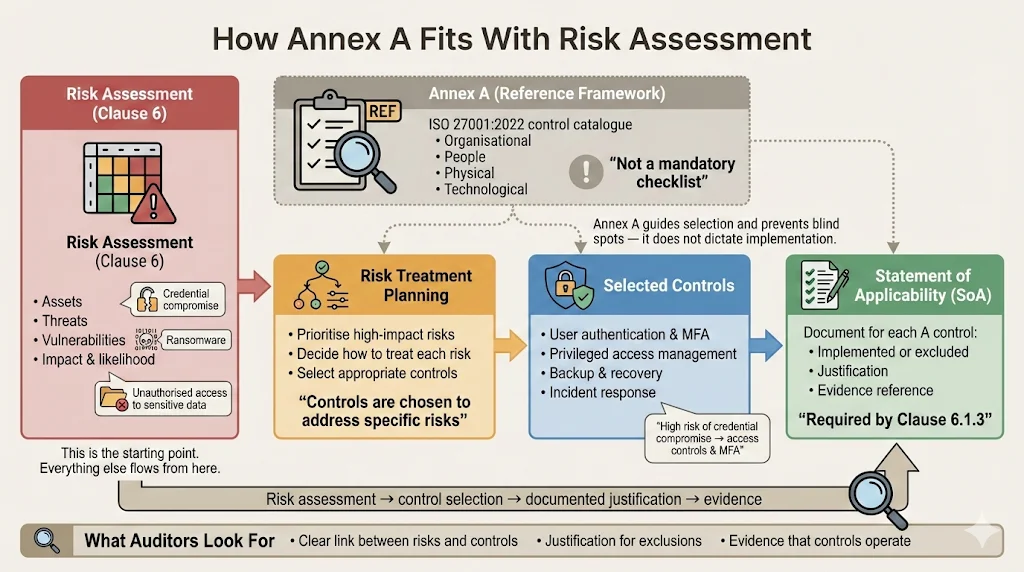
- Annex A: The Reference Control Set. This is a catalogue of 93 information security controls that provide potential ways how to treat risks. These are the "nouns" of information security: things like backups, access control policies, and encryption. Crucially, Annex A is not a mandatory checklist. You select controls from this annex based on your organization's specific risks, which you identify through the process defined in Clause 6.
To start, let's watch a brief segment from a video by Dejan Kosutic, a well-known ISO 27001 expert, which introduces this structure.
ISO 27001 clauses, requirements, and structure explained
This video, "ISO 27001 clauses, requirements, and structure explained", provides a clear, high-level overview.
Watch the section from the introduction, where the presenter explains the two main parts of the standard and, critically, why they are interdependent. Pay close attention to his example of how implementing a control like "backup" (from Annex A) relies on processes defined in the main clauses (like risk management and monitoring).
The relationship described in the video is visualized perfectly in the following diagram. It shows how the mandatory process of Risk Assessment (required by Clause 6) is the starting point that drives the selection of appropriate controls from the Annex A reference framework.
Navigating the Mandatory Clauses (4-10)
Now that we've established the core distinction, let's focus on the mandatory clauses. For the exam, you'll frequently encounter scenarios and need to identify which part of the management framework is being described. These clauses follow the Plan-Do-Check-Act (PDCA) model, a concept you may have encountered in other management systems.
To get a quick but comprehensive overview of what each clause demands, we'll turn to a concise summary.
ISO 27001 Requirements Overview: Clauses 4-10 Summary | Glocert
This article from Glocert International provides a clear, clause-by-clause breakdown of the mandatory ISMS requirements.
Please read the sections covering Clauses 4 through 10. You can find them by scrolling from the beginning of Clause 4 to the end of Clause 10. As you read, focus on the purpose of each clause group, not the minute details. For each clause, ask yourself: "What is the main objective here?"
To consolidate your reading, here is a quick-reference table that maps the clauses to the PDCA cycle and their core purpose. This is a crucial study aid for the exam.
| PDCA Phase | Clause Number & Title | Core Purpose |
|---|---|---|
| Plan | Clause 4: Context of the Organization | Understand your business environment, stakeholders, and define the ISMS scope. |
| Plan | Clause 5: Leadership | Ensure top management commitment, establish a security policy, and define roles/responsibilities. |
| Plan | Clause 6: Planning | Conduct risk assessment, define risk treatment, and set information security objectives. This is the engine of the ISMS. |
| Do | Clause 7: Support | Provide resources, ensure personnel competence and awareness, manage communication, and control documentation. |
| Do | Clause 8: Operation | Implement the plans and processes from Clause 6, including the chosen controls. |
| Check | Clause 9: Performance Evaluation | Monitor, measure, and review the ISMS's effectiveness through metrics, internal audits, and management reviews. |
| Act | Clause 10: Improvement | Address nonconformities with corrective actions and drive continual improvement of the ISMS. |
Applying Knowledge to Exam Scenarios
Your ability to apply this structural knowledge is what the PECB exam tests. Let's practice with two quick scenarios.
Scenario 1:
An organization's HR department is updating job descriptions for the IT team to include specific qualifications related to managing firewall systems and intrusion detection. The CISO states this is necessary to comply with the ISMS.
- Question: Does this activity primarily relate to a mandatory clause or an Annex A control? If it's a clause, which one?
- Answer: This directly relates to Clause 7.2: Competence. The standard requires the organization to "determine the necessary competence of person(s) doing work under its control that affects its information security performance." This is a mandatory requirement from the "Support" clause.
Scenario 2:
Following a risk assessment that identified a high risk of data interception over the company's Wi-Fi network, the security team decides to implement the WPA3 encryption protocol.
- Question: Is implementing WPA3 a mandatory requirement from Clauses 4-10?
- Answer: No. This is a specific technological control selected from Annex A to treat an identified risk. The process of identifying that risk and deciding on a treatment is mandatory (Clause 6), but the choice of WPA3 itself is a risk-based decision, not a universal requirement of the standard.
The PECB Candidate Handbook provides examples that perfectly illustrate this distinction.
ISO/IEC 27001 LEAD IMPLEMENTER
This handbook contains official sample questions that mirror the style of the real exam.
Locate the section "Sample exam questions." Compare Question 1 with Question 3. Notice how Question 1 asks for actions to conform to Clause 7.2, a mandatory requirement. In contrast, Question 3 presents a risk scenario and asks you to select appropriate controls (referenced by their Annex A numbers, e.g., A.13.2.4) to treat the risk. This is the clause/control distinction in action.
Conclusion
In this lesson, we established the critical distinction between the mandatory management framework of ISO 27001 (Clauses 4-10) and the selectable reference controls in Annex A. Your experience with ISMS documentation and risk management will make this structure intuitive: the clauses define the management system you must operate, and that system, in turn, guides you in selecting the right tools (controls) for the job.
Key Takeaways:
- Clauses 4-10 are mandatory: They define what your ISMS must do, following a Plan-Do-Check-Act cycle.
- Annex A is a reference catalogue: It provides a list of 93 potential controls (how you might achieve security), but you only implement those relevant to your risks.
- Risk assessment (Clause 6) connects the two: The mandatory risk assessment process dictates which Annex A controls are necessary.
- The ability to map a scenario to the correct clause (e.g., "management review" is Clause 9.3) or identify an action as an Annex A control (e.g., "implementing backups") is a core exam skill.
In our next session, we will build directly on this foundation. We will move on to Day 2: Sequencing the ISMS Implementation, where we'll examine the logical order of activities and identify the principal documented evidence—like the Statement of Applicability you saw today—that each activity should produce.