Hello! Welcome to your fifth and final lesson in the "Ukulele Fundamentals" module.
In our last session, you developed crucial right-hand control by practicing isolated thumb and index finger strokes on open strings. This built the foundation for producing clean, intentional sound.
Today, we're going to connect your new ukulele journey with your past experience on the guitar. The learning outcome for this lesson is to explain the relationship between guitar and ukulele tuning and chord shapes. This is a powerful "shortcut" that will demystify the ukulele fretboard and give you a massive head start when we begin learning chords in the next module. Instead of learning everything from scratch, you'll be able to transfer and adapt knowledge you already have.
1. Tuning: A Side-by-Side Comparison
First, let's look at the fundamental difference between the two instruments: the standard tuning of their open strings.
- Standard Guitar Tuning (6 strings): E - A - D - G - B - E (from thickest/lowest pitch to thinnest/highest)
- Standard Ukulele Tuning (4 strings): G - C - E - A (from top to bottom as you hold it)
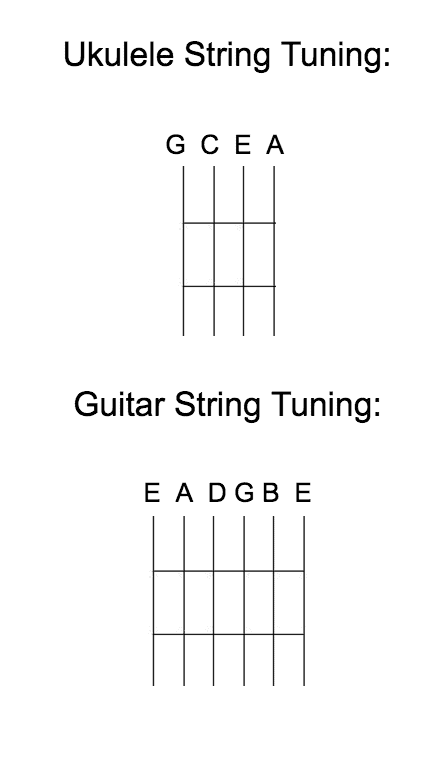
Notice two things: the ukulele has fewer strings, and its tuning isn't linear like a guitar's. The top G string on a standard ukulele is tuned higher than the C string next to it. This is called re-entrant tuning, and it's responsible for the ukulele's bright, jangly signature sound.
2. The Key Analogy: Ukulele as a Capo'd Guitar
Here is the single most important concept for any guitarist learning the ukulele. Thinking of the ukulele this way will make everything else fall into place.
A standard-tuned ukulele is like playing the top four strings of a guitar with a capo on the 5th fret.
Let's watch a short video that explains this idea perfectly.
Are Guitar And Ukulele Chords The Same?
In this video, 'Are Guitar And Ukulele Chords The Same?', instructor Jon MacLennan introduces the core concept that unlocks the ukulele for guitar players.
Watch from the beginning to 02:21. Pay close attention to the 'light bulb' moment he describes. See how placing a capo on the 5th fret of a guitar makes the top four strings (D, G, B, E) become G, C, E, and A—the exact tuning of a ukulele (with a low G).
This analogy is powerful because it means the relationship between the strings—the intervals—on the ukulele is the same as the top four strings of a guitar. Therefore, any chord or scale shape you knew on the top four strings of your guitar is directly transferable.
However, because you've effectively "moved" everything up five frets, the name of the chord changes. This is called transposition.
3. Transposition in Action: Your Shapes Have New Names
Since the ukulele is tuned higher than the guitar, a familiar chord shape will produce a different chord. The rule of thumb is that a guitar shape, when played on a ukulele, produces a chord that is a perfect fourth higher.
Let's see this in action with some common chords.
Can I play Guitar Chords on the #Ukulele? FIND OUT HERE! 🔥🤔🎸
The channel Uke Like The Pros demonstrates this transposition with clear, practical examples. This will help solidify the 'fourth up' rule.
Watch from 03:43 to 08:49. The presenter will show you how: A guitar D chord shape becomes a ukulele G chord. A guitar G chord shape becomes a ukulele C chord. A guitar E chord shape becomes a ukulele A chord. He explicitly states the 'fourth up' rule (e.g., from G on guitar, count up four notes: G-A-B-C. The shape becomes a C chord).
This is fantastic news. It means you don't have to re-learn fingerings from zero. You just need to learn the new names for the shapes you may already remember.
Test your understanding!
Based on the "fourth up" rule, if you play an A major chord shape from a guitar (using only the top four strings) on a ukulele, what chord will you be playing?
Show answer
You would be playing a D major chord. Counting up a fourth from A gives you: A, B, C, D.
4. Visualizing the Connection
Let's put all this theory into a single, easy-to-read visual. The following image compares common chord diagrams for both instruments side-by-side.
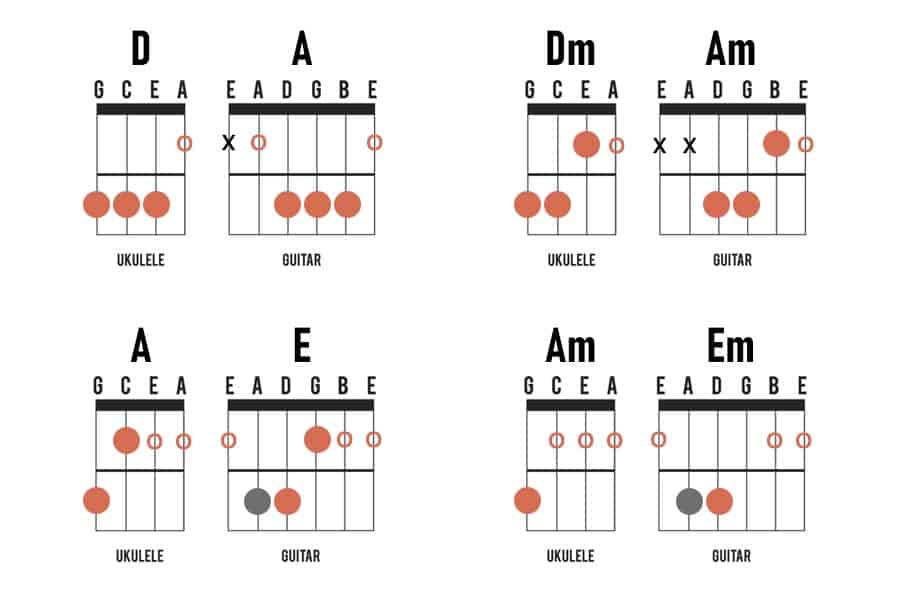
Look closely at the D chord on guitar and the G chord on ukulele. The fingering shape is identical! The same is true for the A (guitar) and D (ukulele) on the right side of the image. This chart is a practical confirmation of the transposition rule.
5. A Reference Guide for the Guitarist-Turned-Uke-Player
To round out your understanding, here is an excellent article that summarizes the key differences and provides a handy table for translating chord shapes.
How Does Ukulele Tuning Really Compare to Guitar? (2026)
This article, 'How Does Ukulele Tuning Really Compare to Guitar?', serves as a great summary and future reference. It breaks down the key concepts we've discussed today.
Please read two specific sections from this article: Start with the section titled '5 Key Differences in Tuning Systems Between Ukulele and Guitar'. This will give you a concise summary of re-entrant tuning, intervals, and transposition. Then, find the table under the heading 'Applying Familiar Guitar Chord Shapes on the Ukulele: What Works and What Doesn’t'. This is a practical cheatsheet that shows how common guitar shapes translate to the ukulele. Focus on understanding the logic behind the translations in the table.
Conclusion
Congratulations on completing the first module! Today's lesson was crucial because it builds a bridge from your past experience directly to your present learning. By understanding the relationship between the two instruments, you've gained a powerful mental framework that will significantly speed up your progress.
Key Takeaways:
- A standard ukulele is tuned G-C-E-A, with a high G string (re-entrant tuning).
- The most useful analogy is to think of a ukulele as the top four strings of a guitar with a capo on the 5th fret.
- Because of this, chord shapes are transferable, but their names are transposed up by a perfect fourth (e.g., a guitar G-shape becomes a ukulele C-chord).
- Your guitar knowledge is not lost; it's a valuable asset that you can now adapt to the ukulele.
In our next lesson, we will begin Module 2, "First Chords and Smooth Changes." You'll officially learn to form and play the essential chords: C, G, Am, and F. Thanks to the knowledge you gained today, you might find that some of these shapes feel very familiar