Hello! Last time, you joined letter sounds to read words such as cat, sit, and sun. Today you will put words together to read short sentences. You will use your finger to keep your place, say each sentence aloud, and check that it makes sense. Keep a pencil and paper nearby for a little writing, too.
Little words make a whole thought
Look at this sentence:
A cat can sit.
It has four words. Point to each word as you read from left to right. English starts on the left side of the line, even if you are used to seeing Arabic start on the right.
You can sound out cat, can, and sit. The little word A is one letter, but here we say it softly, like “uh.” Listen to your teacher read the sentence once. Then point and read it aloud yourself: A cat can sit.
Try a tiny change:
A cat can nap.
The first three words stayed the same. Look carefully at the last word: /n/ /a/ /p/, nap. Read the whole sentence again, without stopping after every word. A sentence sounds like one complete thought.
Notice two marks that help you read and write: A is a capital letter because it starts the sentence, and the full stop (.) tells you the sentence is finished.
Read a tiny story
Here are two helpful little words for our story. Your teacher can say them first, then you can say them:
- is sounds like “iz.”
- not can be sounded out: /n/ /o/ /t/, not.
Now meet Dad and Sid in Sid and Dad. Some lines in the story are longer than the sentences you are practising today. Your teacher can read those lines so you can enjoy the story together; your reading job is the short lines.
Decodable Passages All Kindergarten - UFLI
Read part of “Sid and Dad” from the University of Florida Literacy Institute. Its short sentences let you practise sounding out words and reading them as a whole thought.
Find Lesson 13: d /d/ Sid and Dad, between “Tom and the Fan” and “The Cat Can.” Follow the story from its first sentence, “Dad is sad,” to its last, “Sid sat in the pit.” Read aloud the short sentences Dad is sad., Sid is not sad., Dad is mad., and Sid is not mad. Ask your teacher to read the longer sentences between them. Point to each word as you read, and notice when the story says sad or mad.
Go back to Dad is sad. Say its three words smoothly. Then look at Dad is mad. Only one word changed. Reading every word—not just the first and last—helps you know what the sentence really says.
Let the picture check your reading
Sometimes a picture helps you understand a sentence. But read the words first: a picture cannot tell you which letters are on the page.
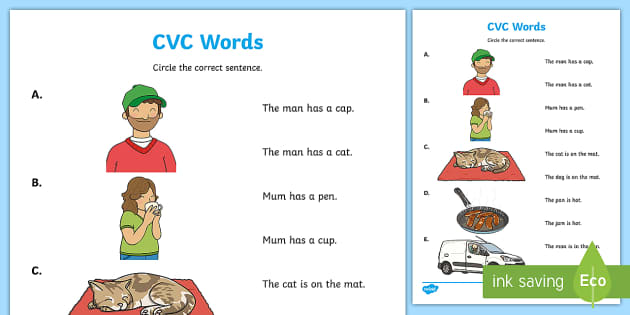
Look at picture B. Ask your teacher to cover the picture for a moment while you read the two sentences beside it. The first three words are the same:
Mum has a pen.
Mum has a cup.
Your teacher can say has with you; it sounds like “haz.” Sound out the final word in each sentence: /p/ /e/ /n/, pen; /k/ /u/ /p/, cup. Now look at the picture. It shows a cup, so Mum has a cup. is the sentence that matches. Read that sentence aloud once more, pointing to its four words.
Read it, say it, write it
To finish, choose one short sentence from today. Read it aloud while your finger moves under its words. Then copy it onto your paper, leaving a space between words. Check the capital letter at the beginning and the full stop at the end. Read what you wrote aloud—your voice can help you notice if a word is missing.
If a word feels difficult, pause at that word. Sound out the letters you know, let your teacher help with a little word such as is or has, and then read the whole sentence again.
You can now read a short sentence by moving from left to right, sounding out familiar words, and reading the words together for meaning. Pictures are useful for checking your reading; the letters tell you what to say.
Next lesson, you will begin a new module by counting objects to ten and matching each group to its number.