Introduction
Welcome back! In our last lesson, we discussed the performance trade-offs of locking, focusing on how threads can create bottlenecks when they compete for access to the same logical data. We saw that coarse-grained locking is simple but can cause high contention, while fine-grained locking reduces contention at the cost of complexity and the risk of deadlock.
This lesson addresses a more subtle and often surprising performance killer. What if threads that are working on completely independent data still manage to slow each other down dramatically? This isn't a theoretical problem; it's a common issue in parallel programming caused by the way modern CPUs manage memory. This phenomenon is called false sharing.
Your learning outcome for this lesson is to diagnose and mitigate false sharing to improve cache performance in OpenMP applications. We will explore what false sharing is, how to recognize its symptoms, and—most importantly—what coding patterns you can use to eliminate it.
1. What is False Sharing?
To understand false sharing, we first need a basic model of how CPU caches work. As you know from your engineering background, optimizing a system often involves addressing its slowest component. In a modern computer, accessing main memory (RAM) is orders of magnitude slower than CPU computations. To bridge this speed gap, CPUs use small, extremely fast memory buffers called caches.
When a CPU needs data from memory, it doesn't fetch just one byte; it fetches a whole chunk, called a cache line. A typical cache line is 64 bytes.
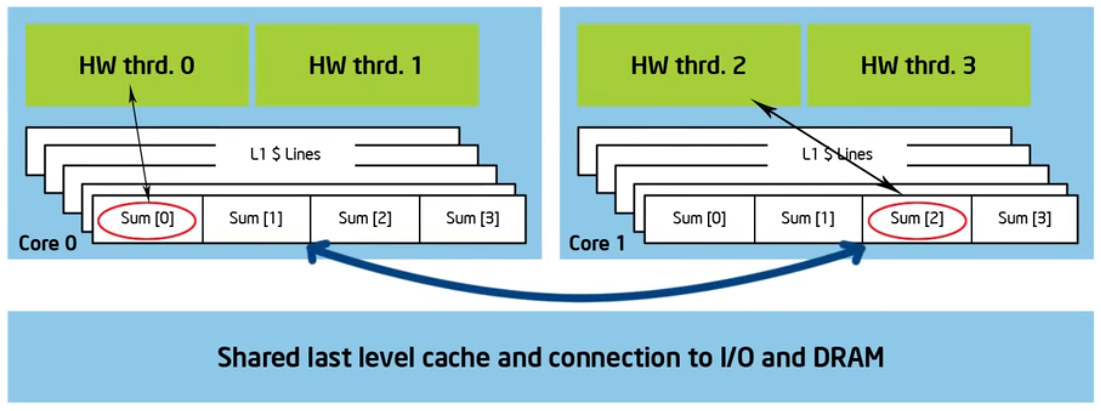
Now, consider a multi-core processor. If Core 0 modifies data in its cache, a cache coherence protocol ensures that any other core holding a copy of that same cache line is notified that its copy is now stale (invalid). The other core must then re-fetch the updated cache line before it can use any data from it.
False sharing occurs when:
- Multiple threads run on different cores.
- These threads access and modify different, logically independent variables.
- These variables happen to be located on the same physical cache line.
Every time one thread writes to its variable, the cache coherence protocol invalidates the entire cache line for all other threads. Even though the other threads' variables weren't changed, they suffer a performance penalty as they are forced to wait and reload the cache line from a slower memory level. The cache line effectively "ping-pongs" between the cores, destroying performance.
Let's start with a short article that defines the problem and shows a clear C++/OpenMP code example that triggers it.
This article from Medium, titled 'Speed up C++ — false sharing', provides a concise introduction to the concept and a practical example.
Please read the initial explanation of cache and false sharing. Then, examine the estimate_pi_false_share code example and note the performance results. The key line to focus on is partial_sum[omp_get_thread_num()] += .... Think about why this structure, while logically correct, leads to poor performance.
As the article demonstrates, the performance impact can be severe. A parallel program can run many times slower than its serial equivalent, which is a strong indicator that you might have a false sharing problem.
2. Diagnosing False Sharing: A Case Study
How can we be sure that poor scaling is due to false sharing and not some other issue, like lock contention? While the ultimate diagnosis often requires performance profiling tools, the symptoms and code patterns are quite distinct.
The following video provides an excellent step-by-step demonstration. It starts with a serial program, parallelizes it in a way that causes true sharing (contention for a single variable), and then parallelizes it in a way that causes false sharing. Although the video uses C++ pthreads, the underlying principles and performance characteristics are identical to what you would see in OpenMP.
This video, 'Parallel C++: False Sharing' by Nick, walks through a practical example of identifying false sharing using performance counters. It will give you a clear sense of what to look for.
Watch the video from the beginning up to 13:47. Pay close attention to these parts: Direct Sharing (02:20 - 07:45): Observe the poor performance when multiple threads update a single counter. Note the high L1 data cache miss rate reported by perf stat. False Sharing (07:45 - 13:47): See how creating an array of counters—one for each thread—does not improve performance. The video uses perf c2c (cache-to-cache) to confirm that the threads are contending over a single cache line, even though they are writing to different array elements. This is the smoking gun for false sharing.
The key diagnostic takeaways from the video are:
- Symptom: Parallel code with no explicit locks or synchronization inside the main loop shows poor or negative scaling.
- Code Pattern: Multiple threads repeatedly writing to memory locations that are close to each other (e.g., adjacent elements in an array).
- Measurement: Performance analysis tools (like
perfon Linux or Intel VTune Profiler) reveal an unusually high number of cache misses, specifically those related to data writes and inter-core cache traffic.
3. Mitigating False Sharing
Once you've diagnosed false sharing, you can fix it by restructuring your data to ensure that data modified by different threads resides on different cache lines. Here are three common strategies.
Strategy 1: Using Local Variables (Privatization)
For loop-based accumulations, this is often the simplest and most effective solution. Instead of having each thread write to a shared array in every iteration, have each thread accumulate its result into a private, temporary variable (which will be stored on its own stack or in a register). After the parallel loop finishes, each thread performs a single, final update to the shared data structure.
This minimizes writes to shared memory locations from many per iteration down to just one per thread.
Let's look at the fix for the estimate_pi example we saw earlier.
The same 'Speed up C++ — false sharing' article shows the fix using a local variable.
Read the final section of the article, focusing on the code modification (local_sum) and the dramatic improvement in the runtime results. This pattern should remind you of the reduction clause, which automates this process.
Strategy 2: Padding
Sometimes, you need persistent, per-thread data that lives beyond a single loop. In these cases, you can't use a temporary local variable. The classic C-style solution is padding: manually adding unused bytes to a data structure to force elements onto separate cache lines.
For example, if you have an array of counters and a cache line size of 64 bytes, you can make it a 2D array where each "row" is 64 bytes long, but you only use the first element.
// Assuming a 64-byte cache line and 8-byte doubles


#define PAD 8
double sums[NUM_THREADS][PAD];


#pragma omp parallel
{
    int id = omp_get_thread_num();
    // Each thread writes to a different, padded row
    sums[id][0] = ...
}
This ensures sums[0][0] and sums[1][0] are in different cache lines. This approach is effective but can be seen as clunky. Let's see another take on it.
[PDF] A “Hands-on” Introduction to OpenMP*
This document, 'A “Hands-on” Introduction to OpenMP*', explicitly discusses and shows an example of padding an array to solve false sharing.
Read slide 26, 'Why such poor scaling? False sharing', and slide 27, which shows the code example for padding an array of sums. This reinforces the padding concept with a clear diagram and code.
Strategy 3: Alignment
Padding feels like a manual workaround. Modern C++ provides a cleaner, more explicit way to achieve the same goal: memory alignment. Using the alignas specifier (introduced in C++11), you can instruct the compiler to place a variable or data structure at a memory address that is a multiple of a given value.
By aligning your per-thread data structures to the cache line size (e.g., alignas(64)), you guarantee that each one starts on a new cache line, thus preventing false sharing.
The video you watched earlier concludes by demonstrating this elegant solution.
Let's return to the 'Parallel C++: False Sharing' video to see the modern C++ solution.
Watch the final part of the video from 13:47 to 16:48. See how wrapping the atomic integer in a struct with alignas(64) solves the performance problem completely, achieving the expected speedup.
This alignment technique is generally preferable to manual padding in modern C++ code as it's more portable and clearly states the programmer's intent.
Conclusion
In this lesson, you've delved into one of the most counter-intuitive performance problems in shared-memory programming. False sharing is a powerful reminder that the physical layout of data in memory is critically important for performance, not just the logical structure of your program.
Key Takeaways:
- False Sharing: Occurs when different threads modify independent variables that happen to share a CPU cache line (typically 64 bytes). This causes the cache line to be repeatedly invalidated and re-fetched, severely degrading performance.
- Diagnosis: The primary symptom is poor or negative scaling in parallel code that seems to have no data dependencies. Profiling tools can confirm the issue by showing high cache miss rates on writes.
- Mitigation: The solution is to ensure that data accessed by different threads is on different cache lines. You can achieve this with three main techniques:
- Local Variables: Accumulate results in private variables within a loop and only update shared memory once at the end. This is often the best approach for loop-based reductions.
- Padding: Manually add unused data to data structures to increase their size to a multiple of the cache line size.
- Alignment (
alignas): Use language features to force the compiler to place data on cache line boundaries. This is the preferred modern C++ approach.
Preview of the Next Lesson
So far, our entire focus has been on shared-memory systems, where all threads can see and access the same memory space. This shared access is convenient, but as we've seen, it leads to complex issues like race conditions, deadlocks, and false sharing.
In the next module, we will make a fundamental shift to a completely different parallel architecture: distributed-memory systems. In our next lesson, we will start our journey with the Message Passing Interface (MPI) and your first learning outcome will be to explain the message-passing paradigm and the SPMD (Single Program, Multiple Data) execution model. Get ready to think about parallelism in a whole new way